
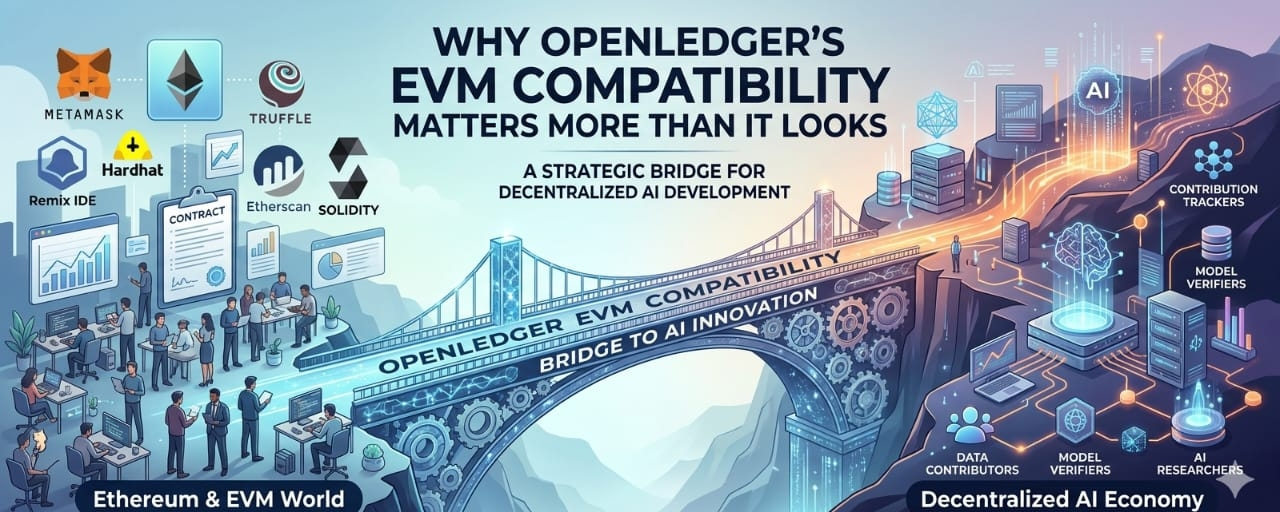
EVM compatibility is one of those things people in crypto now hear so often that it almost loses meaning. A project says it is EVM compatible, and most people simply nod and move on, because at this stage, it feels expected. If a serious Layer 2 is building in the Ethereum orbit, compatibility with the Ethereum Virtual Machine no longer sounds like a breakthrough. It sounds like the minimum requirement. That was honestly my first reaction when OpenLedger brought EVM compatibility into its infrastructure story. I almost treated it as another standard checkbox and looked past it, assuming the more interesting part of the project had to be somewhere else.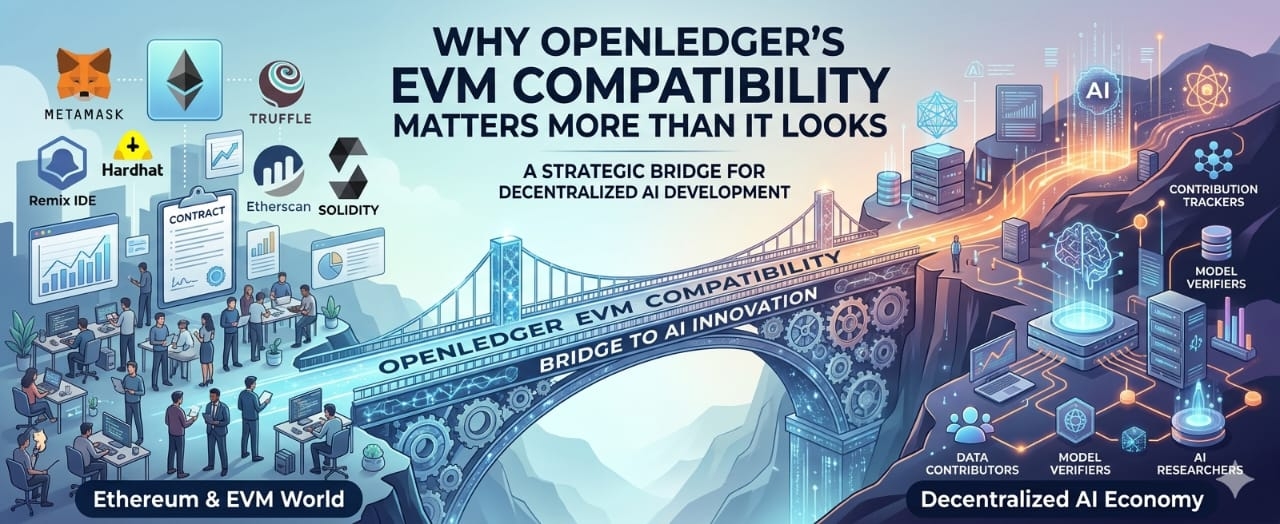
But after thinking about it more carefully, I realized that this feature becomes more important when you look at OpenLedger through the right lens. OpenLedger is not only trying to attract the usual DeFi builders who already know how to deploy contracts, manage liquidity systems, and move across EVM chains without much friction. Its bigger target seems to be people and organizations working around AI data, model contribution, verification, and decentralized ownership. That includes AI researchers, data scientists, data providers, and teams that may understand machine learning deeply but may not have the same level of comfort with blockchain infrastructure. For them, EVM compatibility is not just a technical detail. It is a bridge.
This matters because the Ethereum ecosystem already has the largest smart contract developer base in crypto. The tooling is mature, the documentation is everywhere, the frameworks are familiar, and the knowledge base has been built over years of real usage. Developers know Solidity. Teams know how to audit EVM contracts. Builders know how to work with wallets, explorers, deployment tools, testing environments, and contract standards that came from Ethereum and spread across other chains. When OpenLedger uses an EVM-compatible foundation through the OP Stack, it is not only adopting a runtime environment. It is opening the door to a huge existing developer culture that already knows how to build, test, and ship on this kind of infrastructure.
That is where the real value starts to show. If OpenLedger wants third-party teams to build data marketplace tools, incentive layers, verification systems, contributor rewards, and other economic primitives around AI data, it cannot afford to make the first step unnecessarily hard. A developer should not have to learn a completely new smart contract language just to experiment with the platform. If a contract already works on Ethereum or another EVM-compatible chain, being able to bring it over with minimal changes lowers the barrier immediately. That does not guarantee adoption, but it removes one of the easiest reasons for developers to walk away.
The AI side makes this even more interesting, because the most difficult parts of decentralized AI are not solved inside smart contracts alone. The real complexity lives in data pipelines, model training workflows, contribution tracking, attribution, validation, and proving that certain data or models actually created value. These are not things the EVM was originally designed to handle directly. Smart contracts are excellent for settlement, incentives, ownership records, and programmable economic logic, but they are not naturally built for the heavy technical work that happens inside AI systems. So EVM compatibility gives OpenLedger a strong blockchain base, but it does not magically solve every AI infrastructure problem.
And that distinction is important. OpenLedger’s EVM compatibility should not be misunderstood as proof that the entire AI data economy is already solved. What it does mean is that the blockchain layer becomes easier to access. Developers can work with familiar tools while the harder AI-specific systems are built around and above that layer. In practical terms, this means OpenLedger can make the contract side easier for builders while still focusing its real innovation on data ownership, verification, contribution accounting, and AI accountability.
To me, that is why this feature deserves more attention than it usually gets. It may not sound exciting on the surface because crypto has normalized EVM compatibility so much, but in OpenLedger’s case, it plays a strategic role. It gives the project a smoother onboarding path for Ethereum-native builders and makes the infrastructure more approachable for teams that want to experiment with AI data markets without starting from zero on the blockchain side.
The bigger OpenLedger vision still has to prove itself through execution. EVM compatibility alone will not create adoption, solve AI verification, or build a functioning data economy. But it does remove friction from the part of the system where friction can be avoided. And in a space where developer attention is limited, that matters.
OpenLedger’s real challenge is not just being compatible with Ethereum. It is using that compatibility to attract builders who can turn AI data, incentives, and accountability into something practical. The EVM does not complete the story, but it makes the story much easier for developers to enter.
That is not just a checkbox.
That is a serious advantage if OpenLedger executes well.$OPEN