
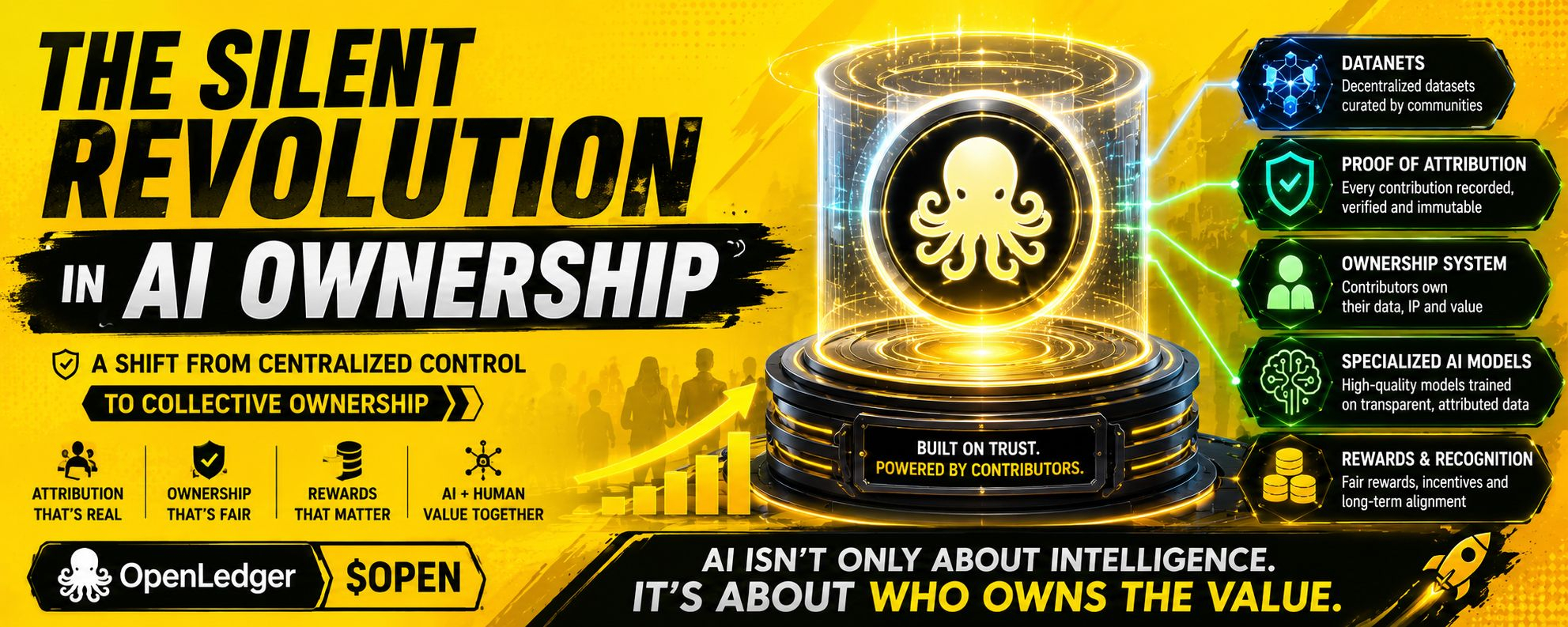
Most people looking at AI today are watching a race for speed.
Who has the most powerful model?
Who launches the flashiest features?
Who creates the loudest narrative?
For months, the AI space has felt like a battlefield of announcements and attention. Every week a new project appears promising bigger models, smarter agents, or revolutionary tools. But after spending considerable time exploring OpenLedger beyond headlines and hype posts, I found myself focusing on something different.
Not speed.
Not noise.
Ownership.
And that shift completely changed my perspective.
The more I explored OpenLedger's architecture, Datanets, and Proof of Attribution system, the more I started feeling that this project is trying to solve a problem many people aren't paying enough attention to yet.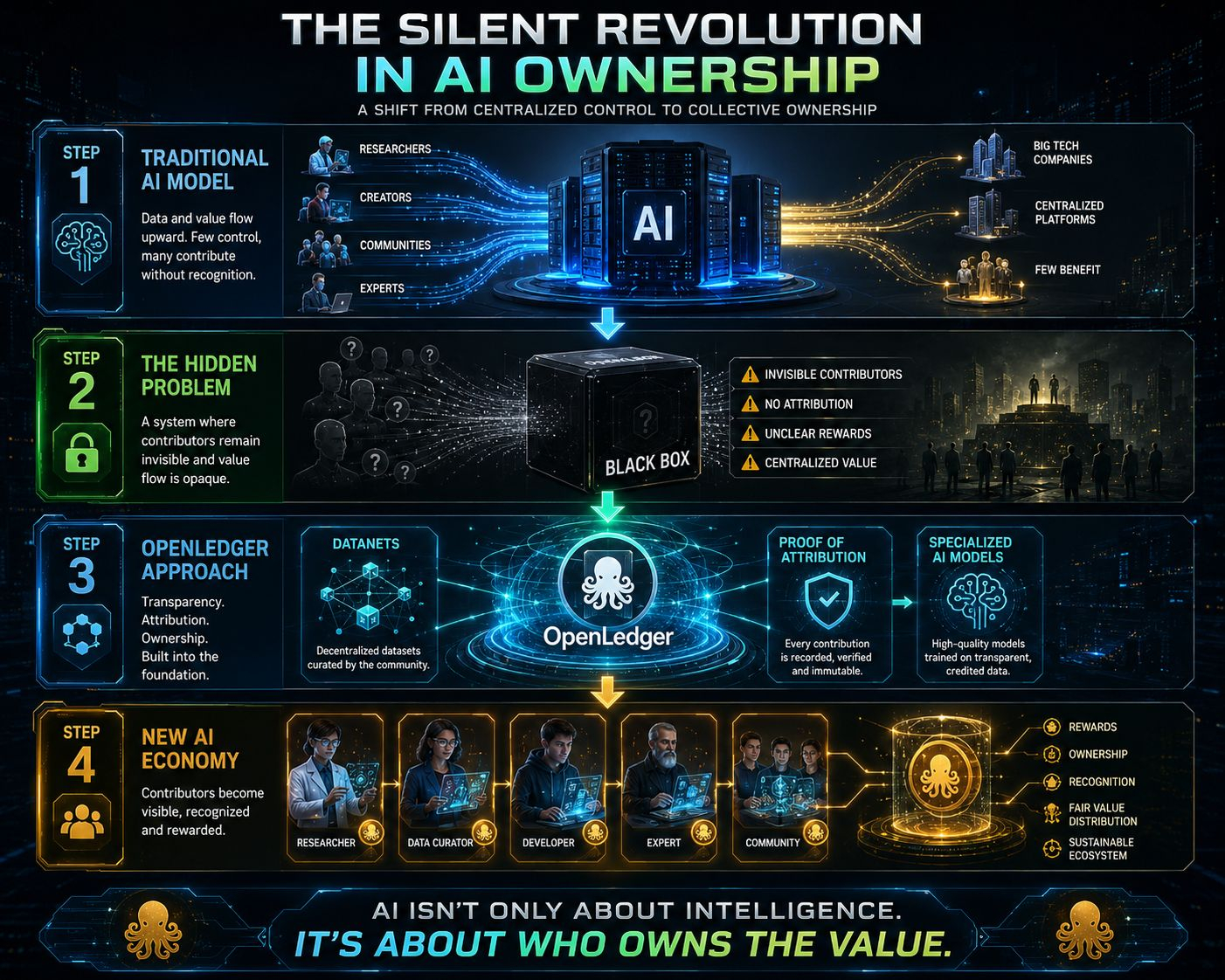
Because AI isn't only about creating intelligence.
It's about understanding who creates value and who deserves to benefit from it.
Today's AI ecosystem often operates like a giant invisible machine. Researchers provide insights, experts contribute specialized knowledge, communities create datasets, and individuals continuously generate information. Yet the economic rewards usually flow toward a relatively small group sitting at the top of the stack.
The people feeding intelligence into the system often become invisible.
OpenLedger seems to approach this differently.
Instead of treating contributors as background participants, it introduces accountability into the process. Every dataset contributed, every specialized model trained, every inference generated can be connected back to the individuals creating that value.
That changes the conversation entirely.
Participation suddenly becomes measurable.
Contribution becomes visible.
Value creation becomes trackable.
And in my view, that's where things become interesting.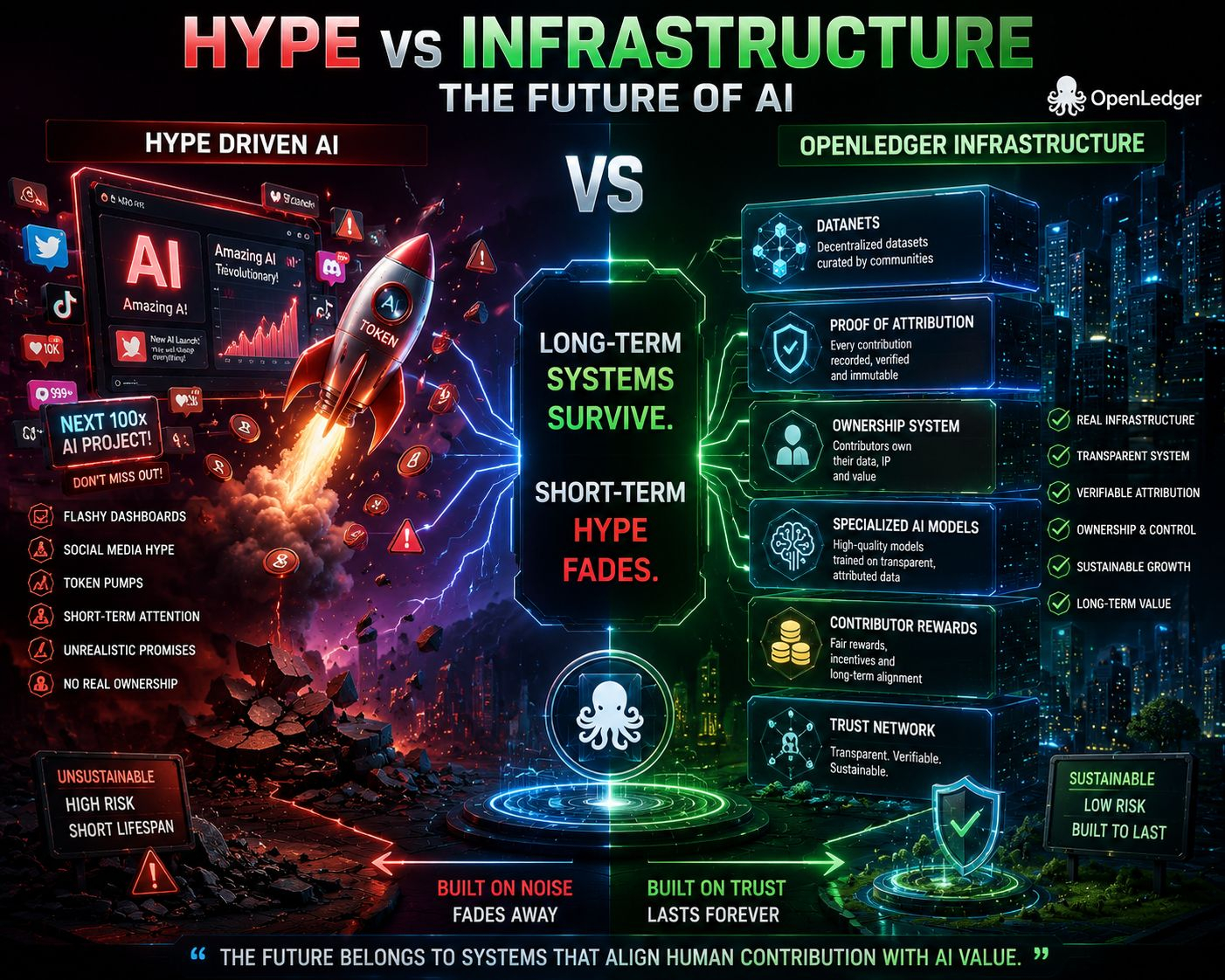
Because incentives shape behavior.
When contributors know their work can actually be recognized and rewarded, they naturally become more intentional. Data isn't uploaded carelessly. Experts do more than just provide their best effort.
Instead:
• Better quality information is collected
• More valuable expertise is developed
• Models improve through careful adjustment
• Communities grow and develop over time
At first, these appear to have little impact.
At first, the perception that the impacts of experience are minimal.
But systems built on aligned incentives usually create compounding advantages.
Months become years.
Small improvements become significant advantages.
Trust becomes infrastructure.
And trust is incredibly difficult to replicate.
This is also why OpenLedger feels less like another AI application and more like a foundational layer.
Many projects compete for attention.
Infrastructure competes for necessity.
The platforms that often survive over long periods are not always the ones making the most noise today. They're usually the ones quietly solving problems that become impossible to ignore later.
The internet itself followed a similar path.
People rarely talk about protocols, rails, or foundational systems while they're being built. Attention usually goes to the visible products sitting on top.
But underneath every large ecosystem sits infrastructure quietly doing its job.
OpenLedger gives me that feeling.
It's building mechanisms where ownership, attribution, and rewards aren't afterthoughts.
They're built directly into the structure itself.
And in an AI world where value may soon be generated faster than humans can even track, that matters.
A lot Because if intelligence becomes one of the most valuable resources on Earth, the question eventually shifts from:
"Who built the smartest AI?"
to:
"Who owns the value it creates?"
That question may define the next era.
When I step back and look at the broader picture, OpenLedger feels less like a sprint toward temporary attention and more like a compass pointing toward a different future.
A future where humans and AI don't compete for value.
They share it.
And that's why I'm paying attention—not for short-term excitement, but for the long-term architecture quietly taking shape beneath the surface.
Sometimes the biggest shifts don't arrive loudly.
Sometimes they arrive silently and change everything afterward.
