
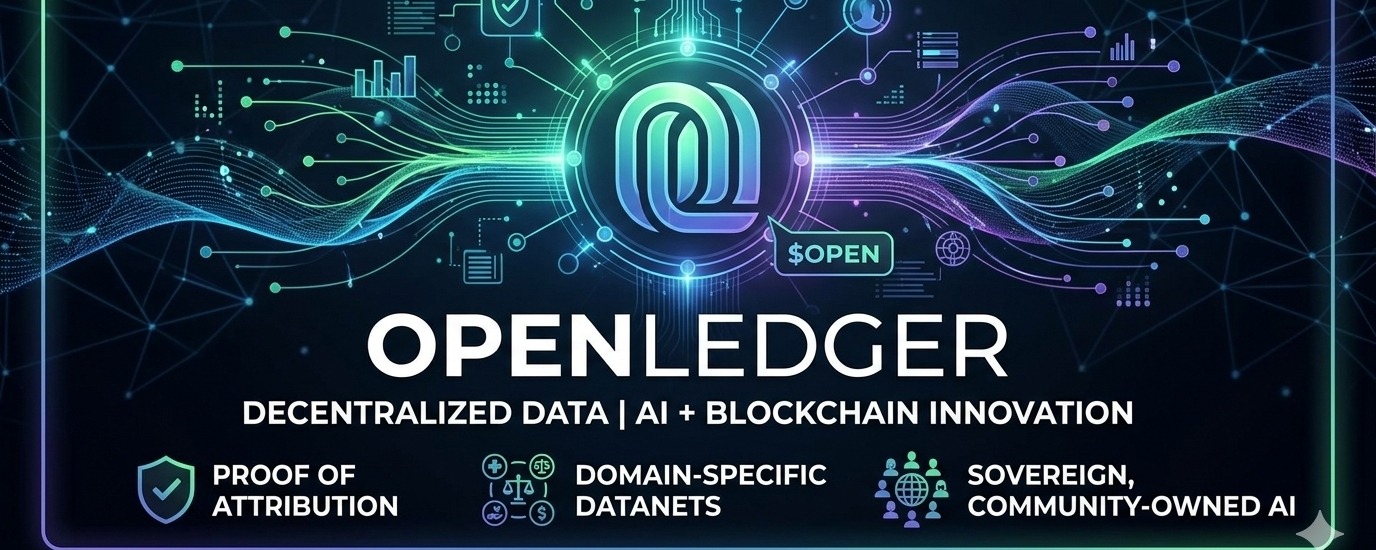
The intersection of artificial intelligence and Web3 has long been plagued by a massive bottleneck: data monopoly and the "black box" problem of centralized AI models. While big tech profits off user-generated data without proper attribution, @OpenLedger is rewriting the narrative by building a dedicated, AI-native data infrastructure.
What sets #OpenLedger apart from standard DePIN or general L2 networks is its implementation of the Proof of Attribution (PoA) mechanism. Instead of treating data as a static, uncompensated commodity, the network allows communities to build "Datanets"—specialized, on-chain data repositories for legal, medical, or financial domains. When developers use these datasets to fine-tune models through the ModelFactory, the exact contribution of each data provider is cryptographically tracked and automatically rewarded. It transforms the AI economy from corporate extraction into a fair, payable ecosystem.
At the core of this infrastructure is the $OPEN token. Far from being a speculative asset, $OPEN serves as the native economic fuel powering the entire lifecycle: gas fees for the EVM-compatible L2, model proposals, pay-per-use inference, and governance voting. By combining the OpenLoRA framework—which allows thousands of fine-tuned models to run efficiently on a single GPU—with robust on-chain attribution, the protocol presents a highly scalable answer to the AI computation crisis.
We are moving away from monolithic, opaque AI toward sovereign, community-owned intelligence. How do you see the role of specialized Datanets evolving compared to the brute-force scraping methods of centralized AI giants? Is decentralized attribution the key to fixing the AI data crisis?