Most people talk about AI through the lens of chatbots, agents, or model performance. But lately, I’ve been paying more attention to something deeper: the infrastructure underneath it all.
The more AI grows, the more obvious one problem becomes. AI is built by many contributors, but the current system rewards only a few.
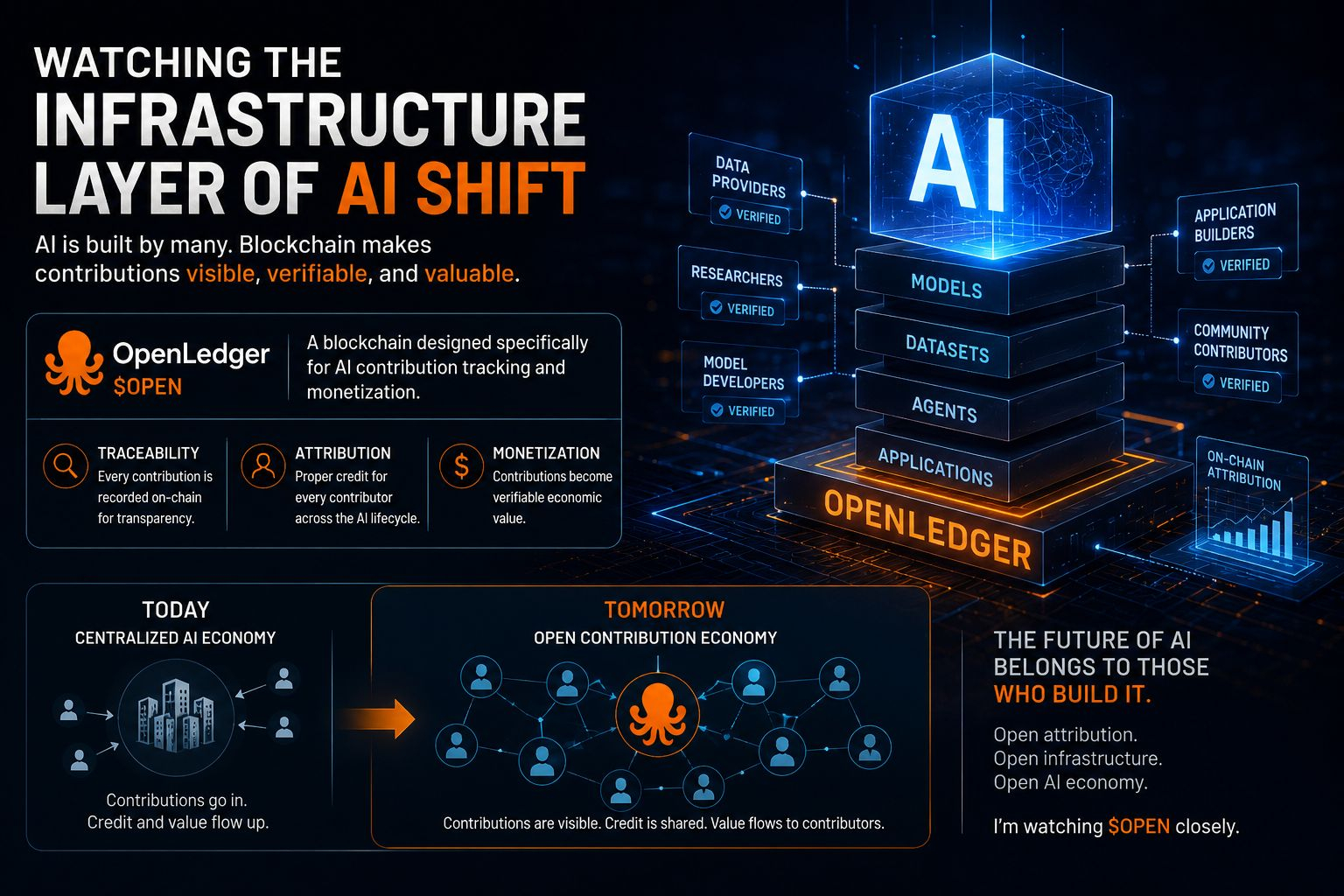
Data providers train the models. Researchers improve architectures. Developers build applications on top. Communities generate feedback loops that continuously refine outputs. Yet attribution is still fragmented, difficult to verify, and often controlled by centralized platforms.
That imbalance is becoming harder to ignore.
This is one reason I’ve been watching #OpenLedger closely.
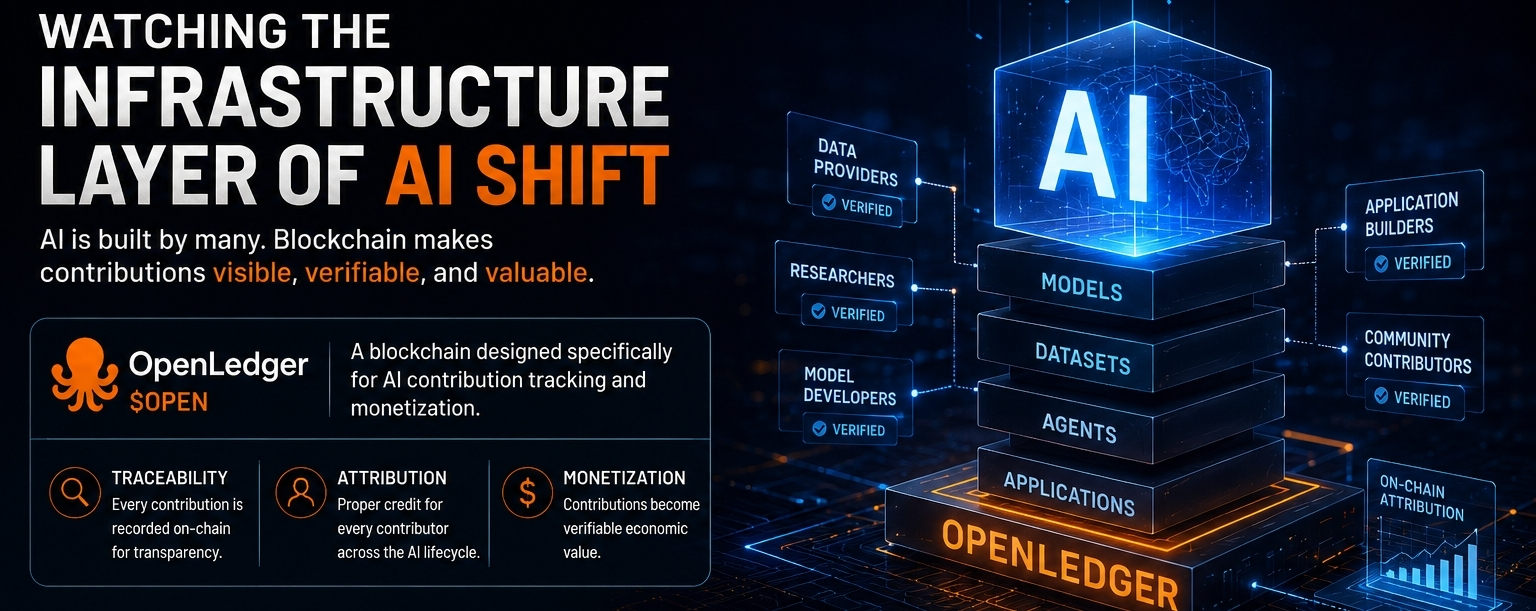
The idea is not just “AI on blockchain”. What stands out is the attempt to build blockchain infrastructure specifically designed for AI contribution tracking and monetization.
The concept feels important because AI today behaves like a black box economy. Valuable inputs enter the system, but ownership and rewards rarely flow back transparently. Most contributors disappear behind centralized layers that decide access, visibility, and revenue distribution.
A blockchain-native attribution system changes that dynamic.
According to the framework, every contribution across the AI lifecycle can be recorded on-chain. That includes datasets, models, agents, and application-level improvements. Instead of contribution history being hidden inside private systems, attribution becomes transparent and traceable.
What makes this more interesting is the economic angle.
If contribution can be verified, it can also become monetizable. That creates a different structure for AI ecosystems where participants are not just users, but economic actors whose inputs carry measurable value.
I think this is where the conversation around AI starts shifting from “who owns the model” to “who contributed to the intelligence”.
That distinction matters.
The current AI race is largely dominated by centralized companies competing for scale. But over time, scalability alone may not be enough. Attribution, transparency, and incentive alignment could become equally important layers of the ecosystem.
Especially as AI agents become more autonomous and interconnected.
Without transparent contribution tracking, future AI economies may inherit the same extraction problems already seen across large internet platforms. Data gets absorbed. Communities create value. Centralized entities capture most of the upside.
Blockchain introduces another possibility: an open contribution economy for AI.
That doesn’t automatically solve everything. Adoption, scalability, and usability are still major challenges. But the direction itself is worth paying attention to.
Because if AI becomes one of the defining technologies of this decade, then the infrastructure deciding ownership, attribution, and incentives may become just as important as the models themselves.
And that’s exactly why I’m watching $OPEN carefully right now. @OpenLedger