
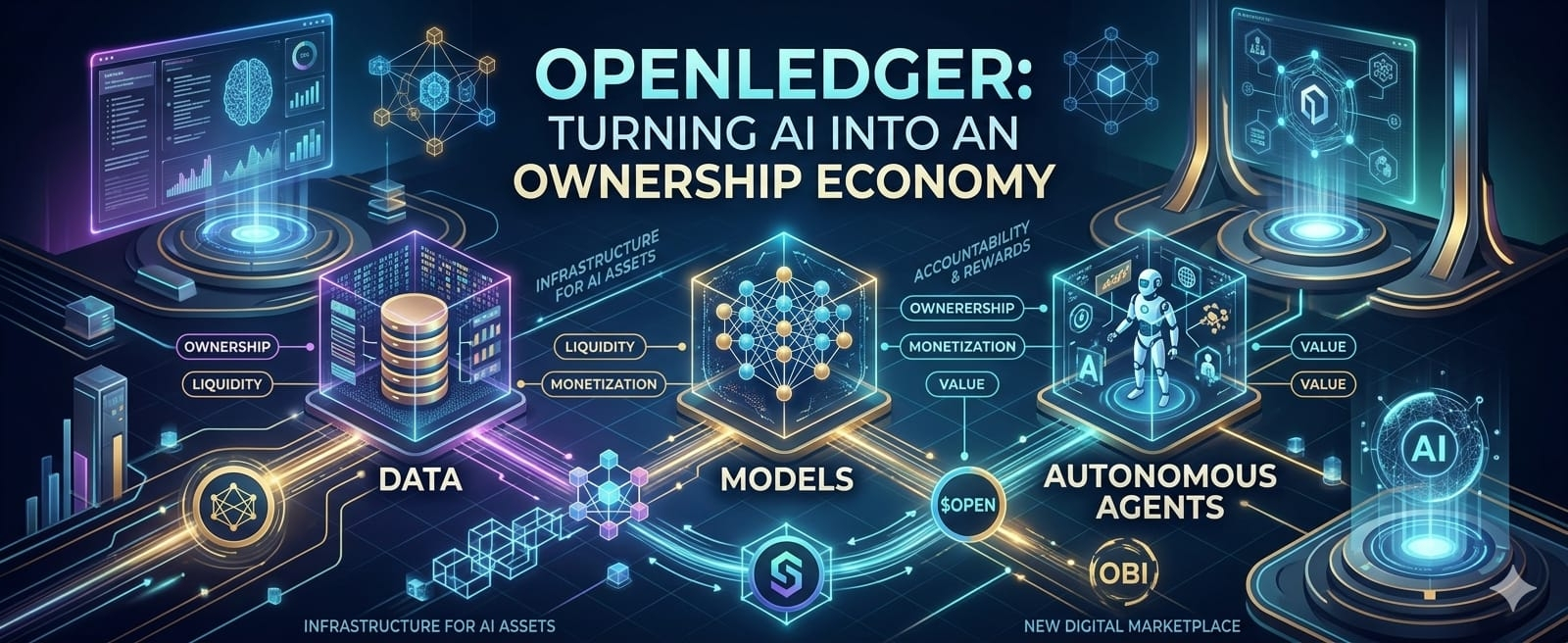
@OpenLedger is one of those projects that feels bigger the more you think about it. At first glance, it may look like another AI blockchain narrative, but the idea behind OPEN goes deeper than just combining artificial intelligence with crypto. OpenLedger is trying to unlock liquidity around something the AI industry depends on every single day but still struggles to value properly: data, models, and autonomous agents. In a world where AI is becoming more powerful, the question is no longer just who builds the best model. The bigger question may become who owns the data behind it, who gets rewarded for contributing to it, and how those digital assets can move through an open market with real value attached to them.
What makes OpenLedger interesting is that it appears to be focused on turning AI resources into something more usable, trackable, and monetizable on-chain. Data is no longer just information sitting in private servers. Models are no longer just tools controlled by centralized platforms. Agents are no longer just automated software running in the background. Through a blockchain-based structure, these assets can potentially become part of a liquid economy where ownership, contribution, access, and rewards are easier to verify. That is the real angle here. OpenLedger is not only trying to support AI growth; it is trying to create a system where the value created inside AI ecosystems can be shared, priced, and moved more transparently.
This is why $OPEN stands out to me beyond the usual market noise. Most people are watching AI coins only for short-term hype, but the stronger narrative may be forming around infrastructure that gives AI assets real economic rails. If data can be monetized, if models can become owned assets, and if AI agents can interact with blockchain systems in a trusted way, then OpenLedger is positioning itself around a very important layer of the next digital economy. It is not just about faster technology. It is about accountability, ownership, and liquidity in a space that has mostly been controlled by closed systems.
The powerful part is that OpenLedger is touching three major areas at once: data, models, and agents. Data gives AI its intelligence. Models turn that data into usable capability. Agents can act on top of those models and create automated value. If these three layers can be connected to blockchain ownership and monetization, then the opportunity becomes much larger than a simple AI token story. It starts to look like a new marketplace for AI-native assets, where contributors may not just provide value and disappear, but potentially participate in the upside of what they help create.
That is why I see OpenLedger as more than just another project following the AI trend. It feels like a bet on where AI infrastructure could move next. The future may not only reward the biggest models or the loudest narratives. It may reward the systems that make AI value measurable, ownable, and liquid. If OpenLedger can execute on that vision, $OPEN could become part of a much larger conversation around how artificial intelligence and blockchain merge into a real ownership economy.