
I’ve spent enough time in this market to know that the loudest stories rarely age the best. Every cycle arrives with something people swear will change everything, and for a while, maybe it feels true. Timelines fill with conviction, communities grow overnight, and suddenly everyone sounds certain about a future nobody can actually see yet. I used to get caught up in that energy more than I care to admit. These days, I mostly find myself watching from a distance, trying to separate curiosity from excitement.
That’s probably why OpenLedger has been sitting in the back of my mind lately.
Not because I’m convinced. I’m not. But because something about the idea feels worth sitting with for a little while.
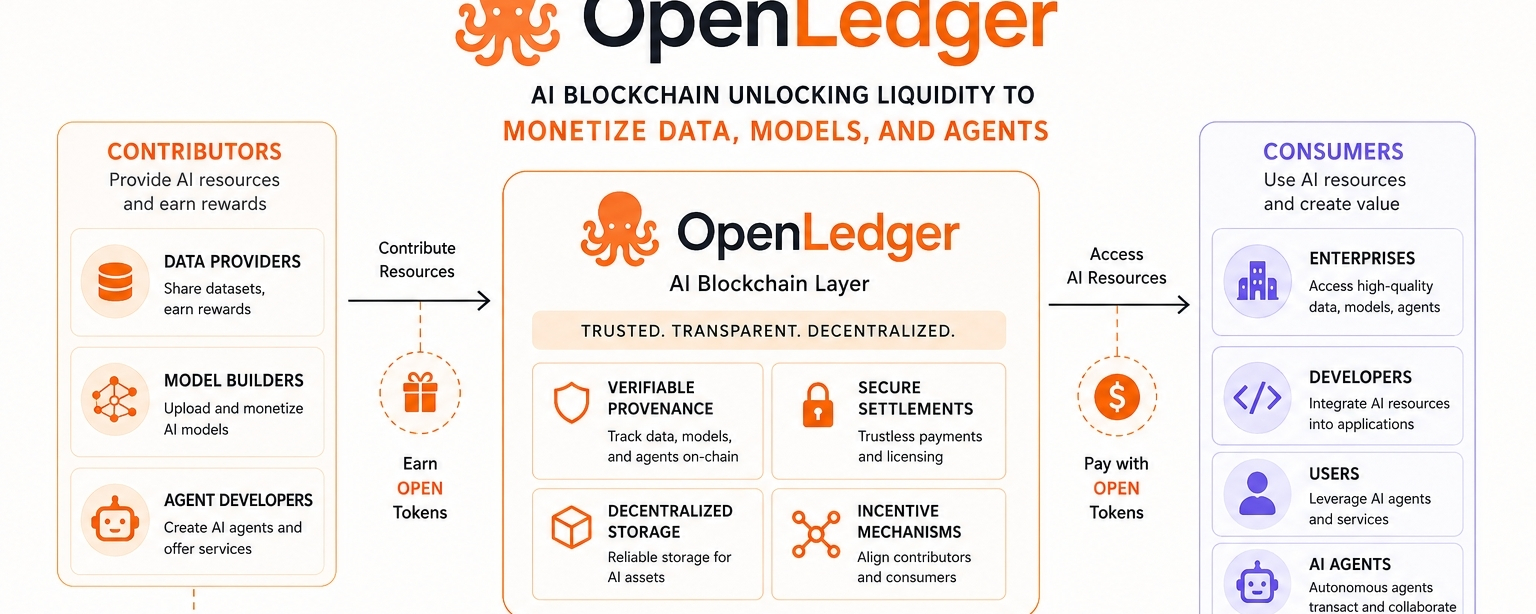
An AI blockchain built around monetizing data, models, and agents sounds ambitious in the kind of way crypto tends to like. On the surface, it almost feels obvious. AI is becoming impossible to ignore, and data increasingly feels like the thing everyone wants but few people fully understand the value of yet. We’re entering a time where information itself feels closer to an asset than ever before. Not just content, not just numbers, but something people and systems are competing to access, refine, and control.
That shift feels real to me.
What I’m less sure about is how projects survive once the excitement around the idea settles.
I think about that often when I look at OpenLedger.
Because in crypto, attention arrives fast. Sometimes too fast. People don’t always show up because they believe in a system. Sometimes they show up because they’re afraid of missing something. There’s a difference, and you can usually feel it if you’ve been around long enough. One kind of energy stays. The other disappears the moment momentum slows.
So when I look at OpenLedger, I’m not really asking whether the narrative sounds strong. Most narratives sound strong at the beginning. I’m wondering whether the people building around it can create something users actually want to return to. Something that feels useful enough to survive outside of speculation.
That’s the difficult part.
A lot of projects can attract attention. Fewer know how to hold it.
I find myself thinking about user behavior more now than technology itself. Do people keep showing up after incentives fade? Does the ecosystem start feeling alive in a natural way, or does activity only happen when rewards are involved? Does the conversation mature over time, or stay stuck repeating the same excitement over and over?
Those things matter more than they used to for me.
OpenLedger sits in an interesting place because the idea behind it touches something bigger than crypto trends. AI isn’t disappearing. If anything, it feels like we’re still early in understanding how deeply it might shape digital systems over the next decade. And if intelligence becomes more valuable, then naturally the systems feeding it — the data, the models, the infrastructure behind it — become more valuable too.
That’s where OpenLedger starts becoming interesting.
At least in theory.
But theory has always been easy in crypto.
Execution is where things quietly fall apart.
I’ve watched enough projects arrive with strong ideas only to struggle once reality demanded consistency. Building something sustainable is slower than people expect. It takes patience, and patience rarely gets rewarded in markets obsessed with speed.
What makes me keep paying attention to OpenLedger isn’t hype around AI. Honestly, hype makes me step back more than lean in these days. It’s the possibility that there could eventually be a real need for systems that make data and AI value more accessible, more structured, maybe even more fairly distributed.
But even saying that, I catch myself hesitating.
Because crypto has taught me caution.
I’m skeptical of certainty now. Especially the kind that comes too early.
There’s still so much we don’t know. Will people actually stay engaged with platforms like this when incentives cool? Will builders continue showing up during quieter periods? Can something tied so closely to AI avoid becoming just another temporary attention cycle?
I don’t know.
And honestly, I think admitting uncertainty matters.
For now, OpenLedger feels like one of those projects I want to keep observing rather than rushing to define. Interesting enough to watch, uncertain enough to question. Maybe it grows into something meaningful as AI infrastructure becomes more important. Maybe it struggles under expectations that arrive too quickly. Both outcomes feel possible from here.
I suppose that’s where I am with it — paying attention, but carefully. Curious, but not convinced. After enough years in crypto, that balance starts feeling less like hesitation and more like experience.