
Most people looking at AI crypto projects are focused on the obvious things:
More compute.
More GPUs.
Faster models.
Cheaper inference.
And to be fair, those things matter.
But the more I think about it, the more I feel like the market may be staring at the surface-level opportunity while missing the deeper one entirely.
Because over time, compute becomes cheaper.
Infrastructure scales.
Models improve.
Access expands.
That’s what technology usually does.
The harder problem — and maybe the more valuable one — is figuring out how value gets tracked and distributed once AI systems start creating economic output at scale.
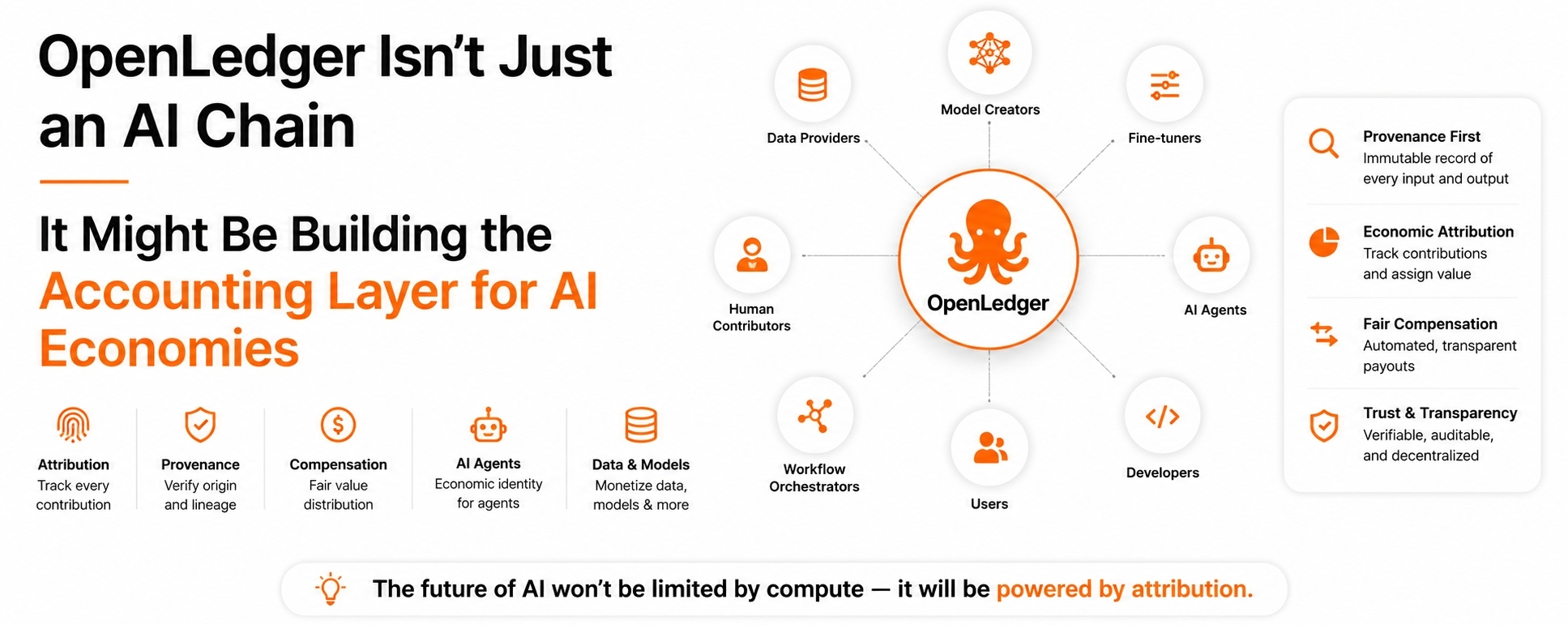
That’s why OpenLedger caught my attention.
Not because it’s “another AI blockchain.”
But because it feels like an attempt to solve something much bigger:
Attribution.
AI Has a Hidden Economic Problem
Every AI output is built on top of contributions from countless sources.
Training datasets.
Human feedback.
Fine-tuned models.
Prompts.
APIs.
Agents.
Synthetic data.
Workflow orchestration.
But when AI creates value, who actually deserves compensation?
That question sounds simple until you try answering it.
If multiple models contribute to an output…
If agents collaborate autonomously…
If datasets are reused across systems…
If human feedback improves model quality over time…
How do you track contribution fairly?
And more importantly:
How do you distribute economic value transparently?
That’s not really a compute problem.
It’s an accounting problem.
Healthcare Makes the Issue Obvious
Healthcare AI is probably one of the clearest examples.
Everyone wants AI-powered diagnostics and predictive healthcare systems.
But those systems rely on incredibly sensitive and valuable data.
If an AI model generates billions in value using hospital imaging, patient records, or clinical annotations, who owns that value?
The hospital?
The patient?
The model developer?
The data provider?
Without reliable attribution, the entire system becomes difficult to audit, regulate, or monetize fairly.
And I think this is where blockchain-native infrastructure actually starts making sense.
Not because “AI needs crypto” as a narrative…
…but because provenance and attribution may eventually become economically necessary.
Advertising Already Solved This Once
The digital advertising industry quietly proved how important attribution really is.
Most of online advertising is basically an attribution system:
- Who drove the click?
- Who influenced the purchase?
- Which platform deserves the revenue?
The companies that controlled attribution ended up controlling enormous economic value.
Now imagine AI agents operating in a similar environment:
- generating campaigns
- optimizing funnels
- training on user interaction
- collaborating with third-party systems
Attribution becomes exponentially more complicated.
And without trust in attribution, economic coordination starts breaking down.
AI Economies May Start Looking Like Royalty Economies
Music is actually a surprisingly good analogy here.
A single song can involve:
- writers
- producers
- performers
- publishers
- distributors
- licensing agreements
Now compare that to AI-generated outputs.
You could eventually have:
- training data providers
- model developers
- fine-tuning contributors
- agent operators
- orchestration layers
- synthetic data creators
AI systems may end up needing royalty-style economic infrastructure underneath them.
Not just compute.
So What Is $OPEN Really Betting On?
This is where I think the OpenLedger thesis becomes interesting.
Most AI tokens are valued around compute utility.
But OpenLedger feels like it’s positioning around something different:
- provenance
- contribution tracking
- compensation routing
- economic coordination
- data monetization
- agent identity
In other words, $OPEN may not simply be a “compute token.”
It may be attempting to become infrastructure for tracking and distributing value across AI ecosystems.
And historically, accounting layers tend to become deeply embedded once they gain adoption.
Most people never think about the invisible systems coordinating the internet today.
But those systems quietly power everything underneath.
But The Risks Are Very Real
Attribution in AI is incredibly difficult.
Modern AI systems are probabilistic, messy, and highly interconnected.
Perfect attribution may not even be fully possible.
There’s also the adoption challenge.
Most companies prioritize speed and efficiency before transparency.
If attribution systems introduce friction, adoption could take much longer than expected.
And even if OpenLedger succeeds technically, that still doesn’t guarantee durable token demand.
Crypto has a long history of building useful infrastructure without clear value capture for the token itself.
Still, I Think The Market Might Be Looking At The Wrong Bottleneck
Right now everyone is chasing compute because compute scarcity is visible.
But long term, AI may need something even more important:
A system that can coordinate ownership, compensation, and trust between intelligent agents, models, datasets, and contributors.
That’s a much deeper economic problem than most people realize today.
And OpenLedger feels less like an “AI blockchain” to me…
…and more like an early attempt at building the accounting system for machine economies.