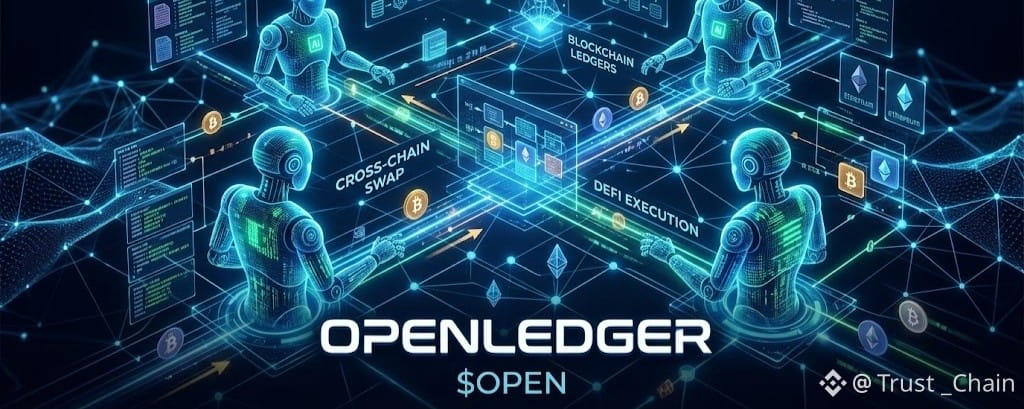
Why @OpenLedger ($OPEN) and OctoClaw Feel Different From the Usual AI Narrative
Most AI projects in crypto today still feel like polished dashboards pretending to be innovation. They talk about analytics, signals, and automation, but in reality, most of them are just adding AI branding on top of existing tools.
What genuinely caught my attention about OpenLedger and its OctoClaw vision is that it focuses on execution, not just analysis.
That changes everything.
Instead of simply telling users what might happen in the market, OpenLedger is building infrastructure where AI agents can actually coordinate actions across chains, swaps, bridges, liquidity routes, fees, and execution layers automatically. That is a completely different level compared to the typical “AI assistant” narrative dominating Web3 right now.
The difference between analysis and execution is massive.
Anyone can build an AI dashboard that summarizes charts or tweets. But creating autonomous agents capable of interacting with blockchain infrastructure in real time requires a much deeper architecture. It requires coordination systems, attribution layers, scalable execution, and transparent incentives.
That is exactly where OpenLedger stands out.
The project positions itself as an AI-native blockchain focused on monetizing data, models, applications, and intelligent agents through transparent on-chain infrastructure.
What I admire most is that the ecosystem is not trying to sell short-term hype. It is building the foundations for how autonomous systems may actually operate in decentralized finance over the next few years.
If AI agents become normal in Web3, speed alone will no longer be the real edge.

The market has always rewarded traders who can click faster, react faster, or move liquidity faster. But with intelligent execution agents entering the ecosystem, the advantage shifts toward strategy, risk management, coordination logic, and efficiency.
That is the evolution many people are still underestimating.
An AI agent that can evaluate routes, manage costs, optimize execution, and coordinate cross-chain operations in seconds could completely reshape how users interact with DeFi. Instead of manually bridging assets, checking fees, comparing protocols, and executing multiple transactions, intelligent agents may eventually handle the entire workflow autonomously.
That future feels much closer with projects like OpenLedger.
I also appreciate how the project emphasizes attribution, transparency, and verifiable AI infrastructure. In an industry filled with black-box systems, OpenLedger is pushing a model where contributors, data providers, and developers can actually be rewarded through the $OPEN ecosystem.
This creates a stronger long-term foundation than simple AI speculation.
At the same time, I still believe caution matters.
Security, trust, governance, and autonomous execution risks are real concerns for every AI-agent ecosystem. Even broader discussions around agent frameworks have highlighted vulnerabilities and the importance of strong governance models.
But despite those challenges, the direction itself feels important.
To me, OpenLedger is one of the few projects in the AI x crypto space that feels closer to infrastructure than marketing.
And infrastructure is what usually creates the biggest long-term impact.
The combination of AI agents, decentralized coordination, cross-chain execution, and transparent attribution could become one of the defining narratives of the next Web3 cycle. While many projects are still focused on appearances, OpenLedger seems focused on building systems that can actually power the future of autonomous on-chain interaction.
That is why I’m paying attention to $OPEN.
The AI-agent era in crypto is only getting started, and OpenLedger looks like one of the projects trying to build the rails before the rest of the market fully realizes where this industry is heading.