
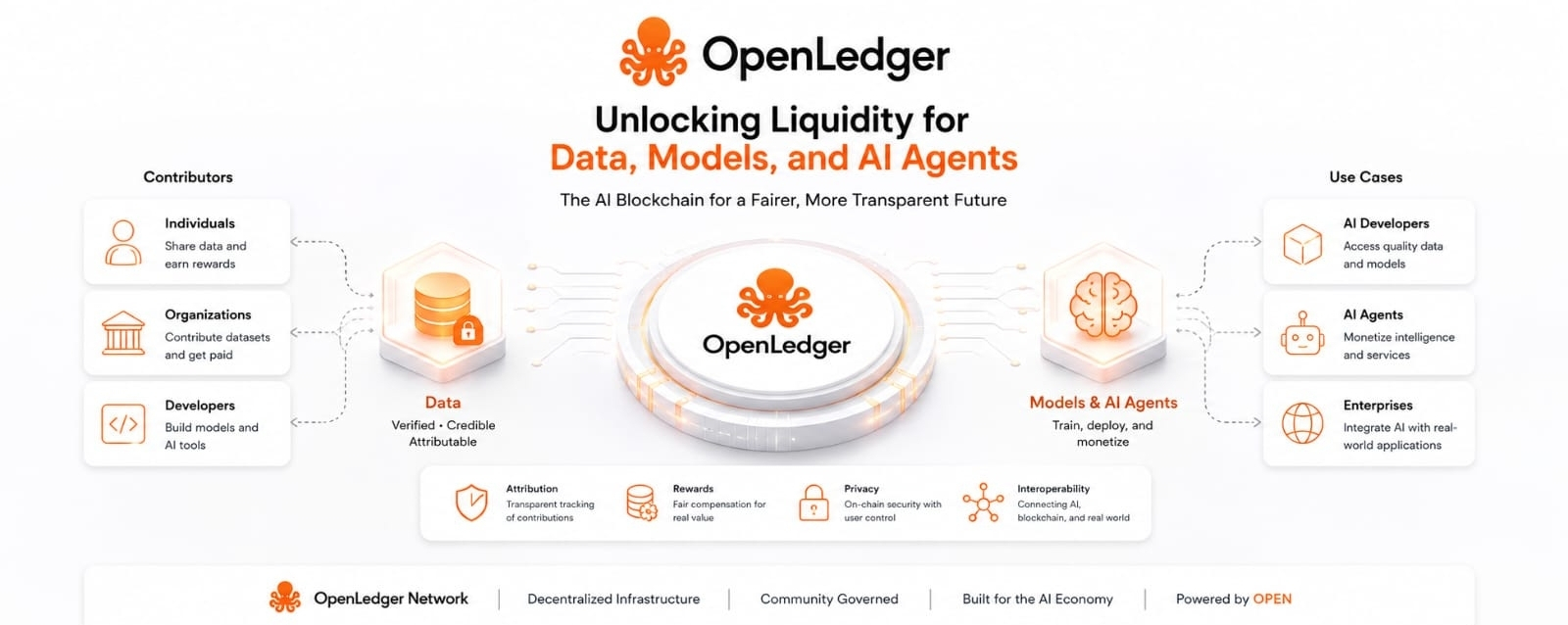
OpenLedger is one of those projects I don’t want to over-romanticize, because the moment crypto puts AI, data, agents, and tokens in the same sentence, my guard goes up.
Look, we’ve been here before.
Big words. Clean diagrams. Some promise about giving value back to users. Then a few months later, everyone is farming points, bots are everywhere, the real users are confused, and the token is doing most of the talking.
That’s the trauma.
Crypto keeps saying it wants fair systems, but a lot of the time it rewards whoever is best at gaming the system. Bad airdrops taught us that. Fake users taught us that. Incentive campaigns taught us that. Half the “community growth” we see is just wallets pretending to be people.
So when OpenLedger talks about data, models, and agents having their own economic layer, I don’t hear something shiny.
I hear plumbing.
And honestly, that might be the only part worth taking seriously.
AI has a data problem under the hood. Not the easy version people like to repeat. Not just “AI needs more data.” The real mess is who owns the data, who gets paid for it, who proves it was useful, and who gets quietly ignored while platforms capture the value.
That part is real.
People create useful data every day. Writers, researchers, niche communities, analysts, developers, traders, users, everyone. Their information trains systems, improves models, shapes outputs, and then somehow the value usually flows upward into a closed platform.
Same old story.
OpenLedger seems to be trying to build around that gap. A place where data, AI models, and agents can be connected with attribution and payments instead of everything disappearing into a black box.
Fine. That sounds useful.
But useful does not mean easy.
The thing is, data is messy. Very messy. Some of it is valuable. Some of it is trash. Some of it is copied. Some of it is legally questionable. Some of it looks useful until you actually try to train something with it. And once rewards enter the picture, people will absolutely try to abuse the system.
That’s not pessimism.
That’s crypto.
If OpenLedger wants to reward contributors, it has to answer the hard question: reward them for what, exactly?
Uploading data is not enough.
Volume is not value.
Activity is not quality.
And a wallet address is not a real user just because it clicked a few buttons.
This is where the project gets interesting, but also where it can break. Attribution sounds good. Paying people based on useful contribution sounds fair. But proving usefulness in AI is not clean. Models do not hand you a neat receipt saying, “this dataset helped.” Influence is blurry. Training is complex. Outputs are weird. People will argue. Farmers will farm.
So OpenLedger is not just building an AI blockchain.
It is trying to build trust inside a very untrustworthy environment.
That is hard.
Maybe too hard. Maybe not.
But at least it is aiming at a real wound.
I also think the agent side needs to be handled carefully. Everyone is obsessed with AI agents right now, but let’s be real, most agents still feel half-baked. They can do useful things, then suddenly make a dumb mistake with complete confidence. That is funny when it is a demo. It is less funny when money, data, or automated decisions are involved.
If OpenLedger wants agents to operate inside its system, then reliability matters. Accountability matters. Bad data matters. Bad outputs matter.
A fake agent economy would be easy to create.
A useful one would be much harder.
And then there is OPEN, the token. I always get uncomfortable here, because crypto has abused the word “utility” to death. Every token has utility until you ask who actually needs it without speculation attached.
If OPEN is used for payments, rewards, access, model activity, and coordination, then okay, there is a reason for it to exist inside the design. But that reason has to become real demand. Not campaign demand. Not airdrop demand. Not “I’m holding because influencers said AI coins are next” demand.
Real usage.
People paying because the system helps them.
Builders using it because it makes their work better.
Contributors staying because rewards actually reflect value.
That is the part that takes time.
And it might not happen.
OpenLedger also has to deal with the ugliest adoption problem in crypto: normal people do not want more friction. AI builders do not wake up excited to manage wallets, gas, tokens, bridges, governance, and all the little rituals crypto people pretend are normal. They want tools that work. They want clean access. They want reliability. They want infrastructure that does not make them regret using it.
So if OpenLedger feels too “crypto” on the surface, that becomes a problem.
The best infrastructure disappears a little.
It works under the hood.
It does not ask users to care about every pipe and valve.
That is probably what OpenLedger has to become if it wants to matter. Not a loud AI coin. Not another narrative machine. Just infrastructure that actually works for data contributors, model builders, and maybe agents when agents become less embarrassing.
It’s not flashy.
It’s just necessary.
And that is why I’m cautiously interested. Not excited. Excited is expensive in crypto. Excited gets people dumped on. Interested is safer.
The problem OpenLedger points at is real. AI data economics are broken. Contributors are invisible. Attribution is weak. Closed platforms keep taking most of the upside. Smaller builders need better ways to access and monetize useful datasets.
But none of that guarantees OpenLedger wins.
The system has to filter quality from garbage. It has to stop farmers from turning incentives into a joke. It has to make the token matter beyond market attention. It has to prove that attribution is more than a nice word. It has to bring in users who care about the product, not just the reward page.
That is a lot.
Honestly, that is the kind of thing that takes years, not a hype cycle.
So I don’t look at OpenLedger as some perfect answer. I look at it as an attempt to build plumbing for a messy AI-data economy that probably needs better plumbing. Maybe the pipes hold. Maybe they leak everywhere. Crypto has shown us both outcomes many times.
For now, OpenLedger is worth watching because it is touching something real.
Not because it says AI.
Not because it has a token.
Not because the market needs another narrative.
Because under all the noise, there is a simple issue: people create value, systems use that value, and most contributors never see the upside.
If OpenLedger can make that less broken, even a little, then it matters.
But it has to prove it.
Slowly.
In the mess.
Where all the real crypto infrastructure either survives or gets exposed.