
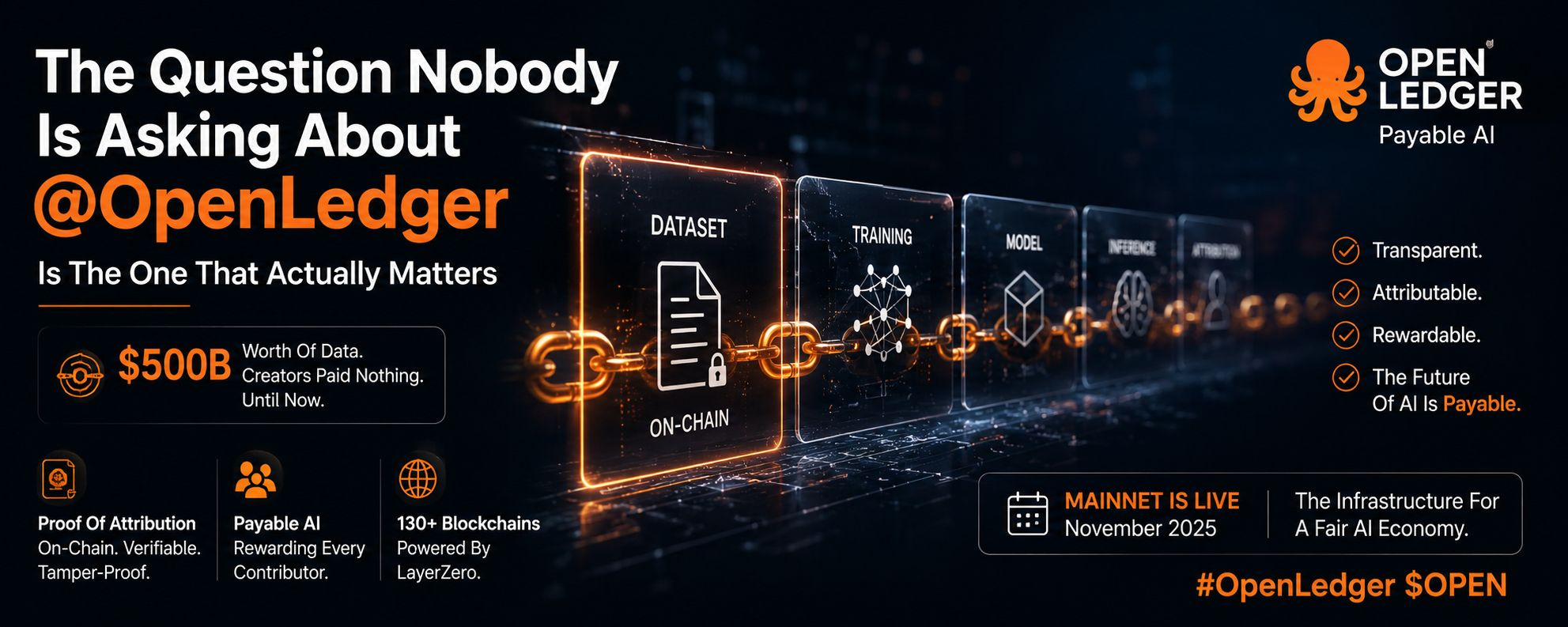
There is a number that keeps coming up when I research the AI economy and it sits at around 500 billion dollars. That is the rough estimate of value locked inside datasets that the people who created them never got paid for. Writers, researchers, domain experts, niche communities. Their work gets scraped, absorbed, and turned into products. The model improves. The company profits. The contributor disappears from the story.
That gap between creation and compensation is not a small inefficiency. It is the structural problem sitting underneath every AI system running today.
I have been thinking about why this keeps happening and it usually comes back to one thing. There was never a technical layer that could actually track influence at scale. A model trains on millions of inputs. By the time it starts producing outputs, the chain between what went in and what came out is invisible. Not deleted. Never recorded in the first place. You cannot pay people for contributions you cannot trace.
@OpenLedger is building on the assumption that this has to change, and more interestingly that it can now actually change. Their Proof of Attribution system records every dataset, every training step, and every model inference directly on chain. Not as a summary or a log file somewhere. As a live, verifiable, cryptographic record. When a model produces an output, the lineage of what shaped that output exists on chain. That makes contributor rewards computable in a way they have never been before.
The mainnet went live in November 2025. The framing the team used was "Payable AI." That phrase is either marketing or it is a category definition. I think it is the second one, and the difference matters. Payable AI is not just about adding a payment layer on top of existing models. It is about making the economics of AI creation legible for the first time. Something closer to how streaming royalties work except the payment logic is in the protocol, not in a contract with a label.
What makes this more than a concept is the timing. Legal pressure on AI companies for data sourcing is genuinely building. Lawsuits against major AI labs over training data are moving through courts. Regulatory frameworks in multiple jurisdictions are starting to ask hard questions about provenance. The window where AI companies could simply scrape and train without accountability is closing. That creates a real demand signal for infrastructure that solves the attribution problem, not just philosophically but commercially.
Then there is the cross chain side. OpenLedger integrated with LayerZero in October 2025, which opens the data and attribution layer to over 130 blockchains. That changes the scale of what is possible. A contributor in one ecosystem does not need to exist only in that ecosystem. Their verified contribution record can follow them. Their rewards can route wherever the attribution trail leads. That is a much bigger surface area than a single chain attribution system.
I keep thinking about what the ecosystem looks like if this works at scale. Datanets become something like specialized intellectual property markets. Domain experts in medicine, law, logistics, or any narrow field can pool their knowledge into a shared dataset, watch it get incorporated into trained models, and receive ongoing payouts as those models get used. The Datanet is not just a dataset. It becomes an asset with a yield, because the attribution engine keeps tracking which inputs are still influencing outputs over time.
The thing I want to see tested is what happens when the attribution chain gets complicated. A model fine tuned on a Datanet that was itself built on earlier community contributions. How far back does the attribution trace? How is influence weighted when a dataset improves a model by two percent versus twenty percent? The June 2025 whitepaper describes influence function approximations and suffix array token attribution methods, which are technically serious approaches. But technical seriousness in a whitepaper and technical seriousness under real usage conditions are two different conversations. That gap is what the next few quarters of mainnet activity will start to answer.
For $OPEN to have a durable thesis, the Datanets need to attract contributors who have data that actually matters. Not generic content. Specialized, high quality, domain specific datasets that models genuinely need and that do not exist at scale anywhere else. If that community gets built, the protocol has real usage. If it stays surface level, the attribution machinery is elegant but empty.
I am watching this with the same patience I apply to any infrastructure layer bet. The question is never whether the idea is good. The question is whether the problem is real enough and the timing is right enough for this to be the version that survives. The data ownership problem is absolutely real. The timing with legal pressure, regulatory scrutiny, and maturing chain infrastructure is actually aligning. Whether OpenLedger becomes the canonical place where AI attribution gets settled is the open question.
That is the only one worth tracking.
