
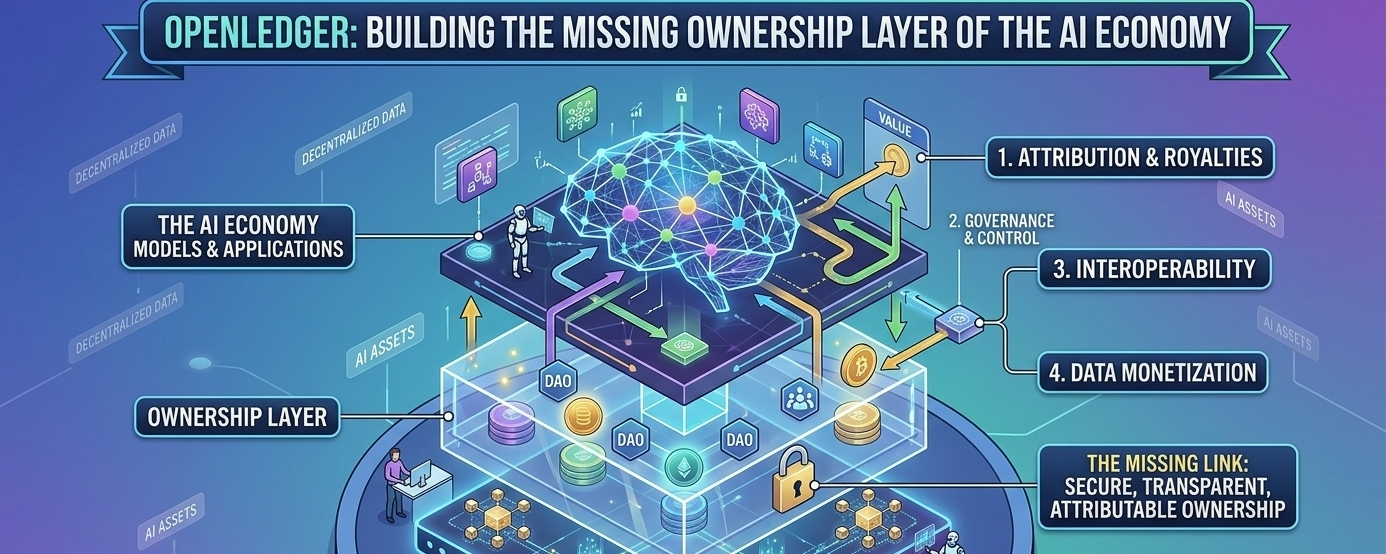
The AI industry is growing at an unbelievable speed. Every month, new models appear, AI agents become smarter, and companies continue competing to dominate the future of artificial intelligence. But while most of the conversation focuses on model performance and automation, one major issue remains largely ignored:
Who actually owns the value created by AI?
This question becomes more important the deeper you look into how modern AI systems work. AI models are not created from nothing. They are trained using massive amounts of human-generated data — conversations, articles, images, research, code, opinions, and public knowledge collected from millions of people across the internet. Yet the people contributing that data rarely receive recognition, transparency, or long-term rewards once those systems become profitable.
That is the exact problem @OpenLedger is trying to solve.
After studying the project closely, OpenLedger feels very different from most AI-related crypto projects currently in the market. It does not look focused on short-term hype or attention-driven narratives. Instead, it appears to be building infrastructure for something much bigger: a transparent and economically fair AI ecosystem where contributors, datasets, models, and AI outputs can finally be connected together through verifiable attribution.
In simple words, @OpenLedger is attempting to build the ownership layer for AI.
Why OpenLedger Stands Out
Most blockchain projects entering the AI space usually focus on similar themes:
AI agents,
decentralized compute,
automation,
or AI-powered applications.
@OpenLedger approaches the market from a completely different direction.
Instead of asking, “How do we build smarter AI?” the project seems to ask, “How do we create a fair economic system around AI?”
That shift in thinking is what makes OpenLedger interesting.
The platform describes itself as an AI blockchain designed to unlock liquidity around data, models, and agents. But the deeper idea behind the ecosystem is attribution. @OpenLedger believes AI contributors should not disappear inside black-box systems after providing valuable data.
Personally, this feels like one of the few AI blockchain narratives that targets a real structural issue instead of simply attaching AI branding to crypto infrastructure.
Because the truth is simple: AI becomes more valuable as data improves, but the people behind that data remain mostly invisible.
@OpenLedger wants to change that.
Proof of Attribution: The Core Idea Behind the Project
The foundation of @OpenLedger is something called “Proof of Attribution.” (openledger.gitbook.io)
At first glance, it sounds technical, but the concept behind it is actually easy to understand.
The system is designed to track and verify how data contributes to AI outputs and model behavior. Instead of data disappearing permanently into AI training pipelines, @OpenLedger attempts to create a transparent relationship between contributors and the intelligence built from their information.
This matters much more than many people realize.
Today’s AI industry operates mostly like a closed system:
companies collect data,
models train on it,
AI products become valuable,
but contributors receive almost nothing in return.
OpenLedger’s attribution model challenges that structure.
The project is effectively trying to transform data into a trackable economic asset. If successful, contributors could potentially earn rewards whenever their information helps power AI systems in the future.
In my opinion, this is where OpenLedger’s real innovation exists.
Most AI projects focus only on intelligence itself. @OpenLedger focuses on the economic relationships behind intelligence.
And long term, that could become extremely important.
Datanets Could Become the Most Valuable Part of the Ecosystem
One of the smartest concepts inside OpenLedger is the idea of “Datanets.” (openledger.gitbook.io)
Datanets are decentralized data ecosystems built around specific categories of information. Instead of relying on one centralized dataset, @OpenLedger allows communities to build specialized data networks for different industries and use cases.
This includes areas such as:
finance,
healthcare,
enterprise workflows,
localized language datasets,
research,
and niche industry intelligence.
The reason this matters is because AI models themselves are slowly becoming commoditized.
As open-source development accelerates, powerful models are becoming easier to replicate. What remains difficult to replicate is unique, high-quality data.
That is why I believe @OpenLedger is making a very important bet on the future.
The project seems built around the idea that data may eventually become more valuable than the models themselves.
And honestly, that theory makes sense.
The companies controlling the best information pipelines will likely have enormous influence in the next generation of AI systems.
@OpenLedger is trying to decentralize that process while giving contributors economic participation at the same time.
That changes the relationship between AI and users completely.
OpenLedger Feels More Like Infrastructure Than Hype
Another thing that stood out to me while researching OpenLedger was the overall tone of the project.
Most AI crypto projects market themselves aggressively around hype narratives:
autonomous agents,
AI revolutions,
automation replacing industries,
or unrealistic growth promises.
OpenLedger feels far more infrastructure-focused.
The project consistently talks about:
attribution systems,
validation mechanisms,
retrieval tracking,
data quality,
and contributor incentives. (openledger.gitbook.io)
That may sound less exciting for short-term speculation, but historically infrastructure projects often become more important than trend-driven applications.
Personally, @OpenLedger does not feel like a project trying to chase temporary attention.
It feels like a project preparing for a future where:
AI systems require transparency,
contributors demand ownership,
and governments begin asking questions about data provenance and accountability.
If that future arrives, attribution layers could become essential infrastructure rather than optional features.
The RAG Opportunity Is Probably Undervalued
Another area where OpenLedger looks strategically positioned is Retrieval-Augmented Generation, or RAG. (openledger.gitbook.io)
RAG systems are becoming increasingly important because businesses want AI systems capable of retrieving live, traceable information instead of relying only on static training data.
@OpenLedger integrates attribution directly into this process.
This creates a very interesting economic possibility: contributors may continue earning rewards whenever their information gets retrieved and used by AI systems during inference.
That is very different from traditional AI economics.
Normally, data providers contribute once and lose visibility forever. OpenLedger’s structure suggests an entirely different model where data becomes a recurring productive asset tied directly to usage.
If enterprise AI continues moving toward explainable and auditable systems, this could become one of OpenLedger’s strongest advantages over time.
Challenges the Project Still Faces
Even though the concept behind OpenLedger is genuinely strong, the project still faces difficult challenges.
The biggest challenge is adoption.
Building decentralized AI infrastructure is much harder than launching speculative tokens because the ecosystem needs multiple components growing together:
contributors,
developers,
validators,
businesses,
and useful datasets.
Without strong network effects, even powerful ideas struggle to scale.
Another challenge is attribution accuracy itself.
Tracking how much influence individual datasets have on AI outputs is one of the hardest technical problems in the industry today. OpenLedger’s vision is ambitious, but scaling attribution systems across increasingly complex AI models will require significant execution.
Competition is also growing rapidly. AI infrastructure has become one of the most crowded sectors in crypto.
Still, despite these risks, OpenLedger feels more grounded than many projects driven purely by narrative cycles.
Final Thoughts
After researching OpenLedger deeply, my overall impression is clear:
This project is not simply trying to participate in the AI boom.
It is trying to redesign how value flows inside the AI economy itself.
Most AI companies focus on creating smarter systems. @OpenLedger seems focused on creating fairer systems where contributors, datasets, and intelligence remain connected through transparent ownership and attribution.
And honestly, that may become one of the most important conversations in the entire AI industry over the next decade.
Because eventually, the future of AI may not depend only on intelligence.
It may depend on who owns the intelligence, who contributed to it, and who deserves to benefit from it.
