
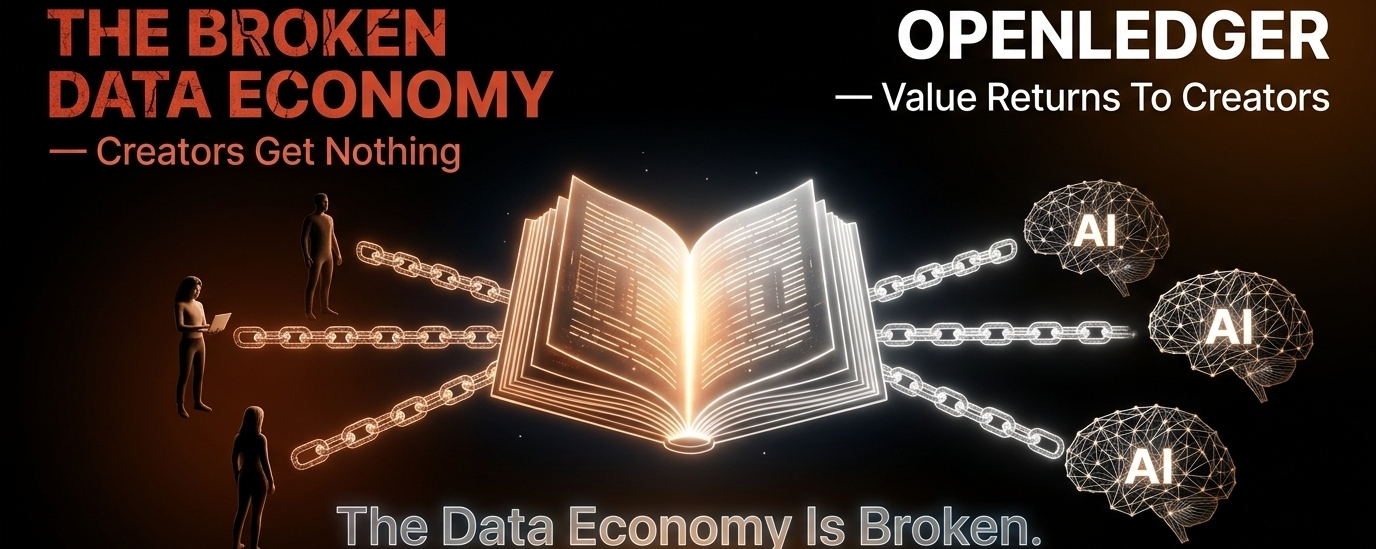
Let's be honest for a second. Most people in crypto don't really think about where AI gets its data. They're watching token prices, chasing airdrops, arguing about which L2 is the best. Meanwhile, one of the most important problems in the entire AI industry is sitting right there, mostly ignored — the fact that data contributors get nothing. Literally nothing. Big AI labs train billion-dollar models on content scraped from the internet, and the people who created that content never see a single dollar. That's not a minor issue. That's a foundational problem.
This is exactly where Open Ledger enters the picture. Not with noise. Not with hype-first marketing. But with an actual infrastructure layer built to fix how AI data is sourced, verified, and rewarded.
I first came across Open Ledger when I was researching decentralized AI infrastructure projects. Honestly, a lot of them felt like the same pitch recycled — "decentralized," "trustless," "community-owned." You know the type. But Open Ledger felt different in the way it framed the problem. It wasn't just saying "let's decentralize AI." It was pointing at a specific broken mechanism — data ownership — and building a system around fixing that specific thing.
The core idea behind Open Ledger is something called a decentralized data network. Contributors — real people, businesses, developers — can bring their data into the Open ecosystem, and instead of having it quietly extracted by a faceless corporation, they get rewarded through a transparent on-chain mechanism. The token, $OPEN, plays a central role in this. It's not just a speculative asset. It's the medium through which the Open Ledger economy actually operates.
Now here's where it gets genuinely interesting. Open Ledger isn't just building a marketplace for data. It's building verifiability into the process. One of the biggest challenges in AI training data is quality — garbage in, garbage out. A lot of data platforms have no real mechanism to ensure that what contributors submit is actually useful. Open Ledger is working on infrastructure that addresses this, where data can be validated, categorized, and attributed properly before it enters any training pipeline.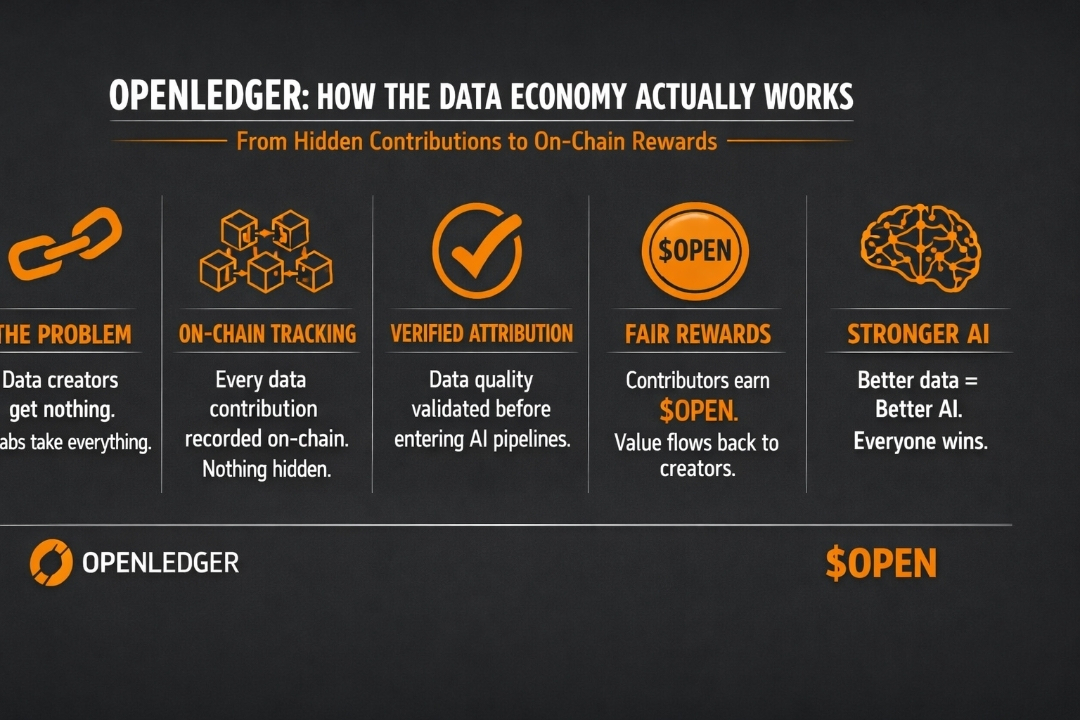
Think about what that means for an AI developer. Instead of scraping questionable datasets from corners of the internet, you can access verified, contributor-attributed data through Open Ledger. That changes the procurement model for AI training entirely. It makes Open not just another DePIN play, but a core piece of infrastructure for the AI era.
I want to pause here and say something that maybe doesn't get said enough. Open Ledger's vision only works if contributors actually trust the system. And trust is hard to build. The Open ecosystem is betting that transparent incentives plus on-chain attribution will create that trust over time. That's a reasonable bet — but it's still a bet. The technology can be perfect and still fail if network effects don't develop. Worth keeping that in mind.
Still. The fundamentals are solid. Open Ledger has attracted real attention from serious players in the space. The roadmap is detailed. The team has been consistent in communication. And the underlying problem Open is solving — data ownership and fair compensation — is only going to get more urgent as AI adoption scales globally.
What I find most compelling about Open Ledger is the timing. The AI boom is not slowing down. If anything, the demand for high-quality training data is increasing faster than anyone expected. Regulatory pressure is also mounting on big tech around how they source training data — in the EU especially. Open Ledger sits at the exact intersection of those two trends: AI data demand going up, and the old "just scrape it" model becoming legally and ethically unsustainable.
This is the kind of project that might look quiet right now, but the infrastructure it's laying down could be foundational in three or four years. Open Ledger doesn't need to be the loudest voice in the room. It just needs to be the most useful one when it matters.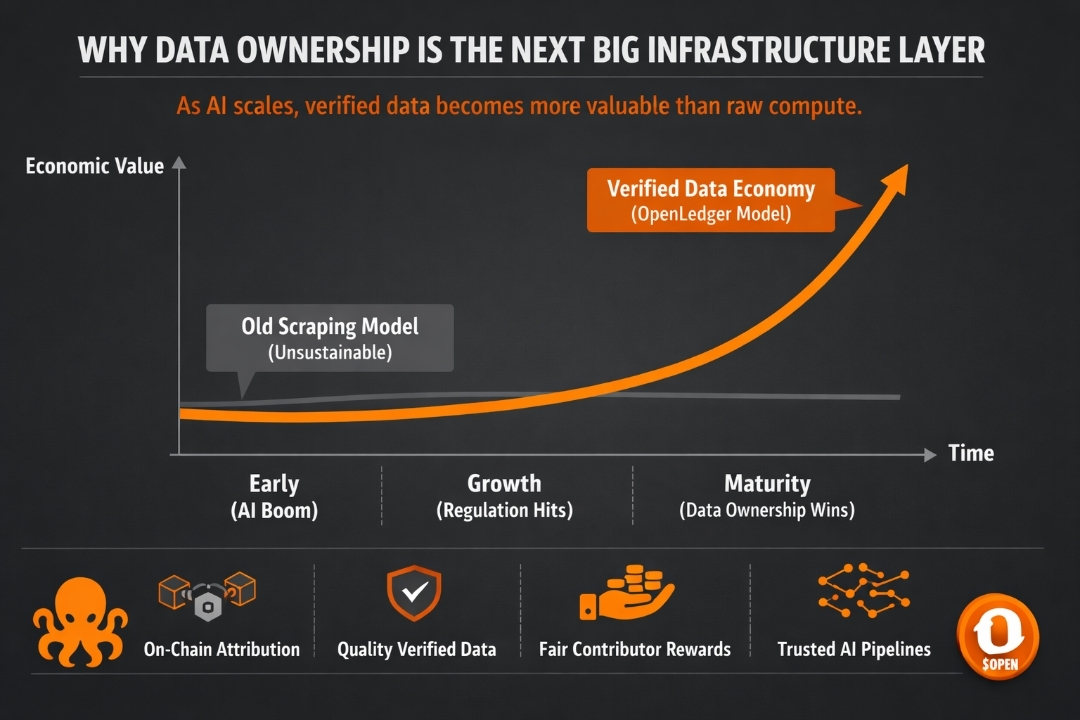
The data economy, for a long time, rewarded the aggregators and punished the creators. Open Ledger is building the rails for a different outcome — one where the people who generate value actually capture some of it. Whether it fully succeeds is still an open question. But the direction? The direction is right. And in crypto, finding something pointed in the right direction at the right time is most of the game.
