
Alright, so... I was reading through OpenLedger again, and the part that kept feeling off was simple.
The attribution path gets all the attention.
I don't even think the real yes happens there.
Not at the Proof of Attribution layer.
The clean version is easy to tell. Datanets feed the model. Proof of Attribution traces contribution. ModelFactory packages deployment. OpenLoRA adapters specialize the thing without making compute costs stupid. AI Marketplace routes usage. $OPEN rewards follow the path. Nice visible trail. Everybody relaxes because now there is a path. Traceable. payable. looks settled.
Alright. Good even.
But the part that kept dragging me back was earlier than that.
Input hits the data gate first.
A Datanet curator checks whatever ugly standard the network wired in.
Source quality. metadata scope. usage rights. domain fit. maybe some model-specific condition that does not look dramatic until it decides what gets to exist later.
Then one of two things happens.
It becomes part of the lineage.
Or it doesn’t.
That’s not setup.
Thats the gate.
And if that's the gate, then the OpenLedger attribution later is not the whole decision. It is what made it through.
That feels closer.
Maybe the easiest way to say it is this... people keep reading the attribution path on OpenLedger like the event. I think it’s the survivor.
One data slice passes the Datanet check. It gets metadata. lineage. model use. PoA visibility. Later systems can touch it.
Another slice dies upstream. No neat provenance path. No payout route. Maybe a rejection buried in a curator note. Maybe just absence. Nothing later builders can really point at the same way.
That split matters.
More than the clean surface makes obvious.
Because the passing path gets an afterlife.
The failing path gets missingness.
And missingness is a terrible thing to argue with... that too once the rest of the AI workflow only knows how to trust what became attributable.
This is where OpenLedger starts looking different to me. Like actually.
Not because PoA is fake. Not because Datanets are suspicious by definition. Because the visible attribution path shows up after the narrower yes already happened, and then the visible object gets treated like it contains the whole story.
It doesn’t.
Or not enough of it.
I keep picturing a boring workflow because boring workflows are where this stuff gets dangerous. A team wants a Datanet feeding a specialized agent. Good. The demo window is close. The config is already sitting in ModelFactory. Nobody wants to reopen the source list because one LoRA adapter is waiting on the run.
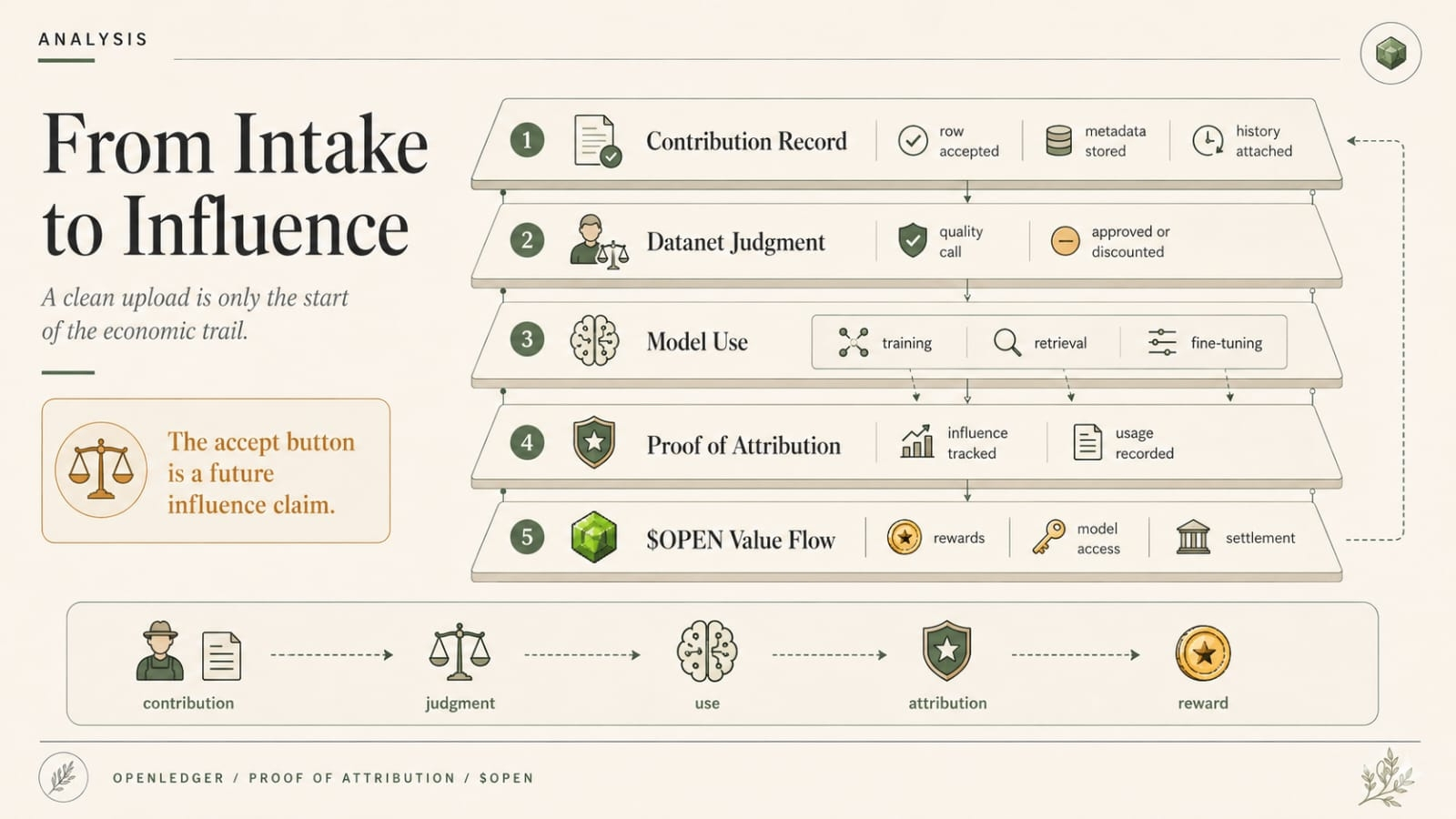
They define the dataset scope. Also good. Then they add curator rules because they do not actually want every valid-looking source becoming training material. Also normal. Maybe the gate checks source rights. Maybe metadata has to line up with a domain. Maybe there is some local review state sitting upstream and only data that already cleared that state gets through.
One input passes.
Later it looks clean as hell.
Another one fails.
Later it barely exists.
That asymmetry is doing more work than the attribution gets blamed for.
Because once the contribution exists, everyone downstream gets lazy in the same boring way. They see Datanet match. provenance trail. model lineage. clean PoA path. Then ModelFactory pulls the accepted path, an OpenLoRA adapter trains around it, and some trading agent says fine, this passed, keep moving.
Nobody asks what got filtered out right before this one.
Nobody asks what the Datanet gate was deciding when it allowed this contribution to become durable enough for reuse.
Why would they.
The visible thing is sitting right there.
Thats the trap.
The attribution path on OpenLedger becomes the thing everyone can see, so it starts getting treated like the whole AI decision. But the Datanet gate may have already decided what counted as admissible before PoA even had anything to track.
Which means the later record is proving something narrower than people talk about.
Not just contribution.
Contribution that made it through the gate.
Different sentence.
Colder one too.
And I don’t mean “policy” in some abstract AI ethics way. I mean real system boundaries. Source-right checks are policy. Datanet scope is policy. Metadata constraints are policy. A rejected source is policy too, just written in a shape people stop calling policy once it lives close enough to data infrastructure.
By the time attribution appears, a lot of that is already out of sight.
Probably why the OpenLedger path looks so calm later.
The fight already happened.
Or enough of it did.
Then some later system treats the attribution trail like it captured the whole decision. Agent routing. @OpenLedger ModelFactory deployment. OpenLoRA fine-tune. Maybe even OPEN payout if somebody upstream got ambitious. That's where the missing half starts mattering again.
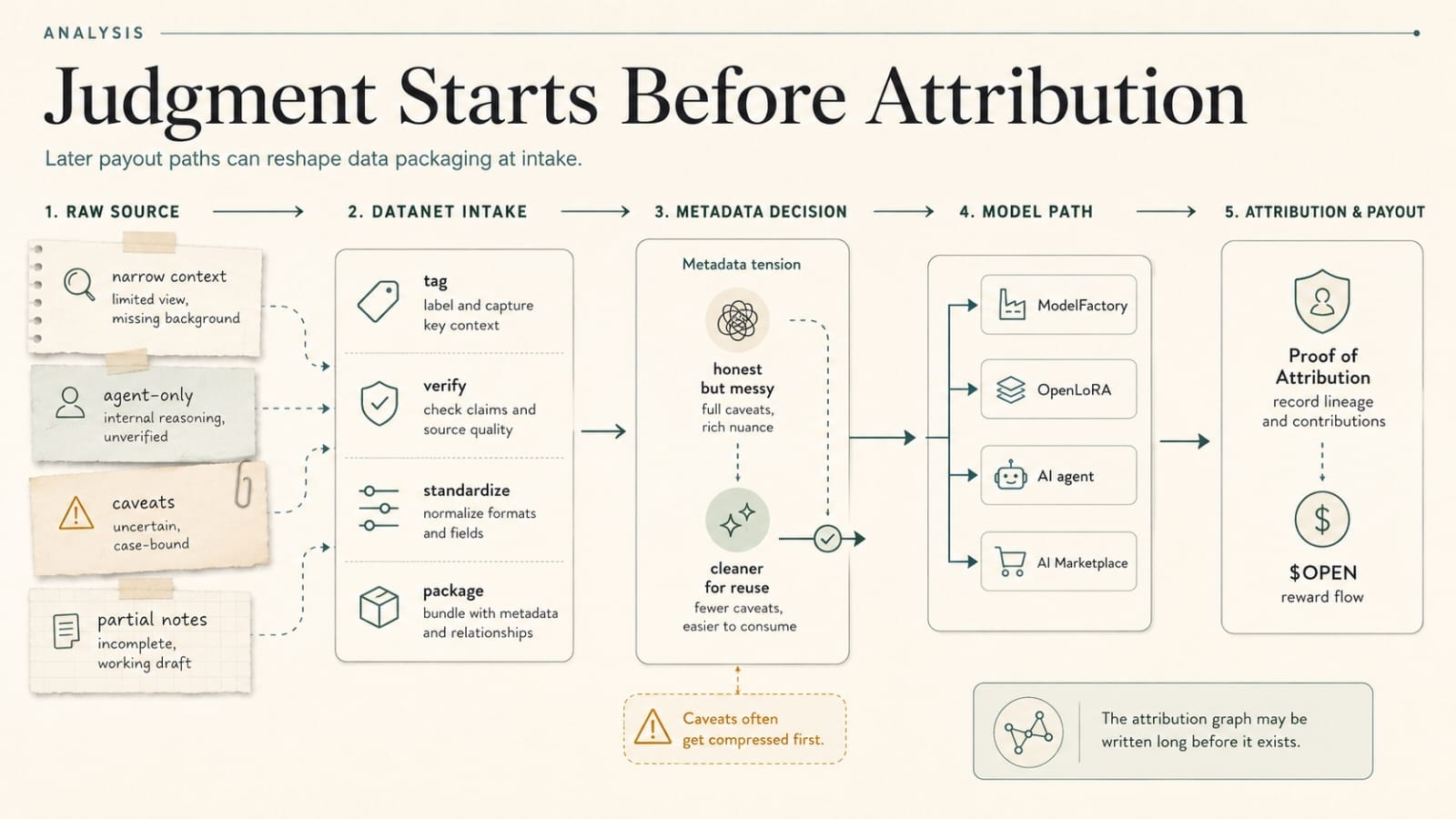
If the output feeds an OpenLedger's Octoclaw-style workflow or trading agent, the missing branch stops being a data-quality footnote and starts becoming execution risk.
Because the clean path is reusable.
The rejected branch isn't.
The filtered-out slice isn’t.
The gate logic that killed neighboring inputs isn’t showing up in the same way.
So the later team ends up trusting a neat attribution path without really seeing the mess that decided it deserved to exist.
Nice.
What exactly did the attribution settle there.
That the data contributed.
Or that the data was useful enough, clean enough, admissible enough, whatever enough, to survive the pre-attribution gate and become something the system can reuse.
I don't think those are the same.
And once some downstream agent starts acting on the record like it is, the missing part comes back in a bad way. Not because the record lied. Because the workflow around it got flattened into one visible survivor and a bunch of invisible failures.
The clean attribution path still gets all the attention.
If the real yes happened before PoA had anything to track, what exactly was the later attribution proving by the time ModelFactory, an OpenLoRA adapter, and some trading agent all trusted it?