
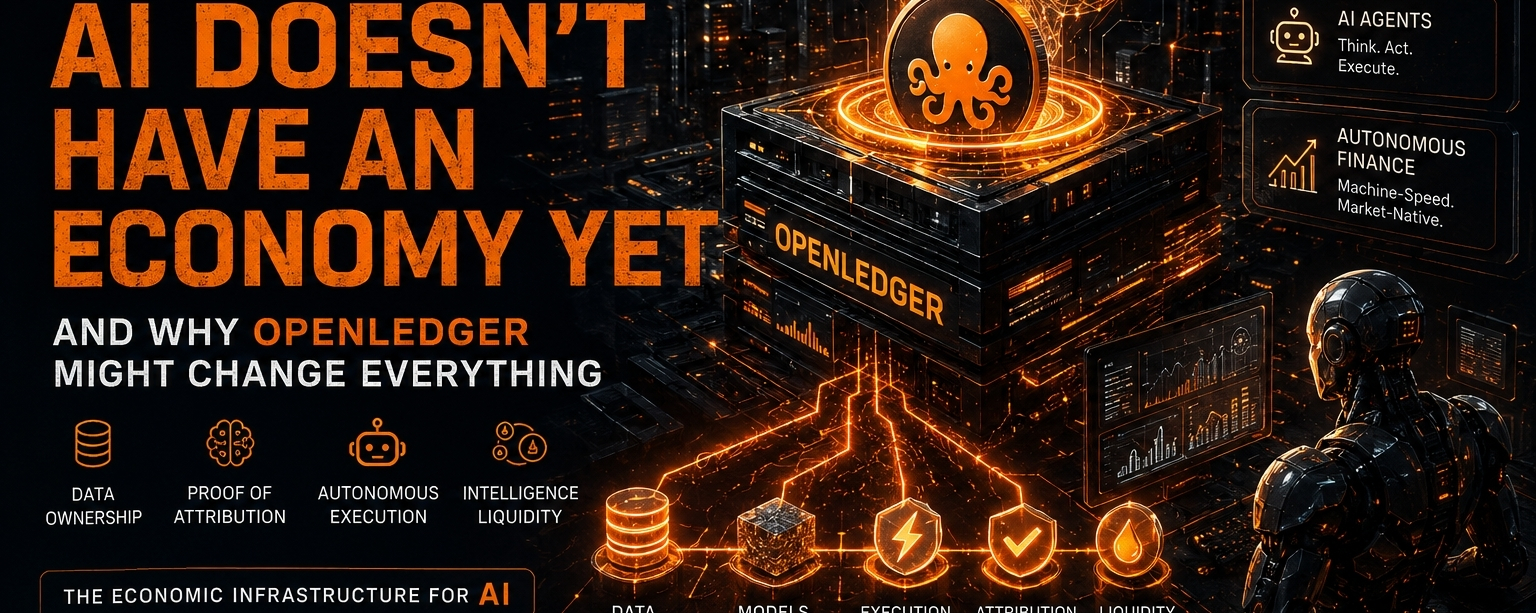
Everyone keeps saying AI is the future.
But the more I study the industry, the more I realize something uncomfortable:
AI today is incredibly intelligent… yet economically broken.
The biggest AI systems in the world are trained on human knowledge, human creativity, human behavior, and human data but almost nobody contributing to that intelligence gets rewarded when the system creates value.
That’s the flaw I can’t stop thinking about.
Right now, centralized AI works like a giant black box: people contribute data, models absorb intelligence, corporations monetize everything, and contributors disappear from the value chain completely.
No attribution. No ownership. No transparent execution. No economic participation.
And honestly, that’s why OpenLedger caught my attention differently from most AI projects.
Because OpenLedger isn’t trying to build another “AI blockchain.”
It’s trying to build the economic infrastructure layer for AI itself.
That changes the conversation entirely.
Most crypto projects still market speed, TPS, cheap gas, or generic scalability narratives.
OpenLedger is positioning itself around something much bigger:
programmable intelligence.
Not just AI models. Not just token speculation.
An actual system where data, models, execution, attribution, liquidity, and autonomous agents become financially programmable.
That’s a massive shift in perspective.
The idea becomes easier to understand when I think about it like this:
YouTube monetized videos. OpenLedger wants to monetize intelligence.
On YouTube, creators finally earned from the content they uploaded instead of platforms capturing all the value.
OpenLedger applies that same psychological framework to AI.
Data contributors become participants in the economy instead of invisible resources feeding centralized systems.
And that’s where concepts like Proof of Attribution, Datanets, OpenLoRA, and payable AI become powerful.
Because the future AI economy cannot scale sustainably if the people contributing intelligence remain unpaid.
The deeper I looked into OpenLedger, the more I realized the project isn’t centered around blockchain narratives at all.
It feels more like an operating system for autonomous economies.
That distinction matters.
Ethereum made money programmable.
OpenLedger is trying to make intelligence programmable.
And in my opinion, that’s one of the most important narratives emerging in crypto right now.
What really stands out to me is the project’s obsession with execution rather than prediction.
Most AI discussions today revolve around signals, forecasting, analytics, dashboards, or trend prediction.
But prediction alone has limited value.
Execution is where value is actually captured.
OpenLedger seems to understand that future markets won’t simply be analyzed by AI they’ll be operated by AI.
That’s why autonomous agents, AI-managed vaults, liquidity routing, execution optimization, and machine-speed coordination feel so central to the ecosystem narrative.
And honestly, humans are already losing the execution race.
A trader manually reacting to volatility cannot compete against agents processing infinite market signals in milliseconds.
Humans get emotional. Agents remain systematic.
Humans monitor a few charts. Agents monitor entire ecosystems simultaneously.
Humans hesitate. Machines execute instantly.
That transition already feels inevitable to me.
The most interesting part is that OpenLedger doesn’t frame this future as science fiction.
It frames it as infrastructure.
That’s why the project keeps leaning into ideas like:
AI liquidity, autonomous finance, execution environments, ERC-4626 vault systems, agent coordination, and machine-native capital flows.
The message underneath all of it is incredibly clear:
future financial systems may not be human-operated first.
They may become machine-coordinated by default.
And if that happens, entirely new infrastructure layers are required.
Not just for computation but for attribution, verification, settlement, automation, and value distribution.
That’s the layer OpenLedger appears to be building.
Another thing I find strategically smart is how the ecosystem blends AI, finance, and data ownership into one coherent narrative instead of treating them as separate sectors.
Most projects specialize in one vertical.
OpenLedger connects all of them into a larger system.
Data becomes an asset. Intelligence becomes liquid. Execution becomes autonomous. Agents become economic participants.
That’s a very different vision from the typical “AI coin” narrative dominating the market.
And maybe that’s why the project feels intellectually sticky.
It doesn’t sell hype. It sells inevitability.
The strongest protocols usually don’t feel like temporary trends.
They feel aligned with where the world is already moving.
That’s exactly the feeling I get here.
Especially when I look at how quickly autonomous systems are evolving, how institutional capital is flowing into AI infrastructure, and how machine-driven execution is beginning to dominate modern markets.
The signals honestly feel impossible to ignore now.
I think the biggest misunderstanding people still have about OpenLedger is believing it’s simply putting AI on-chain.
That’s not the real story.
The real story is much bigger.
OpenLedger is attempting to build the economic operating system where AI, data, agents, attribution, liquidity, and autonomous execution become programmable financial primitives.
And if autonomous economies truly become the next evolution of markets…
then infrastructure like this may become far more important than most people realize today.
