
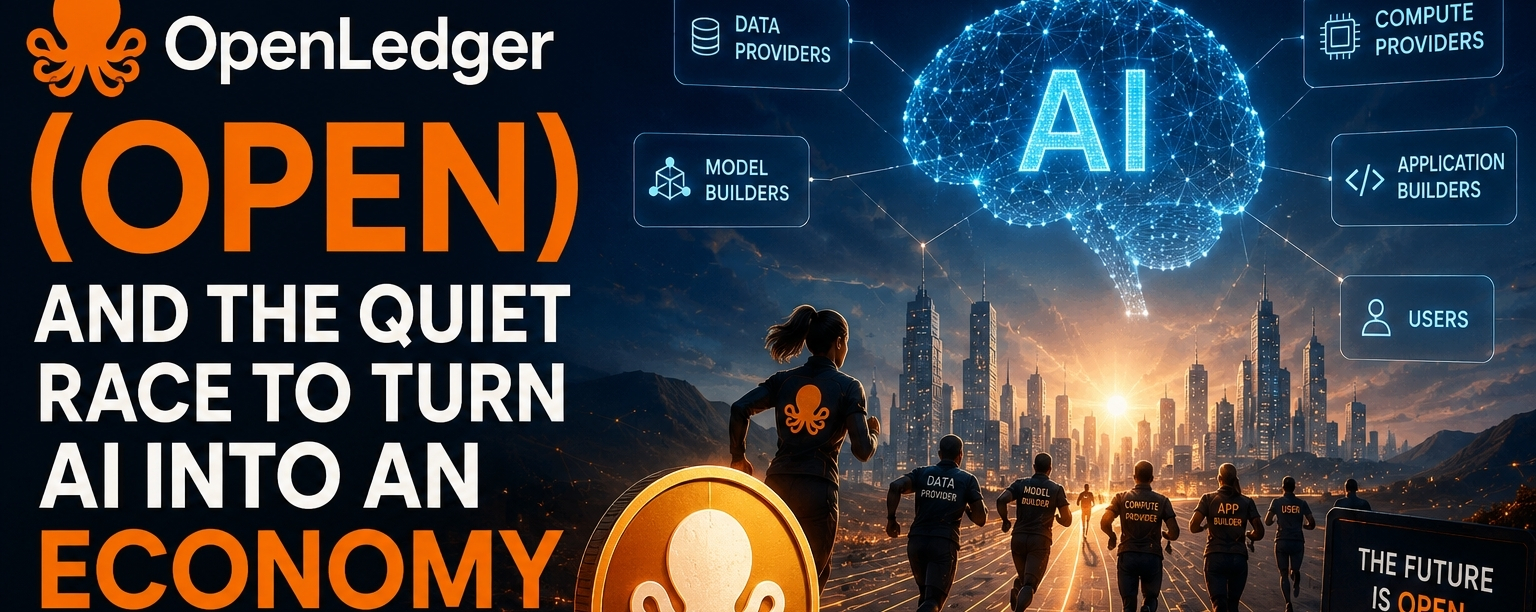
Most people still think of AI as a tool. You open an app, type something, get an answer, and move on. But underneath that simple experience, there is a growing problem nobody really talks about enough: AI systems are hungry. They need endless streams of data, computing power, models, feedback, and human interaction to stay useful.
And almost none of the people providing those things are properly rewarded.
That is the space OpenLedger is trying to step into.
Instead of treating AI as a closed product controlled by a few giant companies, OpenLedger is building something closer to an open marketplace. A place where data, AI models, and even autonomous agents can become assets that people actually own, share, and monetize. It sounds ambitious because it is. But the timing makes sense.
Right now, the AI industry is full of invisible labor. Developers train models. Communities generate useful datasets. Independent researchers improve open-source systems. Small teams build AI agents that solve specific tasks. Yet most of the value usually flows upward into centralized platforms.
OpenLedger seems to be asking a very direct question: what if AI infrastructure worked more like an economy instead of a closed warehouse?
That idea changes the role of blockchain completely. In many crypto projects, the blockchain feels glued onto the product afterward. Here, it feels more connected to the core problem. Ownership, transparency, payments, attribution, and access control are all things blockchains naturally handle well. AI desperately needs those layers if it wants to scale without becoming even more centralized.
The interesting part is that OpenLedger is not only talking about token transfers or speculation. The project keeps focusing on liquidity for AI itself. That phrase matters more than people realize.
Liquidity usually describes money moving easily through markets. OpenLedger applies the same thinking to intelligence and data. If someone creates a useful dataset, there should be a way to price it, verify it, and allow others to use it without losing ownership entirely. If a developer builds a powerful AI agent, it should not disappear inside one company’s servers forever.
That’s where OPEN starts becoming more than just another token.
The token appears designed to sit inside these interactions — rewarding participation, helping govern the network, and creating incentives for contributors who keep the ecosystem alive. Whether that model fully works at scale is still an open question, obviously. Incentive systems in crypto can become messy very fast. Some collapse under speculation long before the actual product matures. We’ve seen that movie already.
Still, there are signs that people are paying attention to OpenLedger for reasons beyond hype. Developer conversations around decentralized AI have increased noticeably over the last year, especially as concerns about closed AI ecosystems continue growing. Communities are becoming more interested in verifiable AI outputs, transparent training sources, and ownership rights around models.
That shift matters.
A few years ago, most blockchain discussions revolved around finance only. Today, AI infrastructure is slowly becoming one of the most serious sectors inside crypto. Not the loudest sector. Just one of the more serious ones.
OpenLedger enters this moment with relatively clear positioning. It is not trying to compete directly with giant consumer AI apps. Instead, it seems focused on becoming a coordination layer beneath them — the rails that allow data providers, model creators, and AI agents to interact economically.
There’s also something quietly practical about that approach.
A small developer in Vietnam, a research collective in Berlin, or even a solo builder working late at 2 a.m. in Karachi could theoretically contribute to an AI economy without needing permission from a major corporation. That vision feels very crypto-native in the best sense. Open systems. Shared incentives. Borderless participation.
And honestly, some of the current AI landscape already feels too concentrated.
One thing I noticed while following discussions around OpenLedger is that community sentiment tends to focus less on short-term marketing and more on infrastructure conversations. People debate data validation, interoperability, and how agents might transact autonomously in future ecosystems. Those are not the usual meme-token discussions. Sometimes they are painfully technical, actually.
The project also sits at an interesting intersection because AI agents themselves may eventually need financial rails. If autonomous systems start performing tasks online — managing workflows, trading services, or coordinating with other agents — they will need ways to exchange value securely. Traditional payment systems were not really designed for machine-to-machine economies.
Blockchain networks were.
That does not guarantee OpenLedger wins anything, of course. The decentralized AI sector is becoming crowded fast. New protocols appear every month claiming they will power the future of AI coordination. Many will disappear quietly. A few may survive long enough to shape the next infrastructure layer of the internet.
OpenLedger’s success probably depends less on narratives and more on whether builders genuinely keep using it. Real usage leaves fingerprints: active developer tooling, integrations, sustained on-chain activity, working AI products, governance participation. Eventually the market notices substance. It just takes longer than people want.
@OpenLedger There is also a small but important psychological shift happening in crypto right now. Users are becoming more skeptical of empty ecosystems. Fancy branding alone does not carry projects very far anymore. People want products that solve visible problems.
OpenLedger at least points toward a real one.
The strange thing is, the idea almost sounds obvious once you hear it explained plainly: if AI becomes one of the most valuable resources in the world, then people contributing to that intelligence layer will eventually want ownership, payment, and control. That pressure was probably inevitable.
