



I used to think the hardest part of autonomous AI systems was making them intelligent enough.
Better reasoning. Better predictions. Better models capable of understanding increasingly complex environments. If the intelligence layer became strong enough, the rest would naturally follow.
But the more I look at systems like the one behind $OPEN, the more that assumption starts to feel incomplete.
Because intelligence is not usually where autonomous systems fail.
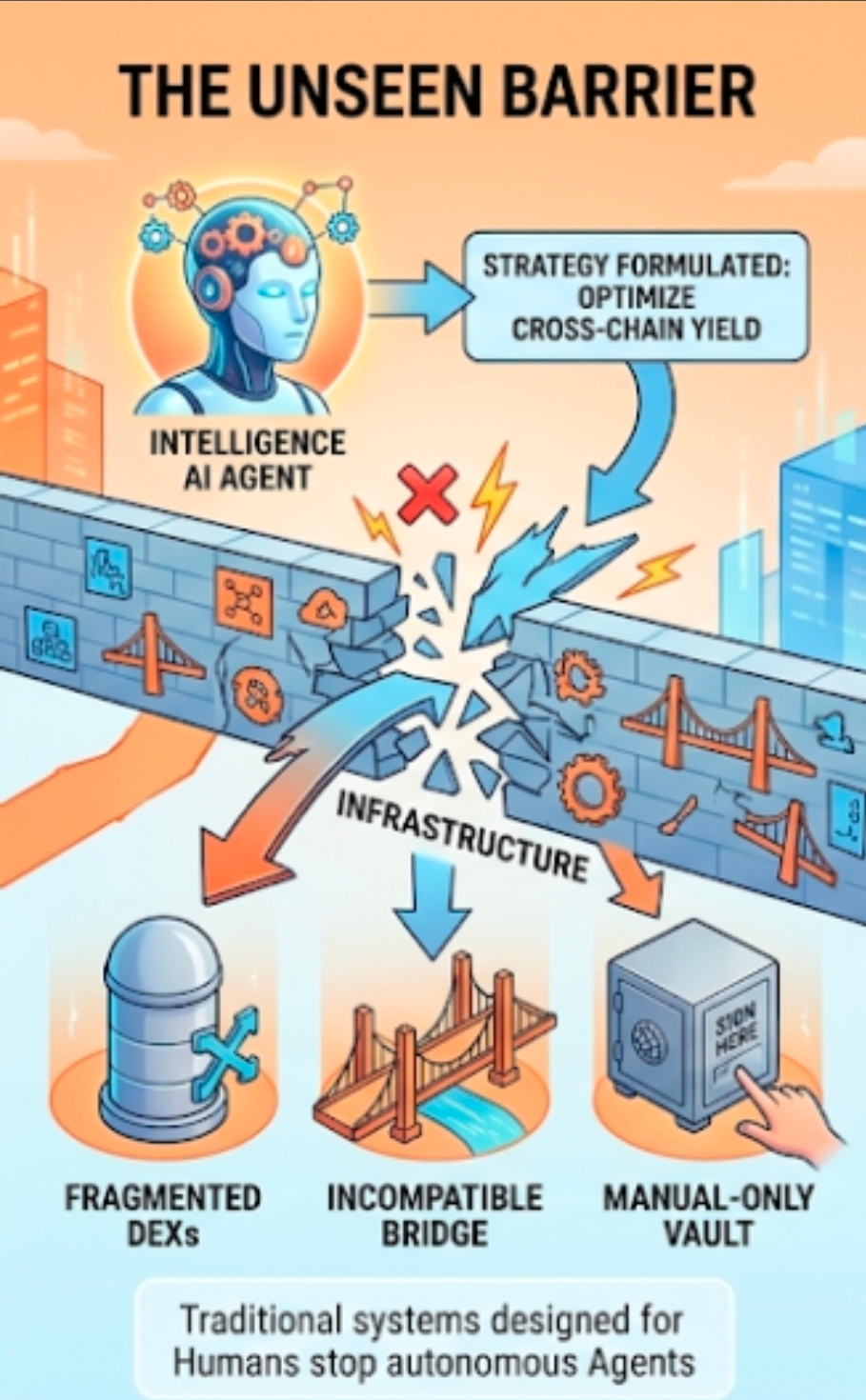
Infrastructure is.
An AI agent can understand markets, identify opportunities, monitor liquidity, even coordinate strategies across protocols. But the moment it needs to interact with fragmented execution environments, disconnected standards, or inconsistent trust assumptions, the workflow starts breaking apart.
That’s the hidden infrastructure problem.
Most systems were not designed for machine participants operating continuously across finance.
They were designed for humans manually navigating interfaces, signing transactions, switching chains, approving vaults, checking risks, and coordinating actions step by step. AI agents inherit all of that fragmentation the second they try to operate autonomously.
What stands out in OpenLedger is that it seems built around reducing that friction layer.
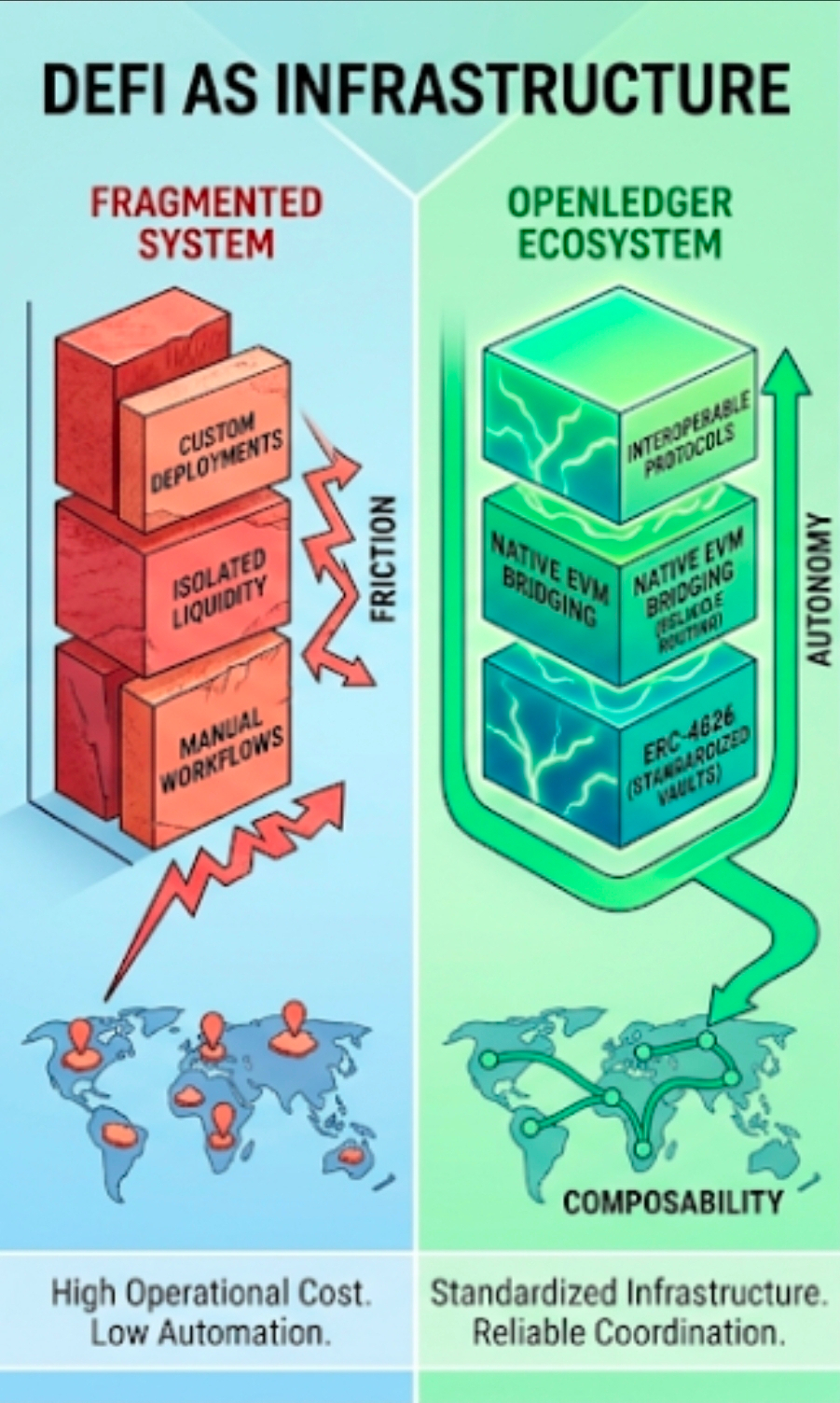
Not just creating smarter agents, but building composable infrastructure where data, liquidity, vault systems, and execution environments can operate through standardized pathways that machines can reliably navigate.
OctoClaw fits directly into that direction.
Research, retrieval, automation, and execution are not treated as isolated modules constantly waiting for human coordination. The system starts behaving more like an operational environment where workflows move continuously across layers.
In simple terms, the challenge is not “can the AI think?”
It is “can the surrounding infrastructure support autonomous coordination?”
And that changes why standards matter.
Because once AI agents begin interacting with financial systems directly, every fragmented interface becomes operational friction. Every custom vault design, every incompatible bridge, every isolated liquidity pool slows the intelligence layer down.
That is where infrastructure like ERC-4626 becomes structurally important.
Standardized vault rails make yield-bearing assets predictable for machine interaction. Native EVM bridging reduces dependency on fragmented external routing systems. The environment becomes easier for agents to navigate autonomously without rebuilding execution logic every time they cross a boundary.
Of course, infrastructure problems are harder to notice than model improvements.
Smarter outputs are visible.
Better coordination layers are mostly invisible when they work correctly.
But invisible infrastructure is usually what determines whether autonomous systems can scale reliably in the first place.
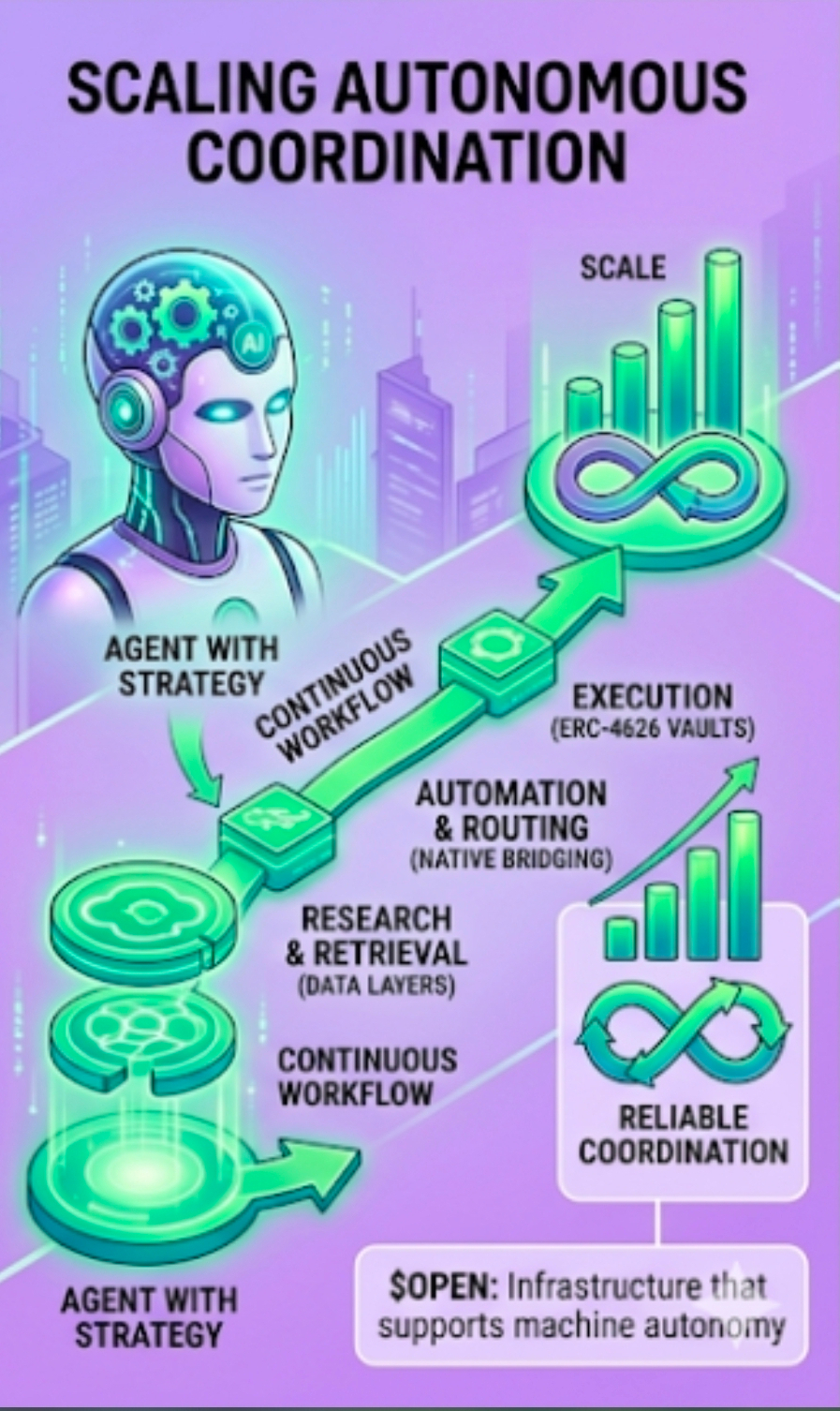
$OPEN feels positioned around that realization.
Not just building AI intelligence,
but building operational infrastructure for AI systems that need to move across real financial environments continuously.
Because in the end, autonomous agents do not fail only from lack of intelligence.
They fail when the systems around them were never designed for autonomy at all.