

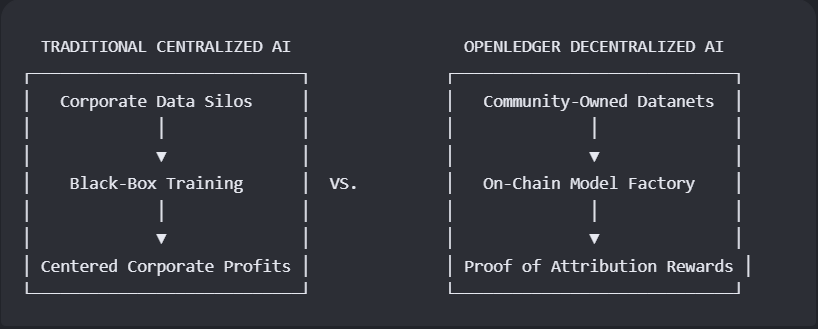
The Shadow in the Data SiloImagine walking through a massive, neon-lit digital metropolis. All around you, towering skyscrapers owned by corporate giants hum with the sound of billions of computations per second. This is the empire of centralized artificial intelligence. Inside these locked structures, massive algorithms consume everything we create: our late-night thoughts, medical research, artwork, and lines of code.Yet, as you stand on the street below, a stark reality hits you. The people who built the bricks of this city—the writers, the developers, the doctors, the everyday internet users—are entirely locked out of the profits. Their data was harvested without permission, fed into black-box models, and monetized to generate trillions of dollars. The creators receive absolutely nothing.This is the $500 billion data problem. It is an economy where high-value datasets remain trapped in silos, used to train models behind closed doors, leaving the true contributors invisible.But a shift is occurring in the digital underground. A new infrastructure has emerged, built to break down these walls and put intelligence directly onto an open ledger. This is the story of how the OpenLedger AI Blockchain is flipping the script on the tech monopolies, rewriting the rules of ownership, and introducing a decentralized economy for the intelligence age.The Birth of the Open InfrastructureFor years, the crypto landscape watched as decentralized finance (DeFi) and digital collectibles captured the spotlight. Blockchains were optimized for processing simple transactions, trading tokens, or minting artwork. Meanwhile, artificial intelligence was scaling at an exponential rate, but it remained firmly bound to centralized cloud servers.Then came a radical realization: AI requires its own financial and operational architecture. Just as the industrial revolution required the invention of banking systems and physical trade networks, the intelligence economy requires a transparent, auditable, and decentralized foundation.
The founders of OpenLedger looked at this gap and began building. They did not want to create another superficial narrative or a simple utility token. Instead, they built an Ethereum Layer-2 infrastructure using the OP Stack rollup framework, partnering with AltLayer as their Rollup-as-a-Service (RaaS) provider.By doing this, they built a fast, highly scalable environment tailored for heavy AI workloads while remaining completely EVM-compatible. This allowed developers to connect their existing wallets, interact with smart contracts, and bridge assets without learning an entirely new programming language.The vision was clear: build a network where every single step of the AI lifecycle—from data contribution and model refinement to inference and autonomous operations—runs transparently on-chain.The Architecture: Datanets, Model Factories, and OpenLoRATo truly understand how this ecosystem functions, we must look at the structural mechanics that make OpenLedger unique.
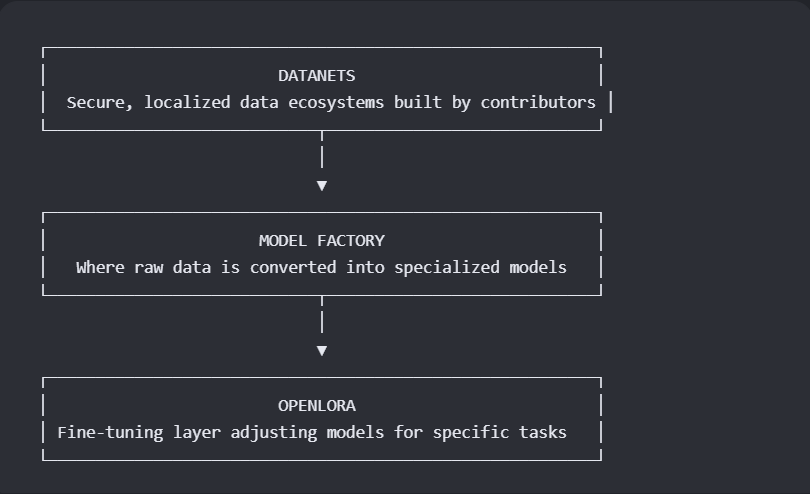
Datanets: The Safe Havens for DataInstead of throwing data into an open pool where it can be stolen or misused, OpenLedger introduces Datanets. Think of a Datanet as a secure, sovereign, and localized data ecosystem.An institution, a developer community, or a group of researchers can launch their own private or public Datanet. For example, a global network of radiologists can create a medical imaging Datanet. They upload highly specialized medical scans, securing them behind advanced cryptographic layers.
2. The Model Factory: The Synthesis EngineOnce high-quality data is secured inside a Datanet, it moves into the Model Factory. This is where the magic happens. Instead of an engineer training a model on a isolated corporate server, the Model Factory acts as a decentralized forge. It takes the verified data from the Datanets and uses distributed computing networks to train specialized AI models entirely on-chain.
3. OpenLoRA: Precision Tuning Standard AI models are often jacks-of-all-trades but masters of none. To solve this, OpenLedger integrates OpenLoRA (Low-Rank Adaptation). This optimization layer acts as a fine-tuning mechanism, allowing developers to take massive base models and adjust them for incredibly niche tasks—such as financial market forecasting, legal contract analysis, or gaming logic—without needing to rebuild the entire architecture from scratch.
The Core Engine: Proof of Attribution (PoA)
If data is the fuel and the Model Factory is the engine, how do we ensure that the person who supplied the fuel actually gets paid? In the old system, tech giants took the data, closed the curtain, and claimed the output as their own. OpenLedger solves this via its core cryptographic innovation.
Proof of Attribution (PoA).Proof of Attribution functions like a digital DNA tracker for information. Every time a piece of data is uploaded to a Datanet, its exact origin, cryptographic signature, and contribution value are permanently stamped onto the ledger. When an AI model is trained and later generates a helpful answer, the PoA consensus algorithm traces the path backward in real time. It determines exactly which datasets made that specific answer possible. If your data contributed 5% to the quality of a highly specialized medical model's diagnosis, the smart contract automatically routes 5% of the financial reward directly back to your wallet. No middleman, no corporate negotiation, and no hidden terms. Ownership and credit are perfectly assigned, making intelligence a verifiable, tradeable asset.
The Economic Lifeblood: The OPEN Token
At the centre of this decentralized economy sits the OPEN token, the native currency of the OpenLedger ecosystem. With a total fixed supply capped at 1,000,000,000 OPEN, the token acts as the primary tool for coordination, transaction, and value capture across the network. On an infrastructure level, the OPEN token serves as the gas that drives the entire Layer-2 network. Every time an AI model runs an inference, a developer fine-tunes an agent, or data is transferred across a Datanet, the transaction fees are paid in OPEN. Beyond simple network fees, the token coordinates incentives across three distinct groups:
For Contributors: Data providers, compute hosts, and AI model developers receive OPEN tokens directly as automated rewards via Proof of Attribution.
For Stakers & Validators: Community members can stake their tokens to secure the data validation layers, earning a portion of network yields while ensuring the integrity of the incoming data.
For Governance: Holding the token gives users a seat at the table, allowing them to vote on protocol updates, fee structures, and the long-term expansion of the network. The token provides immediate liquidity to an industry that has historically been highly illiquid. By listing on major global exchanges like Binance, OPEN allows capital to flow seamlessly between traditional markets and the decentralized AI economy. Navigating the Broader AI-Web3 Landscape. To understand why OpenLedger is capturing so much attention, we must look at how it fits into the broader decentralized AI landscape. It does not exist in a vacuum; it operates alongside a cohort of specialized protocols that are collectively dismantling centralized tech structures.
Token / CoinPrimary Network: Focus Role in the Decentralized AI Economy: OPEN (OpenLedger)Data & Model Lifecycle Attribution Layer focuses on verifiable data tracking, multi-party model training, and programmatic revenue distribution via Proof of Attribution. FET (Artificial Superintelligence Alliance)Autonomous AI Agents & Automation Powers multi-agent systems that can communicate, negotiate, and execute complex workflows without human intervention. RNDR / RENDER (Render Network)Decentralized Compute PowerProvides the raw GPU hardware processing strength required to execute heavy rendering and AI model training tasks. TAO (Bittensor) Decentralized Machine Intelligence Acts as an open marketplace for competitive intelligence, where distinct subnets produce and grade machine learning models. While protocols like Render supply the raw computing power and Bittensor creates a competitive market for model outputs, OpenLedger targets the foundational layer: the verifiable provenance and monetization of data and models. It serves as the transparent, collaborative environment where these distinct components can securely connect and trade value on-chain.
The Horizon of Decentralized Intelligence As we look toward the future, the implications of an open intelligence ledger stretch far beyond simple financial incentives. We are moving into a world populated by Autonomous AI Agents—independent pieces of software capable of earning money, hiring other AI agents, and deploying their own code.Without a blockchain, an autonomous agent is completely dependent on a corporate API key. If the parent company pulls the plug, the agent ceases to exist. OpenLedger treats AI models and agents as first-class economic citizens. Once deployed to the blockchain, an agent can hold its own wallet, buy data from a Datanet using OPEN tokens, pay for decentralized computing power, and sell its specialized services directly to users worldwide—entirely independent of human or corporate intervention.The quiet infrastructure shift occurring right now is laying the groundwork for a fair digital landscape. It offers an alternative path where data creators are respected, models are auditable, and the value generated by artificial intelligence is distributed back to the community that made it possible. The era of the data monopoly is facing its first real systemic challenge, and the ledger is officially open.