
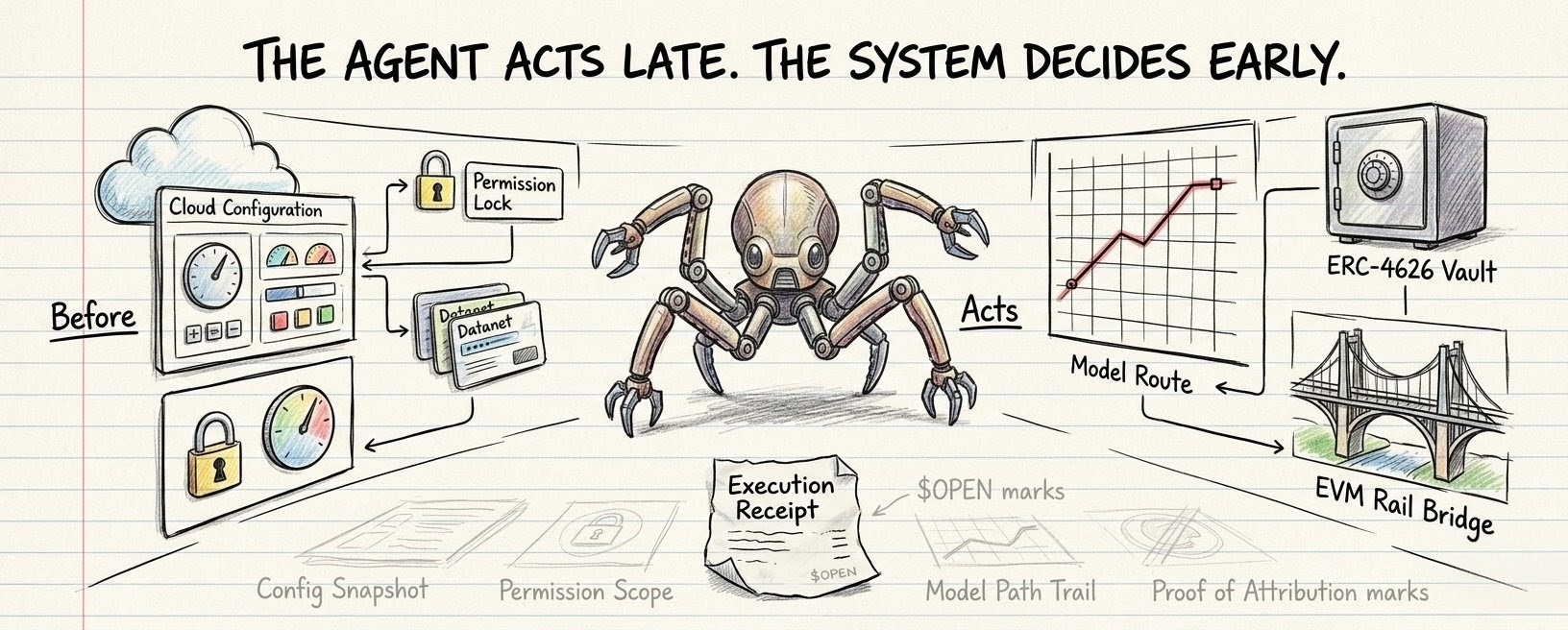

i think the strange part of a OctoClaw inside openLedger (@OpenLedger ) is not about agents.
not the answer. not the trade. not the shiny little execution moment people like to screenshot. i mean the boring layer before that. the cloud config, permissions, routes, data access, model path, vault edge, bridge edge, all the small limits that decide what the agent is even allowed to become inside OpenLedger.
because an agent does not begin when it acts.
that sounds wrong at first, but i don’t think it is. the action is just the part we finally notice. the trade placed, the data pulled, the task routed, the vault touched, the bridge path used. that is the visible moment. but the shape of that moment was already being built earlier, in all the configuration nobody wants to stare at because it feels too much like settings and not enough like intelligence.
and maybe that is exactly why it matters.
on openLedger, AI agents are always sold like personality with hands. ask it something, it thinks, it does. clean story. too clean. because if an agent can execute, then the important question is not only whether it is smart. it is what it was allowed to touch before anyone called it smart.
who gave it access?
which data path was open?
which model route did it follow?
what happens if that route sits close to capital?
that is where OctoClaw feels heavier than normal agent talk. not because agents are magical. they are mostly workflows with confidence issues and better marketing. but once they start acting through OpenLedger’s stack, the boring boundaries become part of the action itself.
a chatbot can be wrong and it is annoying. refresh, argue, laugh at it, ask again. but a trading agent is different. an execution agent is different. an agent that can pull Datanet context, use a model path, move near ERC-4626 vault logic, maybe interact with EVM liquidity through a bridge route… that is not just “AI assistance” anymore.
that is permission turning into consequence.
i keep thinking about that little space between configuration and action on openLedger. it is easy to ignore because nothing has happened yet. no trade. no vault movement. no output with money attached. just settings. cloud config. access rules. maybe a route to some model. maybe allowed data sources. maybe a workflow the agent can trigger later.
but that is the dangerous part, no?
because once the agent acts, people look at the action like it appeared from the agent’s mind. but the action was already shaped by what the system allowed before it started. bad permission can be a bad decision before the decision even happens.
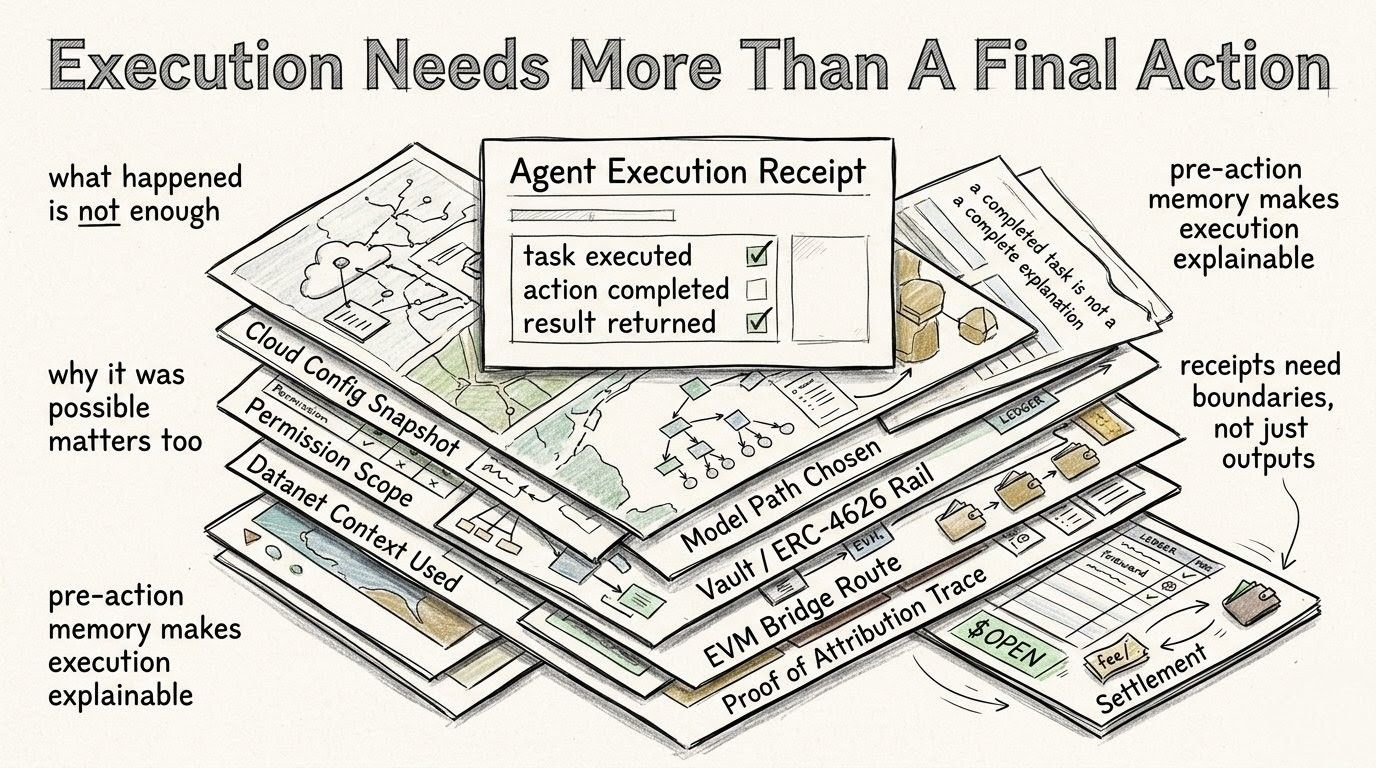
inside OpenLedger, OctoClaw makes that feel more visible. it is not just about launching an agent and hoping the personality behaves. the agent has to live inside a readable environment. what can it query? what model can it use? what Datanet context can it reach? what execution path is open? what happens if the result touches a vault standard like ERC-4626 or crosses into an EVM bridge path?
small questions, but not small.
because every permission is a future excuse if nobody records it.
and that is what most agent systems feel weak on. they make setup feel temporary. like a little admin step before the real thing. choose tools, connect wallet, authorize route, done. but for an agent that executes, setup is not outside the action. setup is part of the evidence.
that is the part i keep coming back to with OctoClaw inside openLedger. maybe cloud config is boring. maybe it should be boring. but the boring layer decides whether the agent is boxed in, overexposed, or quietly dangerous.
if a trading agent reads the wrong context, that is one kind of problem. if it follows a weak model path, another. if it can touch capital without clean limits, another. if it can route through bridge or vault rails without the system keeping receipts, then the agent is not autonomous. it is just an unstructured liability with a nice interface.
and people will still call it smart if it works once.
that is the trap.
because agents can look useful before they are safe. a good output can hide a messy route. a correct trade can hide a bad permission structure. a profitable action can make everyone forget to ask why the agent was allowed to do that much in the first place.
OpenLedger’s architecture pushes against that forgetting. at least, that is the interesting version of it. Datanets create context. Model paths create behavior. Proof of Attribution can keep track of what shaped the output. openLedger ($OPEN ) sits inside the settlement and reward side. and OctoClaw sits in this weird practical place where agent execution needs to be configured before it becomes visible.
not glamorous. but very real.
because the future agent problem is not only “did the agent make the right move?”
it is also, “was the agent allowed to make that move?”
and maybe worse, “can we explain the route after it happened?”
i think that is where ERC-4626 becomes less boring too. vault shares, deposits, withdrawals, standardized accounting… dry stuff. but if an OpenLedger agent gets near capital, boring is suddenly protection. an agent does not need a fantasy brain when capital is involved. it needs constraints. it needs readable rails. it needs a container where movement can be understood after the fact.
same with the openLedger EVM bridge idea. people see bridges and think token movement. move openLedger here, move assets there, connect ecosystems. fine. but for agent execution, a bridge is also an edge. it is where AI-native behavior can meet external liquidity. and every edge needs rules, because an agent crossing into liquidity without a readable trail is just asking everyone to trust a black box wearing a wallet.
that cannot be the future. or if it is, it will be messy in the old way.
what did the agent know?
what was it allowed to access?
which model shaped the action?
which route carried the execution?
where did the value move?
these questions feel annoying until something breaks. then they become the only questions that matter.
that is why openLedger OctoClaw cloud config feels like more than admin to me. it is the pre-action memory. the part that says, before this agent touched anything, here was the shape of its world. here were the doors open to it. here were the paths closed. here was the data it could reach, the model it could use, the rail it could move through.
without that, an execution receipt is thin. it only says something happened. it does not say enough about why that thing was possible.
and once agents start doing more than answering questions, thin receipts are not enough.
maybe this is the difference between automation and accountable automation. normal automation cares that a task completed. accountable automation cares what made the task possible, what boundaries existed before it ran, and who or what gets traced after value moves.
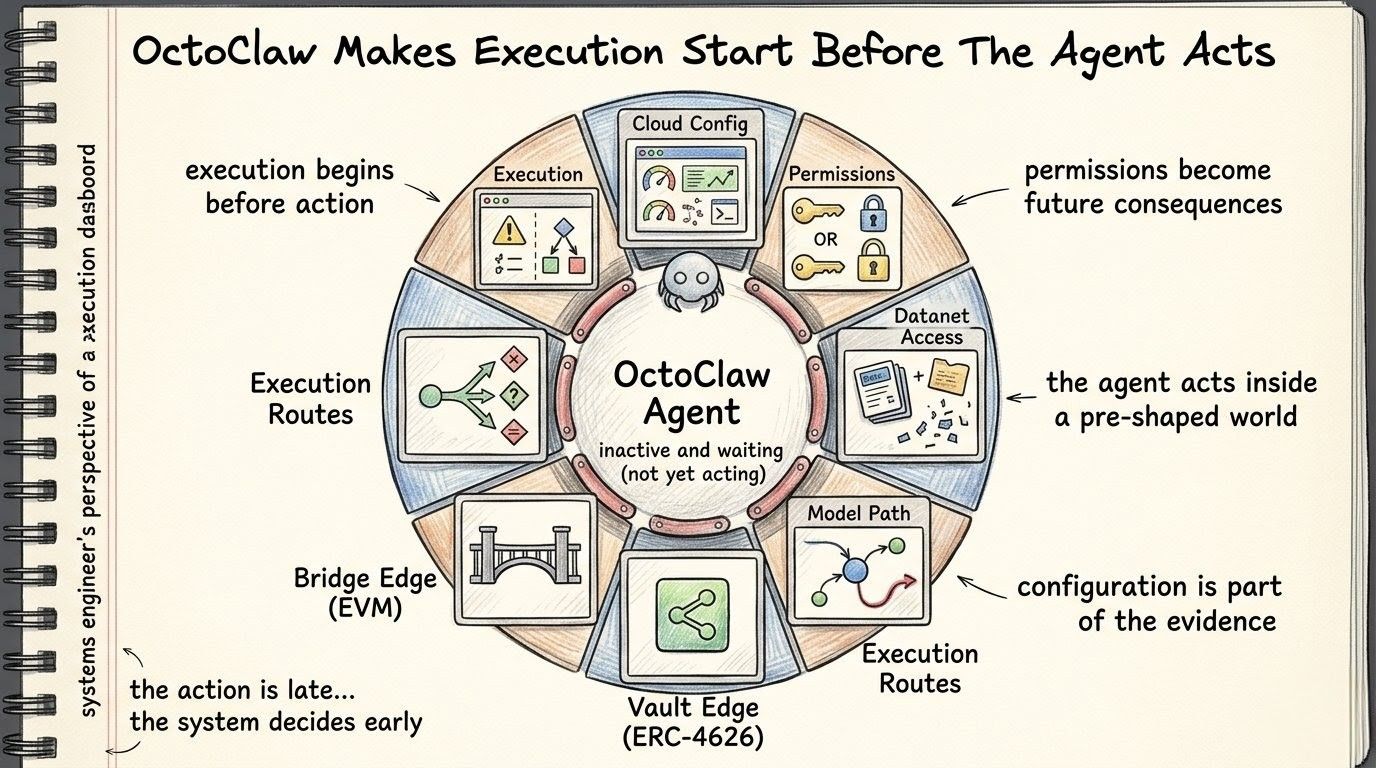
OpenLedger seems built around that second version. not perfectly, not magically, not in the “trustless AI future” marketing voice that makes me want to close the tab. more like, if AI is going to become an on-chain participant, then the system around it has to remember more than the final action.
because an agent is not just its output.
it is the config before the output, the data behind the decision, the model path under the behavior, the execution rail under the action, and the settlement logic after the value moves.
that is a lot of baggage for something people still describe like a helpful little bot.
and maybe that is why I like the OctoClaw angle. it makes the agent feel less like a character and more like an operating surface. less “look, AI can trade” and more “wait, who gave it the right shape before it traded?”
that question is less exciting. better question though.
in the past, software permissions were already annoying enough. apps asked for access, users clicked yes, everyone pretended consent was understanding. now move that same bad habit into AI agents that can act across data, models, contracts, vaults, bridges, and it gets uglier. permission is no longer just privacy. permission becomes execution risk.
and the scary part is that most people will only notice after the action.
OpenLedger’s agent layer cannot work like that. OctoClaw has to make the pre-action world readable, because the action later depends on it. if the agent pulls weak context, follows the wrong model route, touches the wrong rail, or moves through an over-open config, the mistake did not begin at execution. it began earlier, when the agent’s world was shaped badly.
that is the quiet part.
the agent acts late. the system decides early.
and maybe that is the whole point. OctoClaw is interesting not because it makes agents look powerful, but because it makes their power conditional. bounded. configured. traceable enough that the action is not floating in the air pretending it came from nowhere.
some agents will answer. some will trade. some will route tasks. some will probably touch capital in ways that make everyone suddenly rediscover the importance of boring settings.
fine. let it be boring.
because if AI agents are going to move through OpenLedger, then the first serious question is not how far they can go.
it is what they were allowed to touch before they moved.