

@OpenLedger Artificial Intelligence is advancing at an unprecedented, exponential velocity. However, as AI systems increasingly dictate economic, social, and operational frameworks, they confront a critical structural vulnerability: the complete lack of operational transparency. Modern AI development remains siloed within opaque corporate structures, leaving data provenance, training methodologies, and model weights hidden from public scrutiny. To reach its true potential, AI requires a verifiable, decentralized environment.
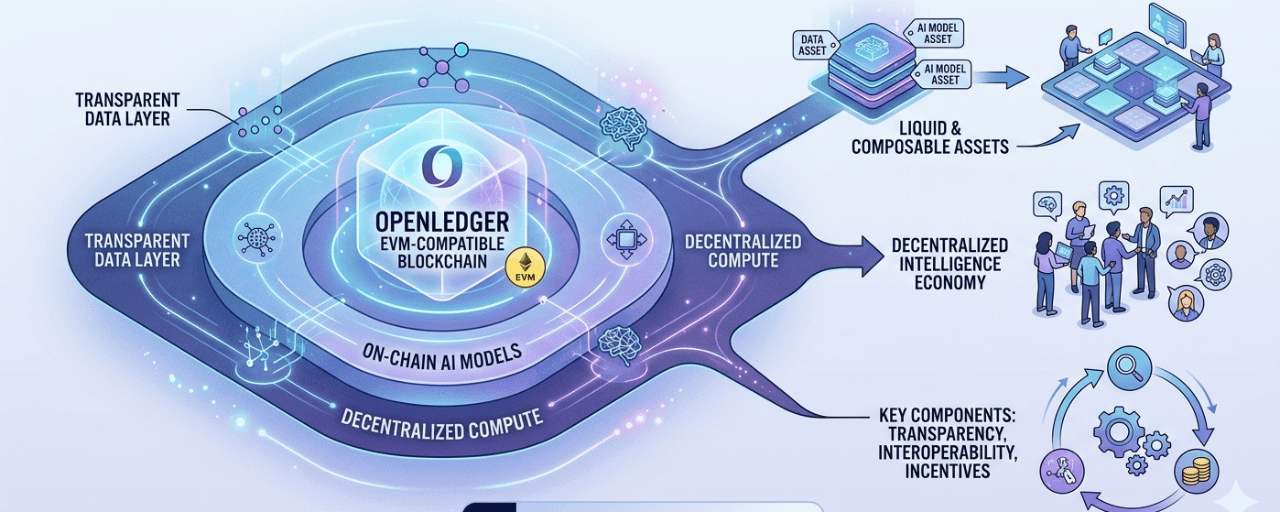
OpenLedger is built precisely to solve this paradigm, delivering an EVM-compatible infrastructure designed from the ground up to support authentic on-chain AI and establish a liquid intelligence economy.
Core Philosophy: By turning data repositories and complex machine learning models into liquid, fully composable assets, OpenLedger ($OPEN) is laying down the technical foundation required for a truly decentralized intelligence economy.
The Core Paradigm: Why Purpose-Built AI Infrastructure Matters
Existing layer-1 and layer-2 blockchain networks were designed primarily for basic transactional throughput, token transfers, and simple decentralized applications (dApps). They lack the compute-coordination layers, massive data handling capacities, and specific primitives required to safely manage complex machine learning workflows.
#OpenLedger introduces a radical shift by offering a custom-engineered, EVM-compatible environment. This architectural choice ensures seamless interoperability with the world's most robust web3 developer ecosystem (Ethereum) while embedding natively optimized data pipelines and cryptographic verification models directly into the consensus layer. The result is a network where AI models do not simply interact with web3 through external APIs, but exist intrinsically on-chain.
Turning Data and Models into Liquid, Composable Assets
In the legacy web2 paradigm, data contributors receive zero upside, and smaller developers are locked out of high-tier foundational models. OpenLedger disrupts this structure through assetization:
Data Financialization: OpenLedger allows data providers to bundle, tokenize, and license high-quality training sets. Data shifts from a static cost center into a yield-bearing, liquid on-chain asset class.
Model Composability: AI models can be seamlessly stacked, integrated, and code-linked like open-source financial building blocks (DeFi legos). A decentralized application can pull intelligence from multiple specialized models on-chain, automatically routing micropayments to each distinct model creator.
Verifiable Auditing: Because the infrastructure tracks every modification, optimization, and query on a public ledger, developers and end-users can trace the exact lineage of an AI's output, solving the critical "black box" trust problem.
$OPEN: The Fuel of Decentralized Intelligence
At the heart of this new ecosystem is the $OPEN token. Far from being a speculative asset, Open functions as the fundamental network currency. It drives governance choices, secures the network through localized staking mechanics, handles compute fees for model training/inference execution, and rewards node operators who provide storage and machine learning processing power to the network.
Conclusion: Looking Forward
The convergence of blockchain and artificial intelligence is inevitable, but its ultimate success hinges on execution. Without decentralized infrastructure, AI risks becoming the ultimate tool for centralized data monopolies. OpenLedger provides the antithesis: a transparent, collaborative ecosystem where intelligence is universally accessible, verifiable, and fairly monetized. By building the definitive home for on-chain AI, OpenLedger isn't just launching another network—it is kickstarting a sovereign, borderless, decentralized intelligence economy.
