
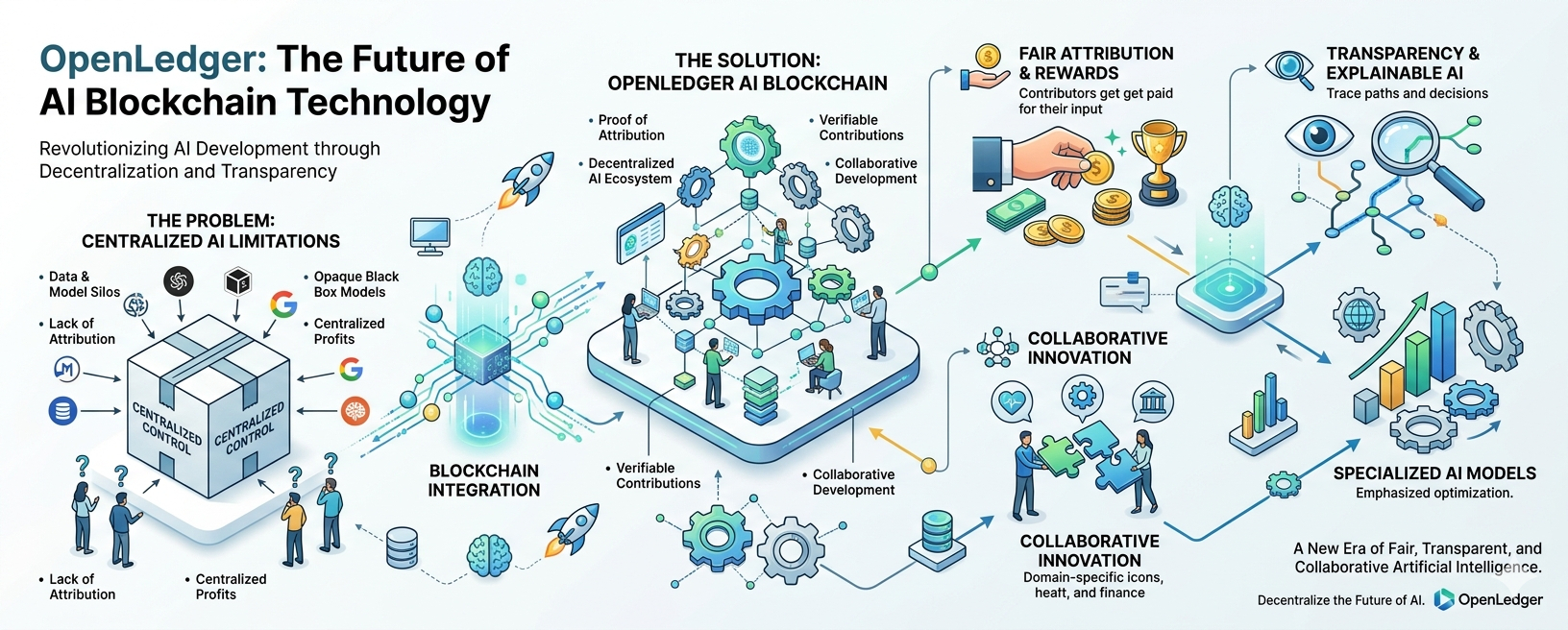
Artificial Intelligence is transforming industries across the world, but the infrastructure supporting AI development still faces major limitations. Traditional AI systems are mostly controlled by centralized organizations that own the data, models, and rewards generated from AI innovations. Contributors who provide valuable datasets, improve models, or help evaluate AI systems often receive little recognition or compensation for their efforts. At the same time, transparency and accountability remain weak because many AI models operate like closed black boxes.
OpenLedger introduces a new approach by combining blockchain technology with artificial intelligence. Instead of relying on centralized systems, OpenLedger creates a decentralized AI ecosystem where contributions can be tracked, verified, and rewarded fairly. The platform is designed specifically for AI workflows and aims to solve some of the biggest problems in modern AI development, including attribution, ownership, transparency, and monetization.
Understanding the Vision of OpenLedger
OpenLedger is described as an AI Blockchain, meaning it is a blockchain network built entirely for artificial intelligence applications and model development. Unlike traditional blockchains that focus mainly on financial transactions or digital assets, OpenLedger is designed to support the complete lifecycle of AI systems.
The core idea behind OpenLedger is simple: every contribution made during AI development should be recognized and rewarded. Whether someone contributes training data, improves a machine learning model, evaluates outputs, or helps refine performance, their work is recorded permanently on-chain. This creates an environment where AI development becomes collaborative, transparent, and economically fair.
One of the most important innovations introduced by OpenLedger is the concept of “Proof of Attribution.” This mechanism ensures that ownership and rewards are distributed according to the actual value each participant contributes. Instead of a few companies controlling AI profits, contributors across the network can benefit from the success of the ecosystem.
Why Artificial Intelligence Needs Blockchain
Modern AI systems depend heavily on data and collaboration. Large language models and machine learning systems require enormous datasets collected from multiple sources. However, existing AI infrastructure struggles to manage contribution tracking and ownership rights properly.
Most AI companies collect data from the internet without providing clear attribution to original contributors. Researchers, developers, and data providers often remain invisible despite playing an essential role in building AI systems. OpenLedger attempts to solve this issue through blockchain-based transparency and traceability.
Blockchain technology offers permanent and verifiable records. By integrating AI development into a blockchain environment, OpenLedger creates a system where every action can be audited. Data origins, model updates, training history, and contributor involvement become visible and verifiable. This helps build trust while reducing disputes regarding ownership and compensation.
Another major advantage is decentralization. Traditional AI ecosystems are dominated by large corporations with extensive computing resources. OpenLedger allows individuals and smaller contributors to participate in AI development without depending on centralized platforms. This creates a more inclusive and open economy for artificial intelligence.
Collaboration and Shared Ownership
One of OpenLedger’s strongest features is its focus on collaboration. AI systems are becoming increasingly specialized, and general internet data is no longer enough for advanced applications. Industries such as healthcare, finance, cybersecurity, and law require highly accurate and domain-specific models trained on specialized datasets.
Building these models requires collaboration between experts, researchers, and data providers. However, without a reliable attribution system, contributors may hesitate to share valuable information because they fear losing ownership or receiving no financial return.
OpenLedger addresses this challenge by permanently linking every contribution to its creator. Contributors maintain ownership of their work while still participating in collaborative AI development. This creates stronger incentives for people to contribute high-quality data and expertise.
As a result, OpenLedger encourages the growth of decentralized AI communities where innovation is shared instead of controlled by a small group of corporations.
Monetization Through Proof of Attribution
A major problem in today’s AI industry is the unequal distribution of rewards. Companies generating billions from AI technologies rarely compensate the individuals who provide training data or improve systems behind the scenes.
OpenLedger’s Proof of Attribution system changes this structure by introducing fair economic incentives. Rewards are distributed based on measurable contributions and impact within the AI ecosystem.
For example, if a contributor provides valuable data that significantly improves model performance, the blockchain records this contribution and ensures the individual receives compensation. Similarly, developers who enhance algorithms or evaluators who improve model accuracy can also earn rewards.
This model transforms AI development into a decentralized economy where participants are financially motivated to contribute quality work. Instead of relying on centralized employment structures, contributors can directly benefit from the value they help create.
Transparency and Explainable AI
Transparency has become one of the biggest concerns in artificial intelligence. Many AI systems make decisions without clearly explaining how those decisions were reached. This lack of explainability creates trust issues, especially in industries involving sensitive information such as healthcare, banking, or law enforcement.
OpenLedger improves transparency by recording the entire development process on-chain. Every dataset, model update, and contributor interaction becomes traceable. This creates a complete historical record of how AI systems evolve over time.
Such transparency offers several advantages. First, it allows users and organizations to verify the reliability of AI systems. Second, it improves accountability by identifying where errors or biases originate. Third, it supports regulatory compliance by making AI processes auditable.
Explainable AI is becoming increasingly important as governments and institutions introduce stricter AI regulations. OpenLedger positions itself as a solution that aligns technological innovation with accountability and ethical standards.
Why Traditional Blockchains Are Not Enough
Although blockchain technology already exists, most current blockchains were designed for cryptocurrency transactions, decentralized finance, or digital collectibles. They are not optimized for the complex requirements of AI systems.
General-purpose blockchains lack important features such as AI model tracking, structured data attribution, version control, and contribution-based reward systems. Attempting to adapt traditional blockchains for AI often results in scalability problems and inefficient workflows.
OpenLedger differs because it is built specifically for artificial intelligence from the ground up. Its infrastructure focuses on AI collaboration, contribution tracking, and specialized governance systems.
For instance, governance in traditional blockchains often revolves around protocol updates or transaction rules. In OpenLedger, governance can also involve model quality, evaluation standards, and improvement strategies for AI systems.
This specialized approach allows OpenLedger to support the growing complexity of decentralized AI development more effectively than general-purpose networks.
The Shift Toward Specialized AI Models
The AI industry is gradually moving away from extremely large general-purpose models toward smaller, optimized, and domain-specific systems. Specialized AI models are more efficient, cost-effective, and suitable for real-world applications.
Instead of replacing foundational AI models, OpenLedger aims to enhance them through specialized fine-tuning and collaborative improvements. This approach allows industries to create intelligent systems tailored to their specific needs while still benefiting from broader foundational technologies.
Smaller specialized models also reduce computational costs, making AI development more accessible to businesses and independent developers. At the same time, specialized systems often provide better explainability and more accurate results in focused domains.
OpenLedger supports this evolution by creating an infrastructure where specialized datasets and model improvements can be shared securely and rewarded fairly.
Conclusion
OpenLedger represents a significant step toward decentralizing the future of artificial intelligence. By combining blockchain technology with AI development, the platform introduces transparency, collaboration, and fair economic incentives into an industry that has traditionally been controlled by centralized organizations.
Its Proof of Attribution mechanism ensures that contributors receive recognition and rewards based on their actual impact, while blockchain-based transparency improves trust and accountability throughout the AI lifecycle.
As AI continues to evolve toward specialized and domain-focused systems, platforms like OpenLedger may play an important role in shaping a more open and collaborative AI economy. Instead of concentrating power in the hands of a few corporations, OpenLedger promotes a future where data providers, developers, researchers, and communities can collectively participate in building and benefiting from artificial intelligence.
