
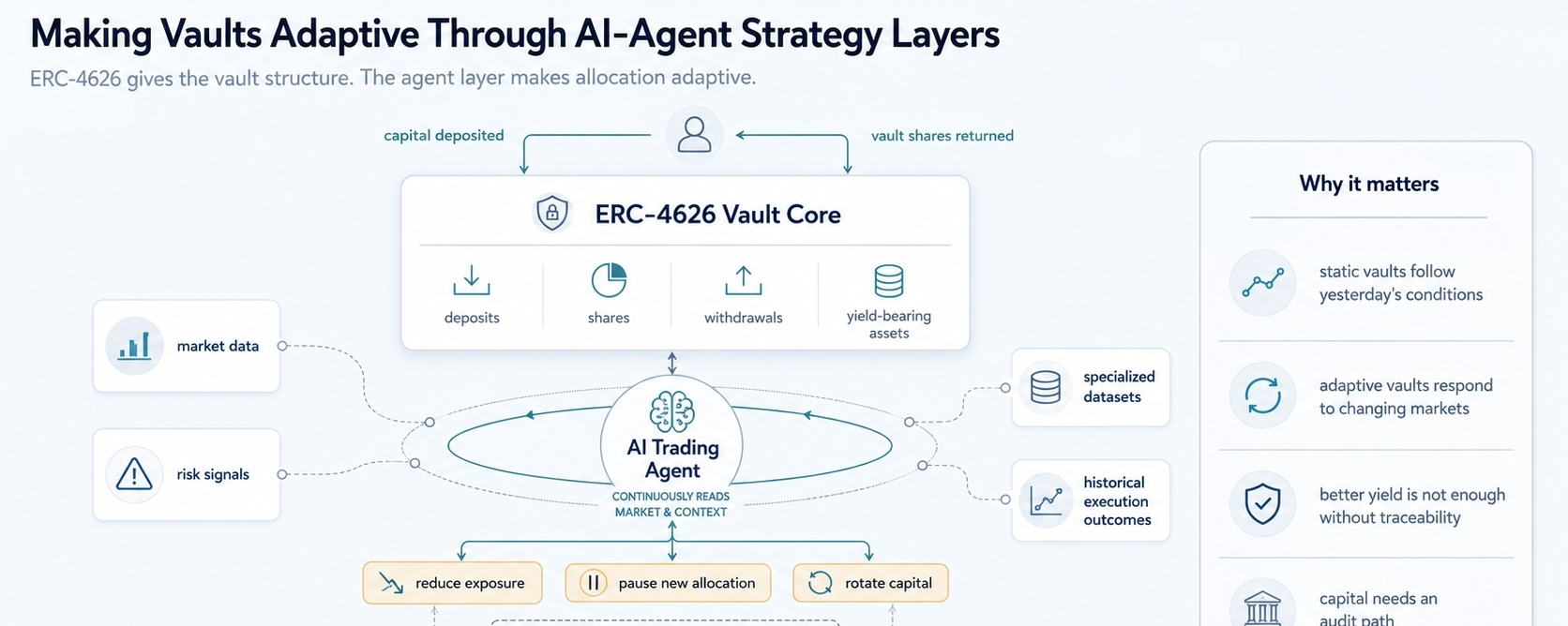
The deposit looked too normal.
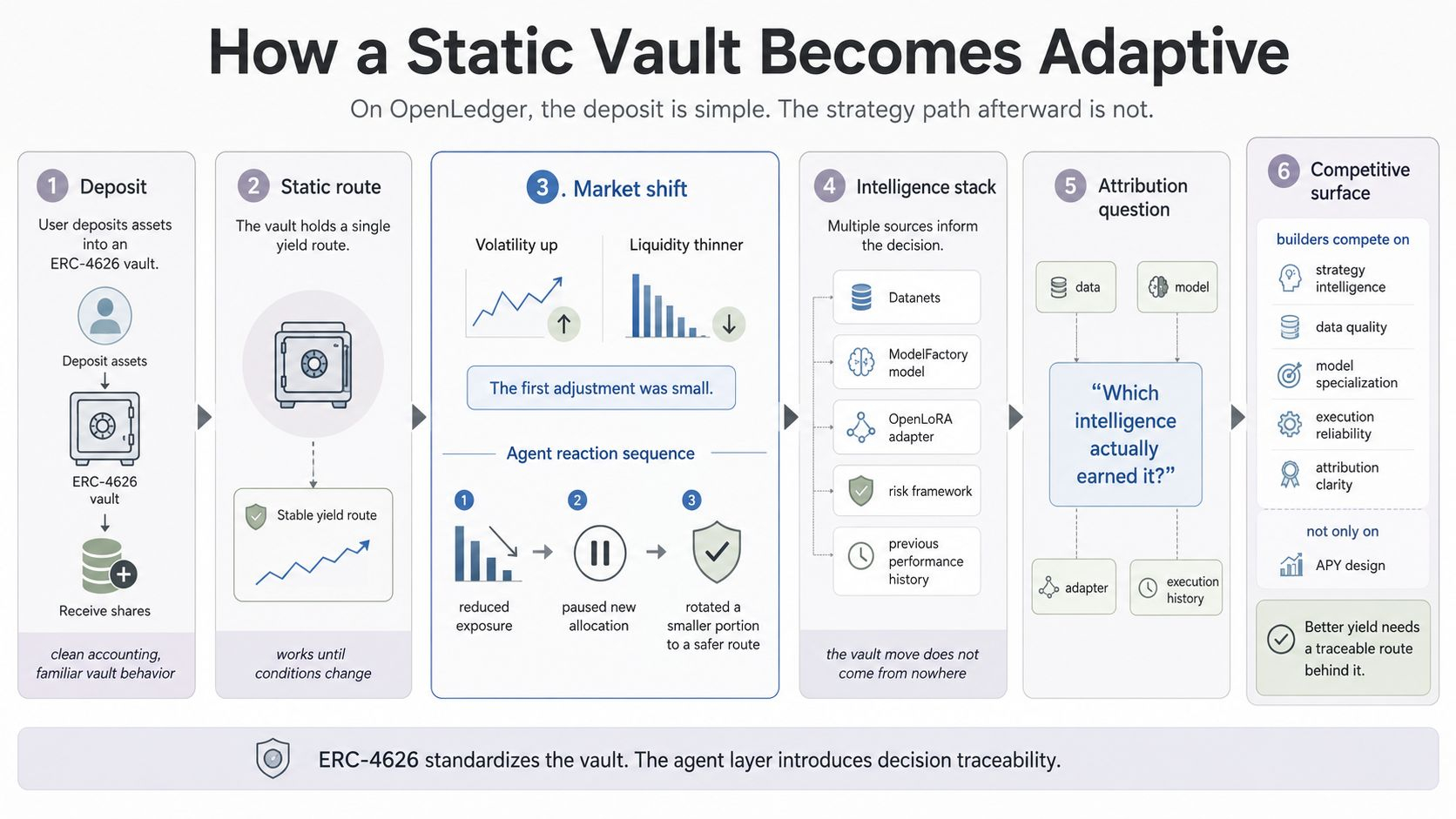
A user moved assets into a vault, received shares back, and the interface showed the kind of clean accounting that usually makes vault activity feel finished. Assets in. Shares out. Yield path selected. Nothing strange on the surface.
That was the first read.
Probably the wrong one.
Because on OpenLedger, the more important activity begins after the vault accepts capital. ERC-4626 gives the vault layer a standard route for deposits, withdrawals, shares, and yield-bearing assets. Useful structure. Clean accounting. Better composability.
But still static if nothing intelligent enters the path.
The pressure starts when an AI trading agent begins operating around that vault logic.
Not as a dashboard comment. Not as a signal pasted beside the vault. The agent becomes relevant when market conditions, liquidity changes, risk bands, and strategy decisions start touching the allocation path itself.
The first adjustment was small.
The vault had been holding most of its exposure in one yield route because the spread looked stable. Then volatility moved. Liquidity thinned on one side. The agent did not fully exit. It reduced exposure, paused new allocation into that route, and rotated a smaller portion toward a safer yield-bearing position until the signal stabilized again.
Nothing dramatic.
No big “AI changed everything” moment.
Just a vault that did not keep behaving like yesterday’s conditions were still true.
That is where ERC-4626 becomes more interesting on OpenLedger. The vault still keeps the familiar structure. Deposits, shares, assets, withdrawals. But around that structure, AI trading agents can begin reading inputs that are not native to the vault contract itself.
Market data.
Strategy models.
Specialized datasets.
Risk signals.
Historical execution outcomes.
Whatever the vault uses, the route becomes harder to treat as passive.
At first, it is tempting to say the agent “optimizes” the vault.
That word is too clean.
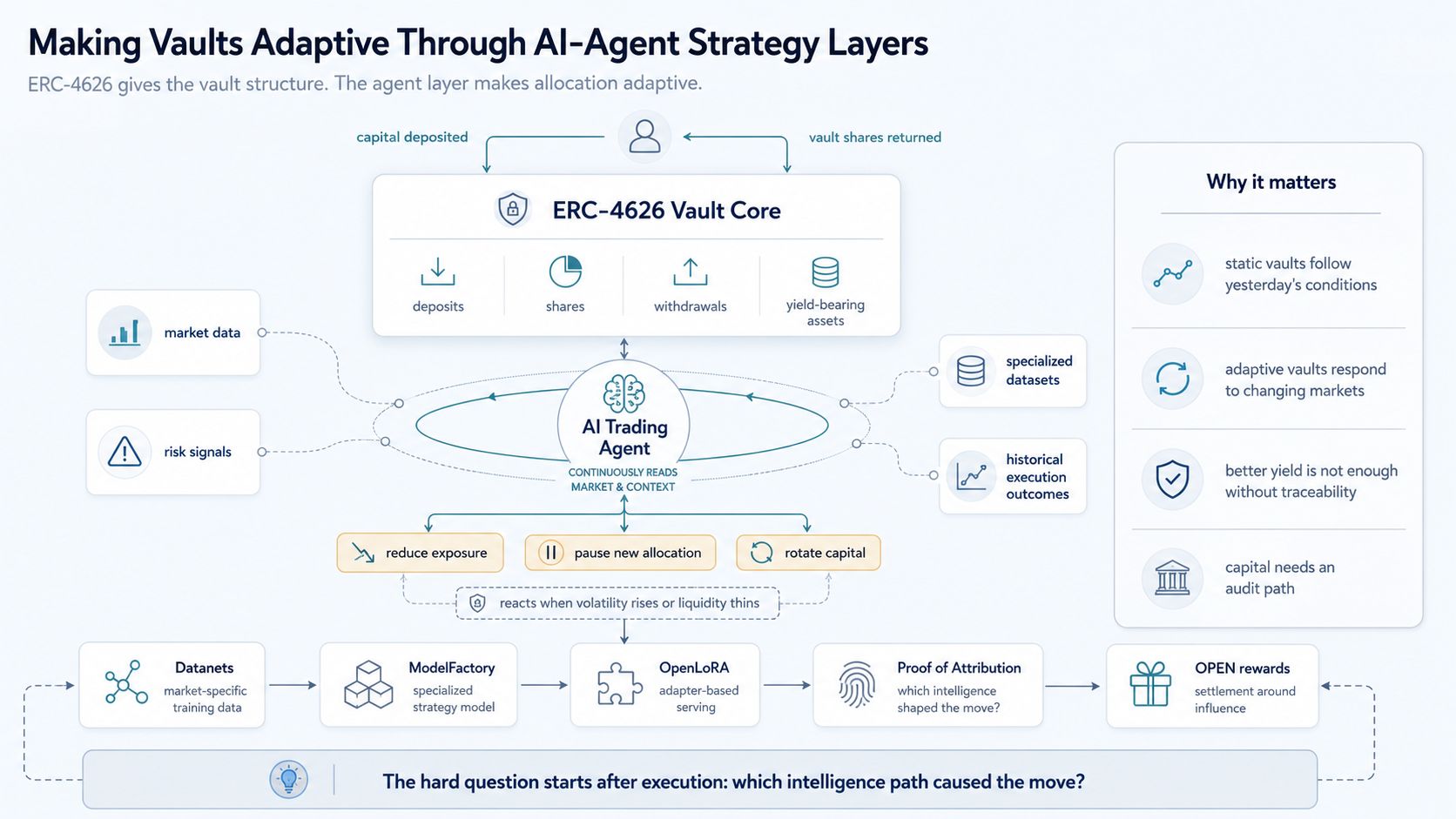
Optimization sounds like one neat improvement. The actual workflow is messier. A trading agent may reduce allocation because a signal weakened. It may rotate capital because another route offers better risk-adjusted yield. It may pause because the model is uncertain. Some decisions will look correct only later. Some will be defensible but not profitable. Some will need attribution even when the outcome is not simple.
Inside OpenLedger, that makes the vault action more than capital management.
It becomes an attribution problem.
The agent may have relied on Datanets for market-specific training data. It may have used a specialized model created through ModelFactory. It may have served a strategy adapter through OpenLoRA instead of running a heavy standalone model every time. Each of those layers can influence the decision before capital moves.
So when the vault changes exposure, the value path should not end with the agent’s output.
Inside OpenLedger, Proof of Attribution becomes relevant because the execution may have multiple upstream sources. A trading agent does not produce a vault adjustment from nowhere. The decision may reflect a dataset, a model, an adapter, a risk framework, or previous performance history. If the vault earns from that decision, the system has to ask which inputs shaped the execution enough to deserve recognition.
That question sounds administrative until capital is involved.
Then it becomes economic.
Because adaptive vaults create recurring activity. They do not use intelligence once. They keep reading, adjusting, routing, and reacting. If that loop produces yield, contributor impact cannot be treated like a one-time upload event. A Datanet that improves the trading model may keep influencing vault behavior. A ModelFactory-built model may keep guiding allocation. An OpenLoRA adapter may keep making the strategy cheaper to serve.
Not every contribution deserves weight.
Not every signal proves useful.
Not every model decision improves yield.
But on OpenLedger, the workflow can keep the question visible: what actually influenced the execution?
That is the difficult part.
ERC-4626 standardizes the vault interface, but it does not automatically explain why a strategy moved the way it moved. It tells the market how the vault handles assets and shares. It gives composability. It gives cleaner integration with DeFi routes. But the agent layer introduces another demand: decision traceability.
A user can understand that assets entered a vault.
A builder can understand that shares represent a position.
A protocol can track deposits and withdrawals.
But when an AI trading agent reduces exposure, pauses allocation, or rotates capital, the harder question appears after the transaction: which intelligence path caused the move?
Inside OpenLedger, the answer has to pass through more than the vault contract. The Datanet route matters if specialized data shaped the model. The ModelFactory route matters if the strategy came from a trained vertical model. The OpenLoRA route matters if adapter-based serving made frequent execution viable. Proof of Attribution matters if the resulting value has to connect back to the contributors, models, and data sources that helped create it.
That makes OPEN rewards more than a simple incentive layer.
They become part of the settlement around influence. If an adaptive vault generates value through agentic execution, rewards can reflect more than who deposited capital. They can also recognize the upstream intelligence that made the execution better.
And that changes the competitive surface.
Vault builders are not only competing on APY design anymore. They are competing on strategy intelligence, attribution clarity, data quality, model specialization, and execution reliability. A vault with a standard ERC-4626 structure can plug into DeFi flows, but the agentic layer decides whether the vault stays reactive or becomes adaptive.
There is risk in that.
A static vault can be limited, but its logic is easier to inspect. An adaptive vault may perform better, but its decisions can become harder to explain if the intelligence stack is not traceable. Better yield is not enough if the route behind it becomes unclear. Capital does not only need movement. It needs an audit path.
So the deposit looked simple because ERC-4626 made the vault legible.
The unresolved part begins later, when the agent changes exposure and the vault has to prove not only what it earned, but which intelligence actually earned it.
