
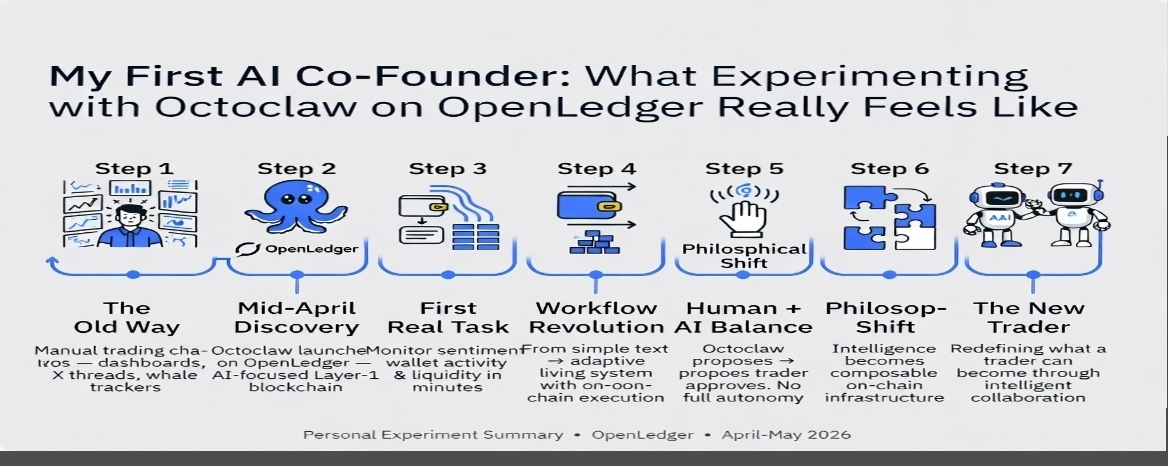
A few months ago, I would’ve laughed if someone told me an AI agent could become part of my daily trading workflow. Not just a chatbot. Not another market scanner. An actual operational partner. But after spending weeks experimenting with Octoclaw on OpenLedger, I’m starting to understand why the conversation around AI agents is changing so fast inside crypto.
I began testing it seriously in mid-April while tracking volatility across mid-cap AI tokens. The market was noisy. Sentiment changed every hour. Liquidity rotated fast. Like many traders, I was spending too much time jumping between dashboards, X threads, whale trackers, Discord groups, and on-chain data tools. It felt inefficient. So I decided to try something different.
That was my first real interaction with Octoclaw.
OpenLedger positions itself as an AI-focused layer-one blockchain where data, models, and autonomous agents can operate directly on-chain. In simple terms, the network is trying to make AI systems verifiable, programmable, and economically connected to blockchain infrastructure instead of keeping them trapped inside closed platforms. That idea sounds abstract at first. Honestly, I thought the same thing.
Then I started using it.
I gave Octoclaw a practical task instead of a theoretical one. I asked it to monitor sentiment around a few AI and DeFi assets, compare wallet activity, and flag unusual movements that matched my risk profile. Within minutes, it aggregated social signals, cross-checked large wallet transactions, and mapped liquidity behavior faster than I normally could manually.
What surprised me wasn’t the speed.
It was the workflow.
Most AI tools still behave like advanced search engines. You ask a question. They return text. The interaction ends there. Octoclaw felt different because the process continued. The agent adapted based on updated information and structured the output in a way that could connect directly with on-chain execution logic.
That changes the role of AI completely.
OpenLedger has been gaining attention recently because the broader market is moving beyond simple chatbot narratives. Investors are now looking at “agentic AI” systems models capable of taking actions, coordinating workflows, and interacting with decentralized infrastructure. Since early 2026, AI-agent related projects have consistently remained among the most discussed sectors across crypto communities.
Still, this is where reality matters more than hype.
There’s a huge difference between a compelling demo and a system traders can actually rely on during volatile market conditions. During my own testing, I noticed that AI-generated insights sometimes looked mathematically correct but ignored liquidity depth or macro sentiment shifts. One signal even suggested a rotation that made sense statistically but failed once sudden Bitcoin weakness changed market psychology.
That moment reminded me of something important.
AI does not understand conviction the way experienced traders do.
It processes patterns. It predicts probabilities. But it doesn’t truly feel fear, uncertainty, or crowd behavior during stress events. Human judgment still matters. Maybe more than people expect.
That’s why I never allowed the agent to operate autonomously with unrestricted execution. Octoclaw proposed scenarios. I reviewed them. Human oversight remained central to the process.
And honestly, I think that balance is where the real future exists.
Not humans versus AI.
Humans working with AI systems that extend analytical capacity.
OpenLedger’s architecture becomes interesting from that perspective. The project focuses heavily on provenance, meaning actions and outputs can be verified on-chain instead of existing as invisible black-box processes. For traders and developers, that matters because trust becomes measurable rather than assumed.
Of course, risks remain everywhere.
Smart contract vulnerabilities still exist. Model hallucinations are still possible. Gas costs can still spike unexpectedly during periods of network congestion. Regulatory uncertainty around autonomous agents also hasn’t disappeared. Even the best AI systems can fail during chaotic market conditions because crypto markets are emotional systems disguised as financial systems.
That part rarely gets discussed enough.
The current AI narrative inside crypto often focuses on productivity and automation. But after weeks of experimentation, I think the deeper shift is philosophical. We are slowly moving toward an environment where intelligence itself becomes composable infrastructure.
Data becomes an asset.
Models become economic participants.
Agents become operational collaborators.
That idea changes how we think about ownership in Web3.
Years ago, DeFi changed how capital moved on-chain. Today, projects like OpenLedger are exploring how intelligence might move on-chain in a similar way. Maybe this trend succeeds. Maybe parts of it fail completely. Crypto history is filled with experiments that looked revolutionary before collapsing under reality.
But ignoring the direction entirely feels dangerous.
I’ve now spent more than a month testing Octoclaw inside my research workflow. Some days the insights genuinely improve my decision-making. Other days the limitations become obvious very quickly. Yet even those failures teach something valuable about where the industry is heading.
The truth is simple.
AI agents are no longer just speculative narratives. They are gradually becoming infrastructure.
And infrastructure matters long after hype disappears.
Maybe that’s the biggest lesson from this experiment. The future of crypto may not belong only to the fastest trader or the largest institution. It may belong to the people who learn how to collaborate intelligently with machines while still understanding the emotional reality of markets.
I’m still skeptical. I’m still testing. But one thing feels increasingly clear to me now.
OpenLedger and systems like Octoclaw are not trying to replace human traders.
They are trying to redefine what a trader can become when intelligence itself becomes part of the network.
