
In TradFi, this means embedding stablecoins into:
Core banking APIs, Payment gateways, ERP systems, and Central bank regulatory frameworks
In DeFi, it requires:
Smart contract operability, Protocol liquidity (e.g., Curve, Aave, Compound), Wallet compatibility and on-chain utility
The true value lies in building a stablecoin that not only operates on-chain but also settles real-world transactions, complies with local laws, and interoperates with institutional infrastructure. This is stablecoin development for enterprises, not experiments.
Build a stablecoin that unites TradFi and DeFi
Launching a stablecoin that serves both TradFi and DeFi audiences is no small feat. You’ll need a strong legal structure, a well-audited smart contract system, a clear peg mechanism, and a compliance-first framework that aligns with evolving global regulations. But technical readiness isn’t enough. Your stablecoin must also be usable, integrated into wallets, DeFi protocols, payment rails, and real-world services from day one.
Antier brings all of that together. As a stablecoin development company with global delivery experience, we build compliance-ready, scalable stablecoins tailored to enterprise, institutional, and government-grade use cases. Let’s design the future of programmable money, together!
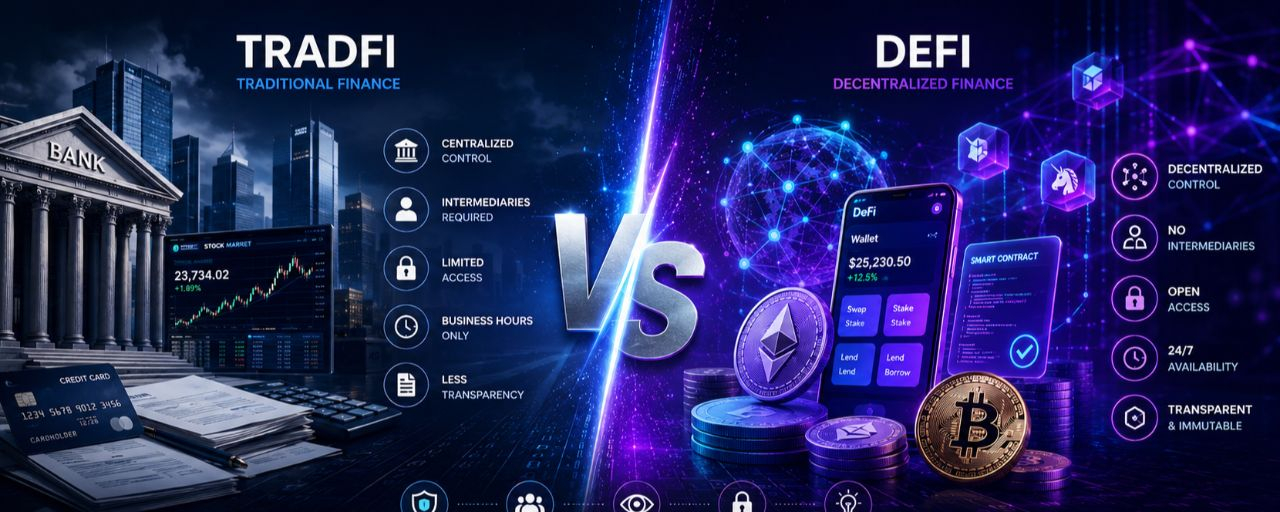
Key Differences Between TradFi and DeFi:
Centralization: TradFi is based on centralized institutions like banks and regulatory bodies, while DeFi operates on decentralized networks, where smart contracts replace intermediaries, providing a trustless financial ecosystem.
Accessibility: TradFi often has high barriers to entry, limiting access to financial services, especially for the “unbanked” population. DeFi, on the other hand, is open to anyone with an internet connection, fostering inclusivity and financial access.
Regulation: TradFi systems are subject to heavy regulation and legal compliance, requiring users to adhere to KYC (Know Your Customer) and AML (Anti-Money Laundering) protocols. DeFi bypasses these regulatory bodies, giving users greater freedom in managing their assets, though this lack of oversight can also introduce certain risks.
While TradFi offers stability and regulation, it can be restrictive and less transparent. DeFi, by eliminating intermediaries, aims to provide more financial freedom and accessibility, but also comes with its own set of risks due to the absence of centralized control.
#TradFi #TradFiToDeFi . #DeFi