I didn’t take it seriously at first. Maybe because I’ve spent too many years watching infrastructure narratives arrive dressed as inevitabilities. Decentralized storage was going to matter. Then indexing layers. Then modular stacks. Then coordination protocols for things most normal people never think about and probably never will.
The language always sounds clean in the beginning. Open systems. Shared incentives. Neutral rails.
Then humans enter the equation slowly, and everything starts bending around money.
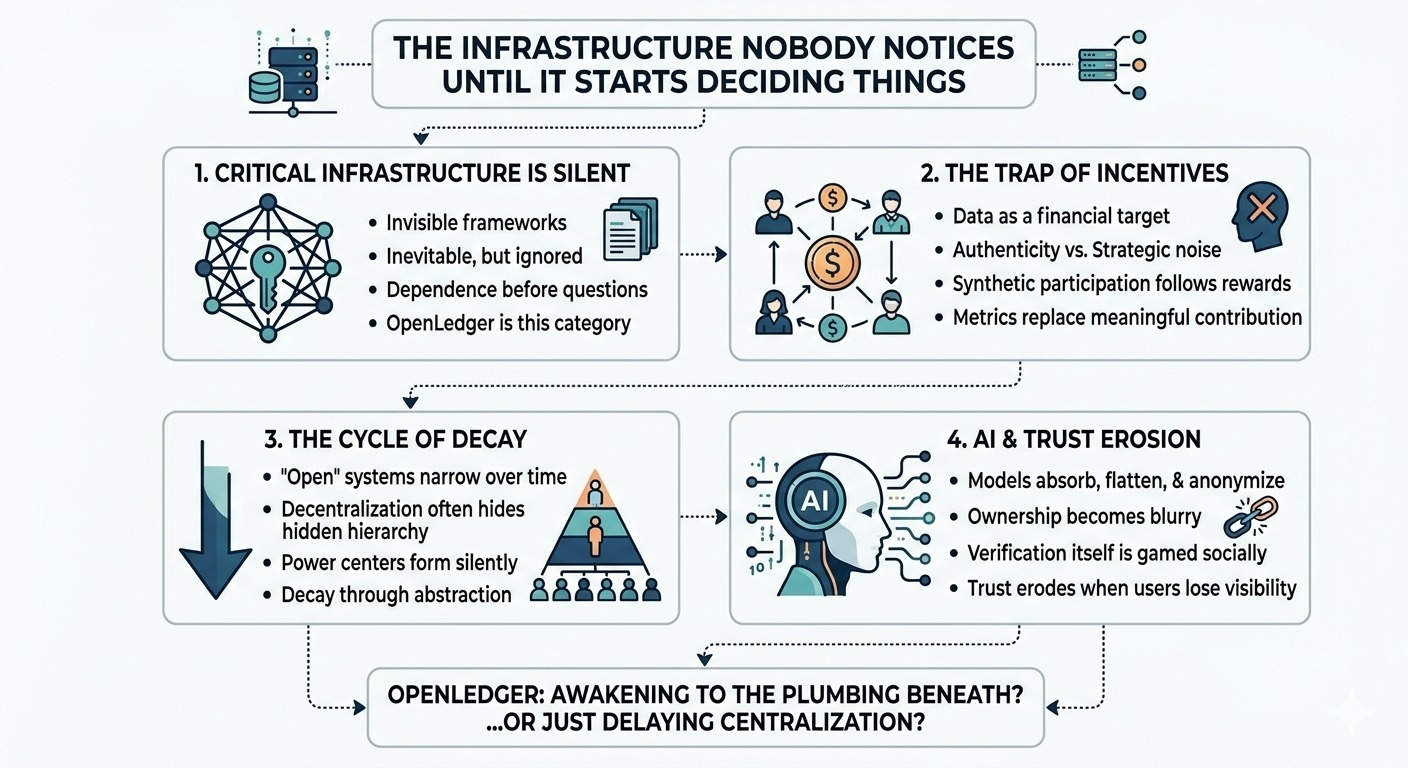
OpenLedger ended up sitting in that category of projects I tried to ignore but kept reopening tabs for anyway. Not because I thought it would “win.” I don’t even know what winning means anymore in crypto infrastructure. Most systems survive by becoming invisible enough that nobody asks hard questions until dependence has already formed.
And this one touches a nerve people still underestimate: who actually contributed to an AI system, and whether that can still be measured once value starts flowing through it.
That part sounds obvious until you sit with it for a while.
Because attribution in AI feels morally intuitive right now. Of course contributors should be recognized. Of course datasets shouldn’t become anonymous extraction pools feeding centralized models forever. Of course there should be some way to trace participation, ownership, influence. But I keep coming back to what happens after scale arrives. After optimization begins.
It works in theory. Most things do.
The problem isn’t really the technology. It’s the behavioral gravity around incentives. Once data becomes financialized, people stop contributing naturally. They contribute strategically. Metrics become targets. Provenance becomes performative. Suddenly the system designed to surface meaningful participation starts attracting synthetic participation instead.
Crypto already taught this lesson years ago, just in different forms. Liquidity mining looked elegant until it became industrialized. Governance sounded democratic until voter concentration hardened quietly in the background. Even supposedly decentralized infrastructure usually ends up orbiting a small number of operators with enough capital, enough tooling, enough time.
“Open” systems have a strange habit of narrowing over time.
Maybe that’s too harsh. But I’ve watched enough coordination layers decay slowly to stop believing openness is a stable condition. It’s usually temporary. Or conditional.
And AI makes this worse because the infrastructure itself is hungry. Models absorb everything they can. Human contribution gets flattened into training material, statistical weight, inferred patterns. Somewhere in that process, ownership becomes blurry in a way that feels economically convenient for almost everyone except contributors.
That’s where things start to feel uncomfortable.
Because projects circling around attribution and verifiable contribution are really trying to solve something deeper than tracking data lineage. They’re trying to preserve trust under conditions where trust naturally erodes. That’s a much harder problem.
I keep thinking about what happens when verification itself becomes gamed. Not technically. Socially. At scale.
How do you distinguish meaningful contribution from optimized noise once enough money depends on pretending they’re equivalent? How many layers of validation need to exist before the validators themselves become power centers? And if coordination systems rely on reputation, staking, delegated trust, or economic weighting, aren’t we just rebuilding hierarchy slowly under different terminology?
That part keeps bothering me more than it should.
Because I don’t think most infrastructure failures happen dramatically anymore. They happen quietly through abstraction. Users stop seeing where data comes from. Operators stop explaining incentives clearly. The system keeps functioning, technically speaking, while trust degrades underneath it.
And to be fair, OpenLedger at least seems aware of the invisible layer most projects avoid discussing. Not just AI outputs. The plumbing underneath. The contribution trails. The coordination mechanisms between humans and models and economic incentives that don’t naturally align for very long.
Still, I can’t tell whether systems like this actually resist centralization or simply delay it in more sophisticated ways.
Maybe that uncertainty is the point. Or maybe it’s just what years around crypto infrastructure eventually does to your brain after enough “open” systems quietly stop feeling open at all.