

The more I look at OpenLedger, the more I feel people are still reading it through the wrong lens. Most of the market sees AI crypto and immediately thinks about prediction, price calls, trading bots, or some dashboard that tells you what already happened. But to me, $OPEN is moving toward something more practical and honestly more important: AI execution with accountability behind it.
That is why the OctoClaw launch matters. It is not just another AI feature added for hype. OctoClaw is being presented as an intelligent agent for real-time automation of on-chain workflows, and that changes the conversation from “AI can analyze” to “AI can actually act.” Recent coverage described OctoClaw as OpenLedger’s agent solution for automating on-chain workflows in real time, combining automation, orchestration, and execution inside Web3 environments.
The Market Is Moving From Prediction To Execution
Most AI trading discussions still focus too much on prediction. Can AI call the next move? Can it detect the next pump? Can it read sentiment faster than humans? That part is useful, but I do not think it is the full edge anymore.
On-chain markets are fragmented. Liquidity is spread across different DEXs, chains, bridges, pools, routing paths, and execution venues. A good signal means nothing if the execution is slow, expensive, exposed to MEV, or broken halfway through the transaction flow.
This is where AI agents become interesting. A human trader can watch charts and make decisions, but an agent can monitor signals, liquidity, slippage, risk limits, venue conditions, and execution feedback at the same time. The edge is not only knowing what to do. The edge is doing it faster, cleaner, and with fewer mistakes.
For me, this is where OpenLedger’s direction makes sense. It is not just building around AI data. It is moving toward verifiable AI agents that can operate inside real financial environments. OpenLedger’s partnership with Theoriq was specifically framed around bringing verifiable AI agents into live DeFi markets, with a focus on turning AI agents from opaque systems into accountable financial actors.
Why Execution Needs A Trust Layer
The problem with autonomous on-chain execution is simple: speed can become dangerous if there is no validation around it.
An AI agent moving funds or routing trades across DeFi cannot just be fast. It has to be protected. It has to understand smart contract risk, oracle manipulation, failed execution logic, MEV exposure, abnormal market behavior, and liquidity traps. Otherwise, automation becomes another attack surface.
That is why the idea of vulnerability mitigation fits perfectly into the OpenLedger thesis for me.
What people see on the surface is seamless agent execution. But underneath, the real infrastructure has to constantly validate every move. An autonomous trading agent needs anomaly detection, deterministic validation, decentralized oracle aggregation, encrypted transaction routing, and proper risk constraints. Without that defensive layer, agentic execution is not infrastructure. It is just a faster way to make mistakes.
This is also why OpenLedger’s broader architecture matters. Its core system is built around Datanets, ModelFactory, OpenLoRA, and Proof of Attribution, creating a stack where data, models, and AI outputs can be connected instead of staying hidden inside a black box. CoinMarketCap’s recent explainer describes OpenLedger as using Datanets for data, ModelFactory for training, OpenLoRA for deployment, and Proof of Attribution to connect datasets with model outputs and rewards.
Where $OPEN Fits Into This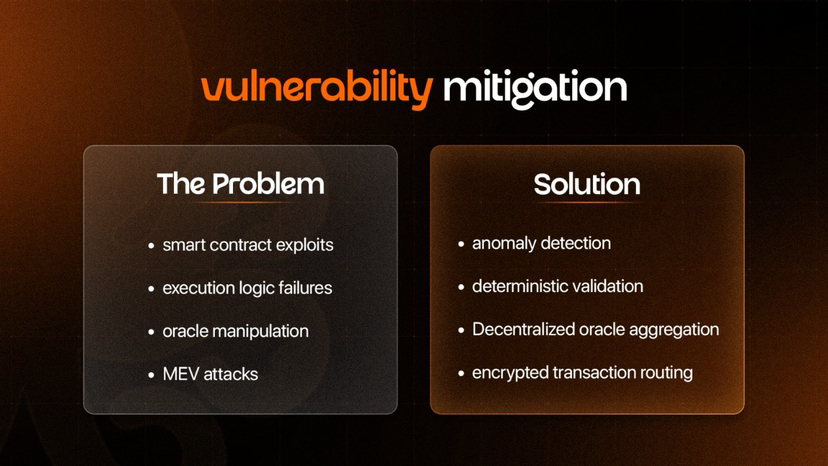
The reason I keep coming back to $OPEN is because the token is not only sitting beside the product. It is connected to the economic layer of the network.
OpenLedger’s tokenomics describe token powering interactions across the OpenLedger AI blockchain, including Proof of Attribution rewards. That means the token sits inside the loop of data contribution, AI model usage, attribution, and reward distribution.
This is important because many AI tokens have a weak connection between the token and the actual product. The project may sound strong, but the token does not always capture real network activity. With $OPEN, the stronger thesis is that if more datasets, models, agents, and execution systems use OpenLedger infrastructure, then attribution and reward flows become part of the token’s relevance.
I am not looking at only as an AI hype trade. I am looking at it as a bet on whether AI systems will need a trust and ownership layer as they become more active on-chain.
And honestly, I think they will.
OctoClaw Shows Where OpenLedger May Be Heading
OctoClaw feels important because it points toward the next phase of AI agents: not passive assistants, but active execution systems.
A passive AI tool gives you information.
An active AI agent takes action.
A serious AI execution layer proves why that action happened.
That last part is where OpenLedger’s Proof of Attribution becomes valuable. If agents are going to make decisions, route trades, manage workflows, and interact with smart contracts, then the network needs a way to track what data influenced those actions and which models contributed to the result.
This matters even more in trading. Imagine an AI agent pulling from market data, on-chain liquidity, sentiment, volatility signals, and strategy rules. If that agent executes a trade, I want to know what influenced the decision. Was it a clean signal? Was the data reliable? Was the route chosen because of better liquidity? Was the execution protected from MEV? Was there any abnormal oracle behavior?
That is the difference between blind automation and accountable automation.
OpenLedger’s Algebra integration also supports this direction because it added native multi-DEX trade execution capabilities for AI agents, allowing them to analyze liquidity across multiple DEXs, infer routes, and execute trades end-to-end.
AI Trading Agents Need More Than Speed
A lot of people think the future of AI trading is just faster bots. I do not fully agree.
Speed matters, but speed alone is not enough. If an agent is fast but uses bad data, it loses. If it is fast but exposed to MEV, it loses. If it is fast but cannot handle failed transactions, it loses. If it is fast but cannot explain its decision path, institutions will not trust it.
That is why the next real edge may come from the full execution stack:
signal ingestion, risk controls, routing logic, cross-venue coordination, continuous feedback, and vulnerability mitigation.
That is also why the images around AI trading agents and vulnerability mitigation match this OpenLedger narrative so well. They show what is actually happening beneath the surface. The agent is not just clicking buy or sell. It is receiving market data, on-chain data, sentiment data, and strategy signals, then passing through risk limits, exposure controls, slippage guardrails, and position limits before execution.
That is how serious on-chain automation should work.
The Bigger OpenLedger Thesis
To me, OpenLedger is becoming more interesting because it sits between three major shifts happening at the same time.
First, AI is moving from content generation into execution.
Second, DeFi is becoming too fragmented for manual users to manage efficiently.
Third, the market is starting to care more about where AI decisions come from.
That third point is the most important.
If AI agents are going to operate in financial markets, then provenance matters. Attribution matters. Data quality matters. Model transparency matters. Execution records matter. The future will not just ask, “Did the agent make money?” It will ask, “Can we verify why the agent made that move?”
That is where OpenLedger’s positioning feels strong. It is not only trying to be another DeFAI tool. It is trying to become part of the coordination and accountability layer for AI systems.
The Risk Is Still Real
I do not want to make this sound like everything is already solved.
Autonomous agents on-chain are risky. Smart contracts can fail. Oracles can be manipulated. MEV can damage execution. Agents can make bad assumptions. Data can be low quality. Attribution can be gamed if incentives are not designed properly.
This is the hard part for OpenLedger. It has to prove that its infrastructure can scale without becoming noisy, exploitable, or too complex for real builders.
The opportunity is big, but the execution standard also has to be high. If OpenLedger wants to support agentic finance, then it needs strong security assumptions, real developer adoption, good data quality, and reliable attribution.
That is why I see as a thesis to track over time, not something to judge from one headline or one launch.
My Final Take On $OPEN
The OctoClaw launch made me look at OpenLedger differently.
Before, the project was already interesting because of Datanets and Proof of Attribution. But now the direction feels clearer. OpenLedger is not only about AI data ownership. It is moving toward AI agents that can act, execute, coordinate, and eventually become part of real on-chain workflows.
That is a much bigger market than simple prediction tools.
The future of DeFi will not be only manual trading. It will be agents reading signals, managing risk, routing execution, and learning from feedback. But those agents will need something underneath them: attribution, validation, security, and accountability.
That is the layer OpenLedger is trying to build.
So for me, it is worth watching because it sits close to the future direction of AI in crypto. Not just AI that tells users what might happen, but AI that can execute while proving where its intelligence came from.
And if that shift really plays out, @OpenLedger could become much more than another AI narrative.
It could become part of the infrastructure behind accountable on-chain automation.