
Bitcoin used to feel simple.
That is probably the biggest reason so many people trusted it in the first place. A decentralized currency with a fixed supply, no central authority, and a network strong enough to survive governments, bans, crashes, and endless predictions of death. For years, the core idea behind Bitcoin felt almost untouchable. You bought it because the system itself felt safer than the traditional financial world around it.
But after watching this market closely for years, I think something has changed.
Not with the code itself. Bitcoin still works exactly as designed. Blocks continue to arrive. The supply remains capped. The network is still one of the most secure digital systems ever created. The problem is that Bitcoin no longer exists in the same environment it was created for.
That is the part many people still underestimate.
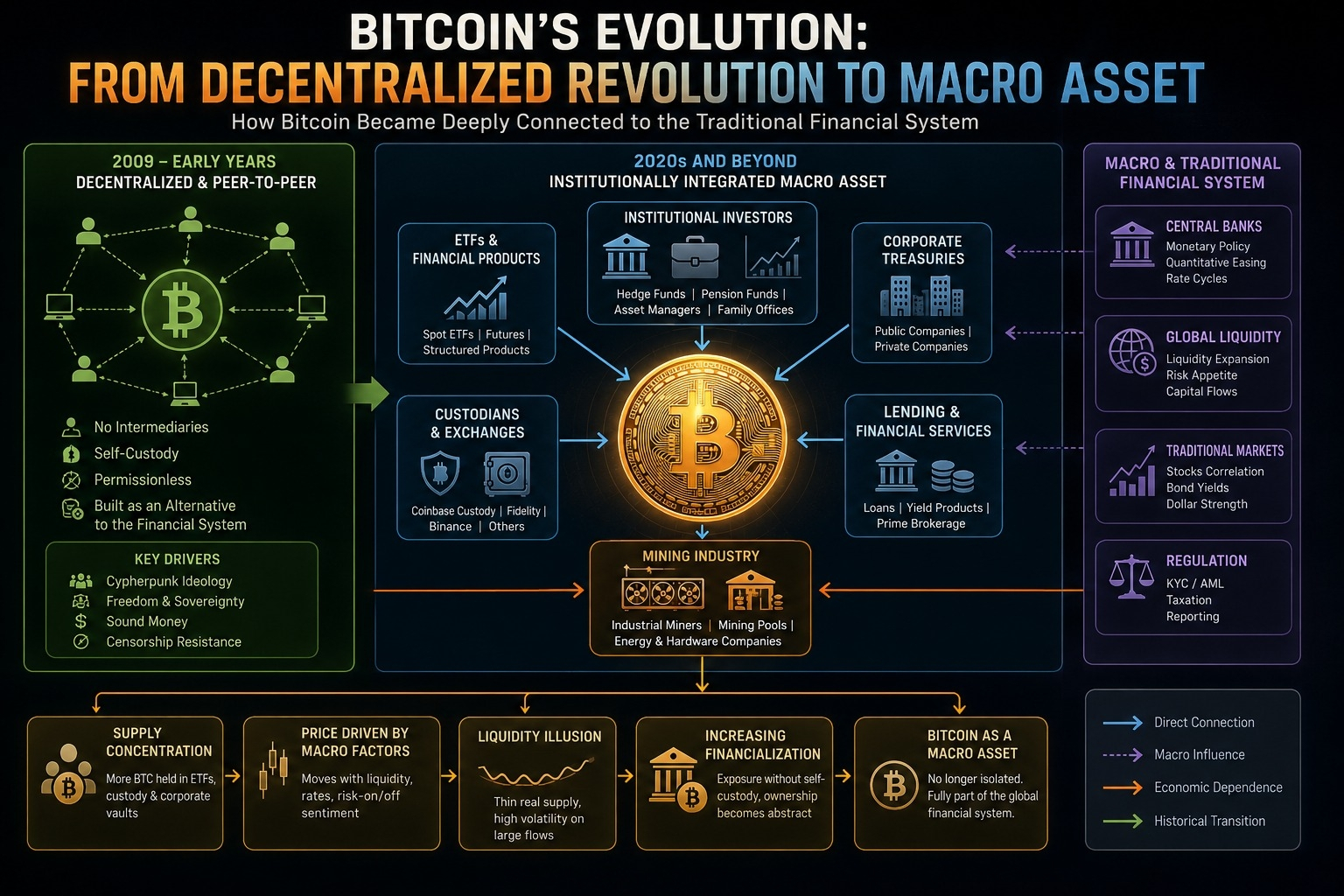
Bitcoin was originally built as an alternative to the financial system. Today, it is increasingly becoming absorbed into that system. And while that adoption has pushed prices higher, it has also introduced a different kind of risk that most retail investors barely talk about.
I think the biggest misunderstanding in crypto right now is the idea that institutional adoption automatically makes Bitcoin safer.
In some ways, it does. Large institutions bring liquidity, infrastructure, custody solutions, regulatory clarity, and long-term capital. Spot ETFs changed Bitcoin permanently because they opened the door for pension funds, hedge funds, and traditional asset managers to enter the market without touching private wallets or exchanges directly. That created demand on a scale crypto had never seen before.
But the deeper I watch this happen, the more I notice that Bitcoin is slowly drifting away from the decentralized culture that originally gave it value.
The uncomfortable truth is that a massive percentage of Bitcoin is now being held inside centralized structures. ETFs, custodians, corporate treasuries, and institutional vaults are becoming dominant holders of supply. On paper, Bitcoin remains decentralized. In practice, more coins are being concentrated into fewer hands.
That changes market behavior.
Years ago, Bitcoin felt like a network driven by retail conviction and ideological believers. Today, price movement increasingly reacts to macroeconomic conditions, Federal Reserve expectations, liquidity cycles, bond markets, and institutional positioning. Bitcoin still trades 24/7, but psychologically it behaves more and more like a high-volatility macro asset.
I notice this every time inflation data releases or interest rate expectations shift. Bitcoin no longer moves purely on crypto narratives. It moves because global capital flows move.
That creates a strange contradiction.
Bitcoin was designed to escape dependence on traditional finance, yet today its price depends heavily on traditional finance remaining stable enough for institutions to continue allocating capital into risk assets. When liquidity disappears from global markets, Bitcoin suffers alongside tech stocks and speculative growth assets. That correlation has become difficult to ignore.
Another issue I think people underestimate is the mining economy itself.
Bitcoin’s security depends on miners. That part is obvious. But the economics behind mining are becoming increasingly aggressive. The halving events reduce miner rewards every four years, which means miners become more dependent on high Bitcoin prices and transaction fees to remain profitable.
That sounds manageable during bull markets. It becomes far more dangerous during long periods of stagnation.
Large industrial mining firms now dominate hash power in ways early Bitcoin users probably never imagined. Mining has become a capital-intensive industry requiring enormous infrastructure, energy access, financing, and hardware supply chains. Smaller independent miners continue disappearing because they simply cannot compete.
Again, the network itself still functions. But the economic power inside the network is consolidating.
I think this matters because Bitcoin’s reputation for safety largely comes from the belief that no single group can gain enough influence over the system. Technically, that remains true to a large extent. But economically, the system is becoming far more dependent on powerful entities than many people realize.
Then there is the issue nobody likes discussing during bull cycles: liquidity illusion.
Bitcoin looks incredibly liquid when markets are rising. But underneath the surface, actual tradable supply is often thinner than people think. Long-term holders rarely sell. Institutions lock supply into custodial products. Large wallets sit inactive for years. That creates violent price reactions whenever major selling pressure appears.
This is why Bitcoin corrections still feel brutal despite the market becoming more “mature.”
A mature asset usually becomes less volatile over time because liquidity deepens and speculation stabilizes. Bitcoin has not fully followed that path because so much of its available supply remains structurally illiquid. The result is a market where relatively small waves of panic can still create massive drawdowns.
I also think regulation introduces a more subtle danger than outright bans.
Most governments now understand that banning Bitcoin entirely is unrealistic. The smarter approach is integration. Tax it, monitor it, regulate the entry points, track large transfers, and absorb it into the financial system slowly enough that people stop viewing it as an alternative system altogether.
That may actually be happening already.
The more Bitcoin becomes financialized through ETFs and institutional products, the more ownership becomes abstracted away from self-custody. People gain exposure to price movement without ever interacting with the network itself. They do not run nodes. They do not hold keys. They simply own paper exposure through traditional brokers.
At that point, Bitcoin starts losing part of its original purpose.
I am not saying Bitcoin is doomed. Far from it. In fact, I still think Bitcoin will likely survive longer than most assets people trust today. The network effect is enormous. Its brand recognition is unmatched. Governments, corporations, and institutions now have incentives to keep it alive rather than destroy it.
But survival and safety are not the same thing.
What concerns me is that many newer investors treat Bitcoin as a guaranteed safe haven without understanding the system-level risks now attached to it. They see institutional adoption and assume the volatility, uncertainty, and structural fragility have disappeared. I do not think they have.
They have simply evolved.
Even the narrative around digital gold deserves more scrutiny. Gold became trusted over thousands of years because it maintained purchasing power across civilizations, wars, political systems, and economic collapses. Bitcoin has existed for a relatively short period during one of the most liquidity-driven eras in modern financial history.
Nobody truly knows how Bitcoin behaves during a prolonged global financial restructuring, sovereign debt crisis, or extended period of high real interest rates. We have theories. We have narratives. But we do not yet have historical proof.
That uncertainty matters more than people admit.
I still believe Bitcoin remains one of the most important financial inventions of the modern era. But I no longer think of it as “safe” in the simplistic way crypto culture often describes it. It is resilient, yes. Durable, probably. Scarce, absolutely.
Safe? I am less convinced.
Because the biggest risk to Bitcoin today may not be governments attacking it or developers breaking it. The biggest risk may be that Bitcoin slowly becomes absorbed into the exact financial machine it was originally created to escape.
And if that process continues, we may eventually discover that the system did not need to destroy Bitcoin to neutralize it. It only needed to make Bitcoin dependent on everything it once stood against.
