

I watch what continues without being noticed.
Most infrastructure never becomes visible. The parts that matter usually disappear into routine before anyone decides they matter. I’ve seen entire sectors spend months discussing systems that users moved around instinctively, almost to avoid. The market reacts first. Usage arrives later, or it doesn’t.
OpenLedger sits somewhere inside that familiar delay.
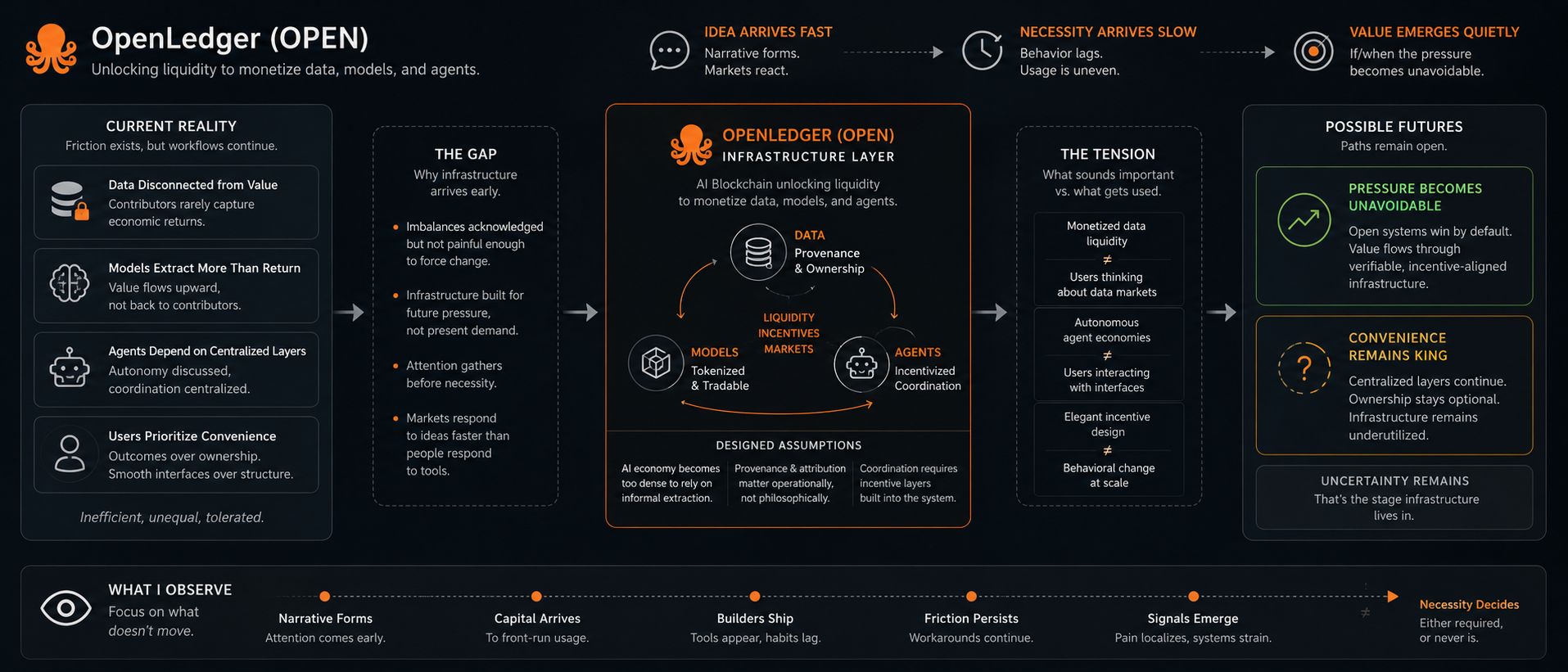
The language around it comes early. Liquidity for data. Models becoming assets. Agents interacting through markets instead of platforms. It sounds inevitable when compressed into headlines. Almost too coherent. The kind of idea people understand immediately because they’ve already heard versions of it before. AI needs coordination. Data needs ownership. Infrastructure needs incentives. The sequence assembles itself faster than the product does.
But behavior stays uneven.
Most people still move through AI the same way they move through everything else: convenience first, abstraction second. They use whatever responds quickly enough. They rarely stop to ask where the model came from, how the data moved, who supplied it, whether the incentives underneath it remain stable. Markets care about those questions long before users do. Sometimes years before.
That gap matters more than the architecture itself.
I keep noticing how quickly attention gathers around systems designed for future pressure. Not present demand. OpenLedger feels close to that condition. Built around assumptions that may eventually become unavoidable, but aren’t painful enough yet to force adaptation. There’s always tension there. Infrastructure waiting for a problem large enough to justify it.
And still, the idea persists.
Because there is friction underneath the current model economy. Quiet friction. Data contributors remain disconnected from value capture. Models consume more than they return. Agents are discussed as autonomous participants while depending almost entirely on centralized environments. Everyone acknowledges the imbalance, but most workflows continue anyway. People tolerate inefficient systems longer than expected when the interface remains smooth.
So the chain becomes conceptual before it becomes necessary.
I’ve watched this happen before with storage, with compute, with interoperability. Narratives form around eventual dependency. Capital arrives to front-run usage. Communities speak in completed tense about systems still searching for recurring behavior. Sometimes they’re right. Sometimes the infrastructure spends years waiting for a reality that stabilizes somewhere else entirely.
What keeps OpenLedger interesting is not adoption. Not yet. It’s the direction of the pressure.
The project assumes that AI eventually becomes too economically dense to operate through informal extraction alone. That data provenance starts mattering operationally, not philosophically. That agents require coordination layers with incentives embedded directly into them. Maybe that happens slowly. Maybe users never see it happening at all. The most important systems usually arrive that way — absorbed into process before they become culturally visible.
But there’s another possibility I can’t ignore.
The tooling around AI may continue consolidating upward instead of outward. Convenience may outperform openness indefinitely. Users may never care enough about ownership structures to change behavior. Markets often mistake structural elegance for inevitability. A system can make perfect sense and still remain optional.
I don’t think the uncertainty weakens the project. It defines it.
What I notice now is how much of the conversation exists ahead of demonstrated necessity. People speak about monetized agents and data liquidity as if the behavioral layer already changed. It hasn’t. Most users are still interacting with interfaces, not ecosystems. They want outcomes, not participation rights. Infrastructure projects tend to overestimate when that transition occurs.
Still, I keep watching the quieter signals. What developers tolerate. What they rebuild repeatedly. Where incentives break under scale. What becomes expensive to coordinate manually. Those shifts appear long before the broader market recognizes them.
OpenLedger feels positioned inside that waiting period. Not fully demanded. Not irrelevant either.
Just present.
And sometimes that’s the only stage where
 infrastructure can actually be understood.