
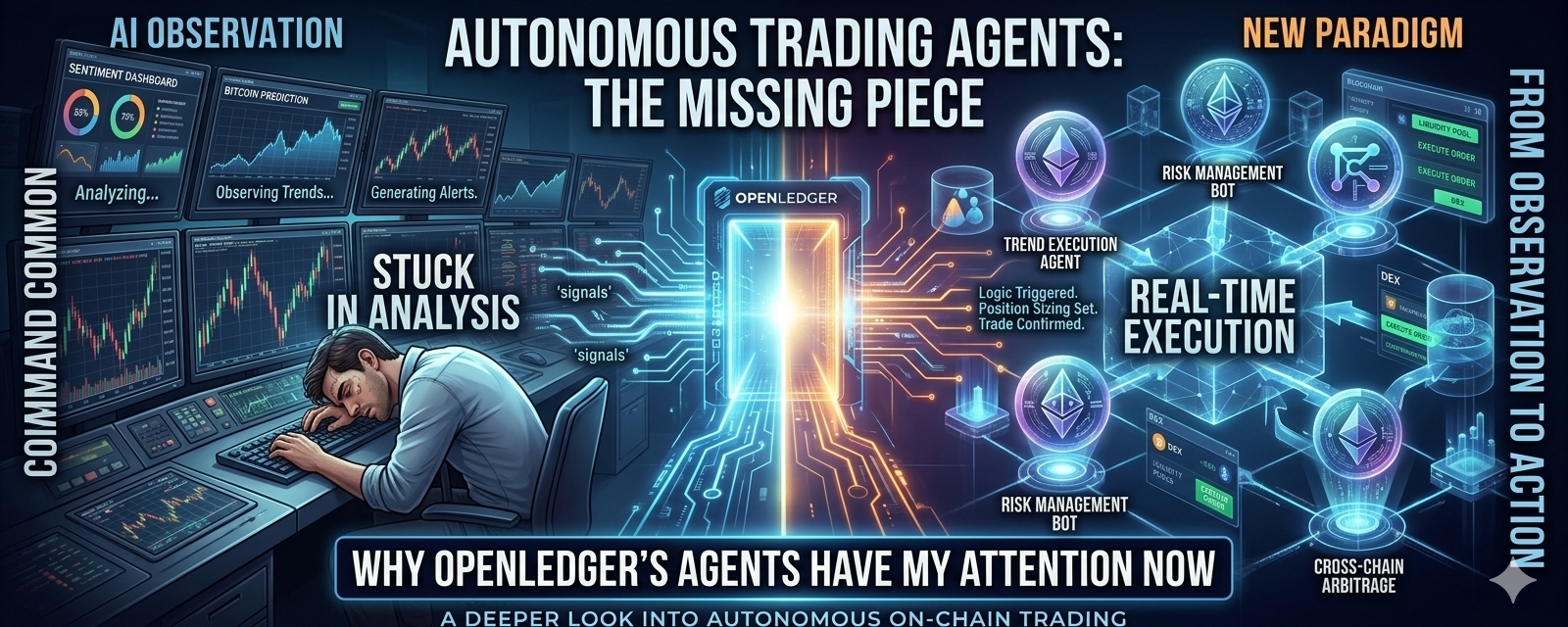
Every crypto cycle finds a new obsession. This time it’s AI. The space is flooded with projects promising smarter trading, predictive analytics, sentiment dashboards, automated market insights, and AI-generated strategies. But after looking through dozens of them, most feel like different versions of the same thing. They analyze, summarize, and observe — but they stop right before the part that actually matters. Execution.
That’s the reason OpenLedger caught my attention differently.
What interested me wasn’t another AI assistant telling traders what Bitcoin “might” do next. We already have enough tools repeating the same signals in different formats. What stood out was the idea of autonomous trading agents that can actually operate on-chain based on predefined logic. That changes the conversation completely. Instead of just helping traders interpret markets, the system starts helping them act inside those markets in real time.
That matters more than most people realize.
A huge percentage of missed opportunities in trading don’t happen because the setup was wrong. They happen because timing failed. The breakout happens while you’re asleep. The retest comes when you’re away from the screen. The perfect entry disappears during the few minutes it takes to confirm funding, check liquidity, calculate risk, and finally hit execute. By the time everything lines up, the move is already stretched.
That’s the gap autonomous agents could realistically solve.
Imagine having a system watching specific conditions you already defined yourself. It waits for structure confirmation, checks volatility, executes position sizing based on your own risk parameters, and exits automatically if market conditions invalidate the setup. That doesn’t replace the trader. It extends the trader’s presence beyond the hours they can physically monitor charts.
And honestly, the timing for this technology finally makes sense now.
Two cycles ago, this kind of infrastructure still felt unreliable. Gas spikes were unpredictable, RPC stability was inconsistent, cross-chain execution was messy, and autonomous systems felt too fragile for real trading environments. But crypto infrastructure matured quietly while attention stayed focused elsewhere. Faster finality, cheaper execution layers, stronger oracle systems, and improvements around account abstraction changed the environment significantly. The foundation now exists for autonomous systems to actually function in a way that feels usable instead of experimental.
That’s why OpenLedger pushing into this category feels early in the right way, not early in the unrealistic way.
At the same time, I’m not blindly convinced either. The concept is strong, but execution quality will decide everything. Autonomous trading sounds impressive until real market stress hits. I want to know what happens during failed transactions, delayed oracle updates, liquidity gaps, or network congestion. I want to see how quickly systems recover from broken states and how safely risk controls react under pressure. Those aren’t negative questions — they’re the same standards any serious trader would apply before trusting capital to any system.
For me, the interesting part is what this could mean for trading behavior long term.
If autonomous agents become common across crypto markets, speed stops being the primary advantage because everyone eventually gets access to similar execution capability. The real edge shifts somewhere else. Strategy design becomes the differentiator. Risk management becomes the differentiator. Clear thinking becomes the differentiator. In that environment, traders are no longer competing based on reaction time alone. They compete based on the quality of the systems they build and the logic behind them.
That’s a much bigger shift than most people are talking about right now.
And that’s where $OPEN either becomes meaningful or fades into another temporary narrative. The token only matters long term if the ecosystem around these agents becomes genuinely useful. Traders need transparent execution data. Developers need clean infrastructure and reliable documentation. There needs to be accountability around performance, failures, and benchmarking. If OpenLedger evolves into a serious hub where autonomous trading systems are actively built, tested, compared, and used on-chain, then the value proposition becomes real. If it remains just another AI-themed crypto product without adoption, the market eventually moves on.
Right now, I’m watching it more like an infrastructure thesis than a short-term trade.
I’m less interested in whether it pumps next week and more interested in whether this category sees real adoption over the next 6 to 12 months. Because if autonomous trading agents actually become part of normal on-chain activity, the projects building reliable infrastructure today could end up far more important than most people currently expect.
That’s why OpenLedger stays on my radar.
Not because of hype. Not because of AI buzzwords. But because this feels like one of the few areas where crypto AI could evolve from simply talking about markets to actually participating to them.
