

Most AI narratives in crypto still revolve around compute power, GPU marketplaces, or agent frameworks. That is where most of the attention goes because it is easier to understand. People can immediately visualize AI models, bots, and inference systems. What gets ignored much more often is the layer underneath all of that: the economic coordination problem.
That is the part I keep coming back to when I look at @OpenLedger
The market is slowly reaching a point where AI is no longer limited by model creation itself. Models are everywhere now. Open-source frameworks continue improving, inference costs are falling, and smaller teams can suddenly build products that previously required massive infrastructure budgets. But despite that progress, one thing still feels structurally broken. Most data contributors, model builders, and AI agents still operate inside fragmented ecosystems where value capture is uneven and liquidity barely exists.
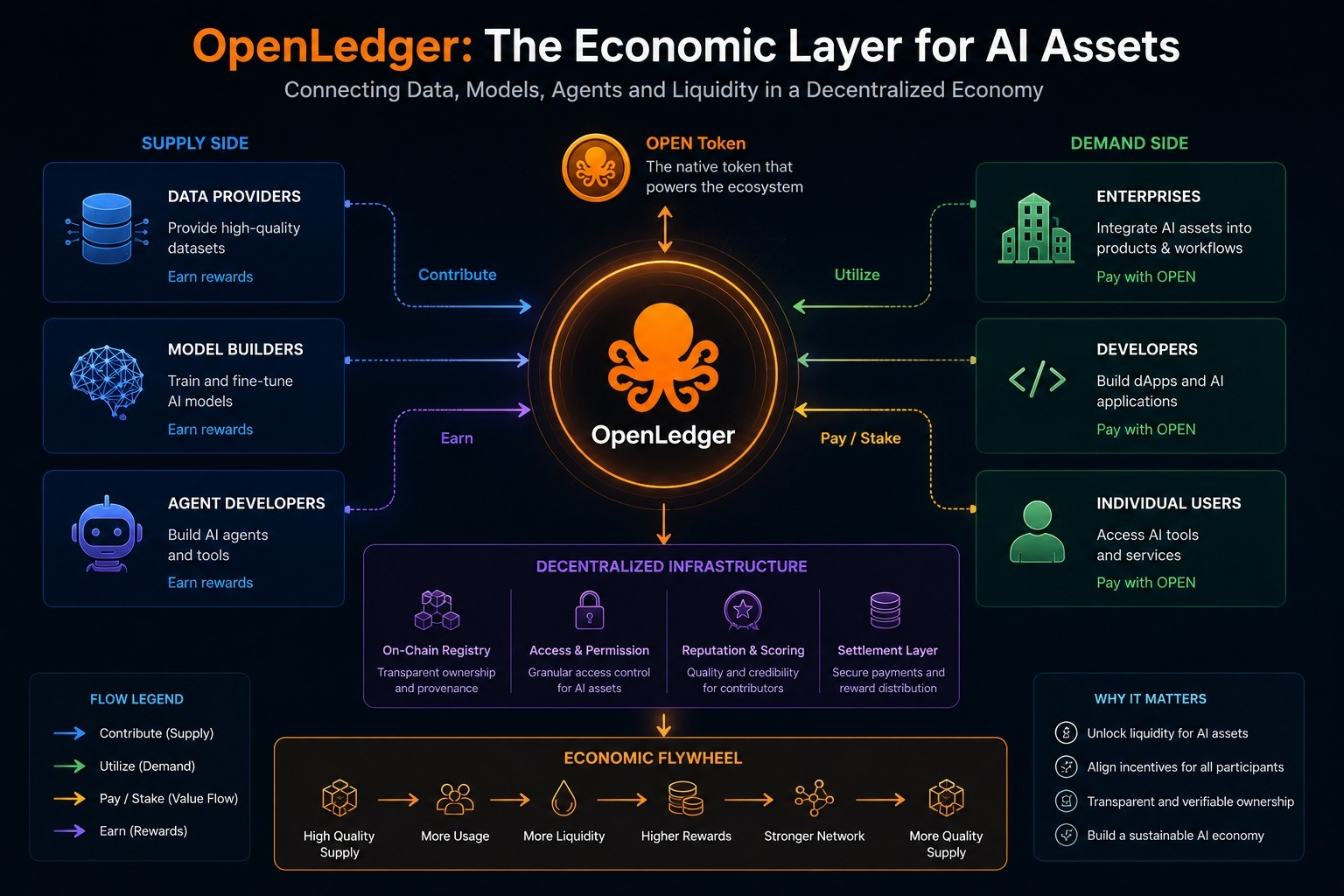
That is the environment OpenLedger seems designed for.
I do not really see OpenLedger as just another AI blockchain. I think that framing undersells what it is trying to do. What I notice instead is an attempt to create financial rails around AI-generated value itself. Not just tokenizing compute, but making datasets, models, and autonomous agents behave like productive digital assets that can circulate through an economy.
That distinction matters more than people realize.
For years, crypto tried to tokenize static things. Tokens represented governance, staking rights, or speculative access. But AI introduces a different category entirely. AI outputs are active systems. They learn, adapt, generate information, and influence decisions continuously. Traditional crypto infrastructure was not really built for that kind of dynamic economic activity.
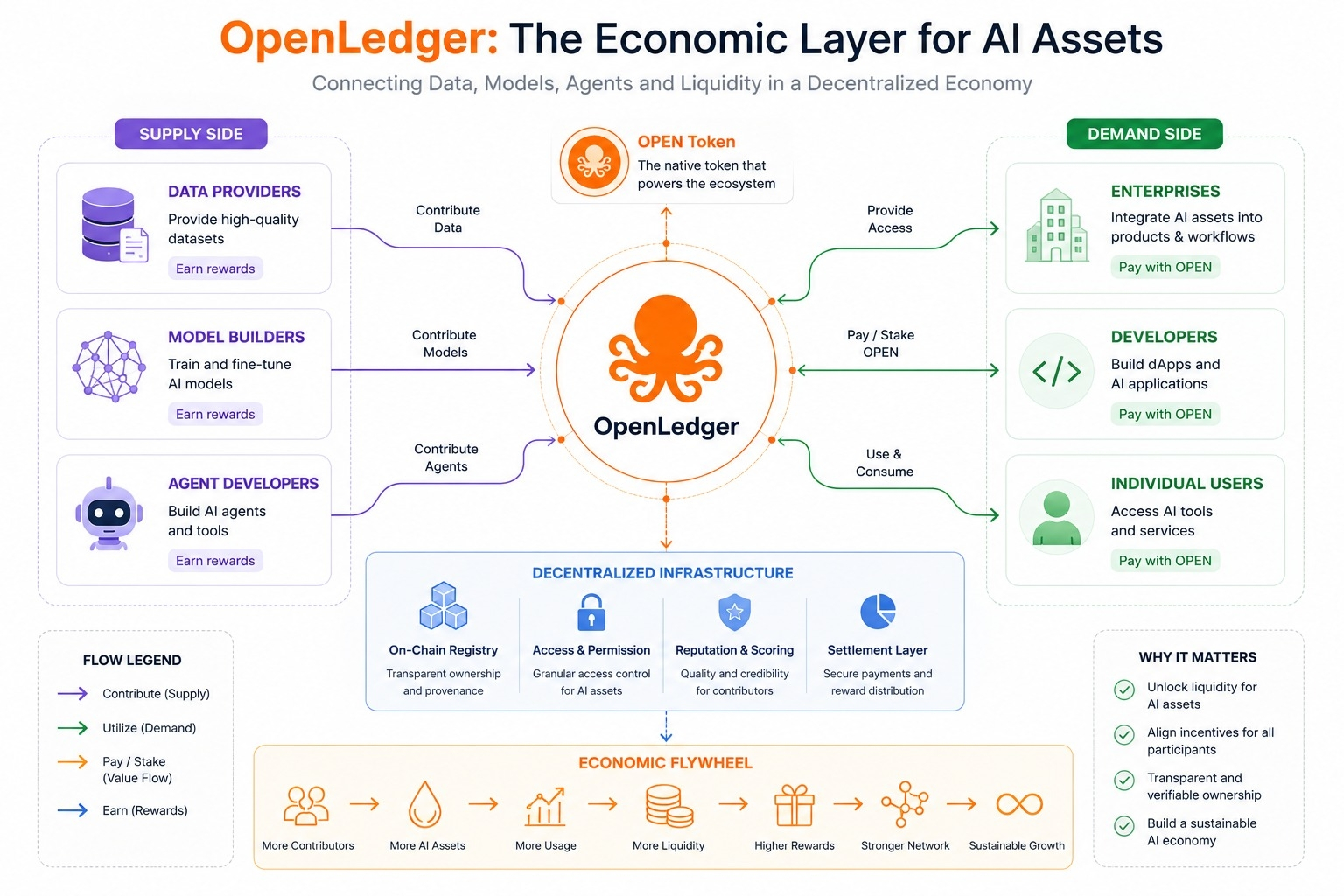
OpenLedger appears to recognize this early.
The idea of “unlocking liquidity” for AI assets sounds abstract at first, but when I break it down practically, it becomes easier to see why the concept matters. Imagine a researcher training a niche financial model, or a developer building an autonomous trading agent. Normally, monetization is isolated. They either charge subscriptions, keep systems private, or rely on centralized marketplaces. Liquidity remains trapped around the creator.
OpenLedger seems to push toward a different structure where these assets become composable and financially accessible inside an on-chain environment. Instead of AI systems operating like isolated software products, they begin behaving more like productive primitives inside a decentralized economy.
That changes incentives.
If the infrastructure works properly, contributors are no longer only rewarded for speculation around a token. They are rewarded because their data, models, or agents actively participate in a larger network economy. In theory, this creates a feedback loop where useful AI systems attract more usage, more liquidity, and more economic gravity.
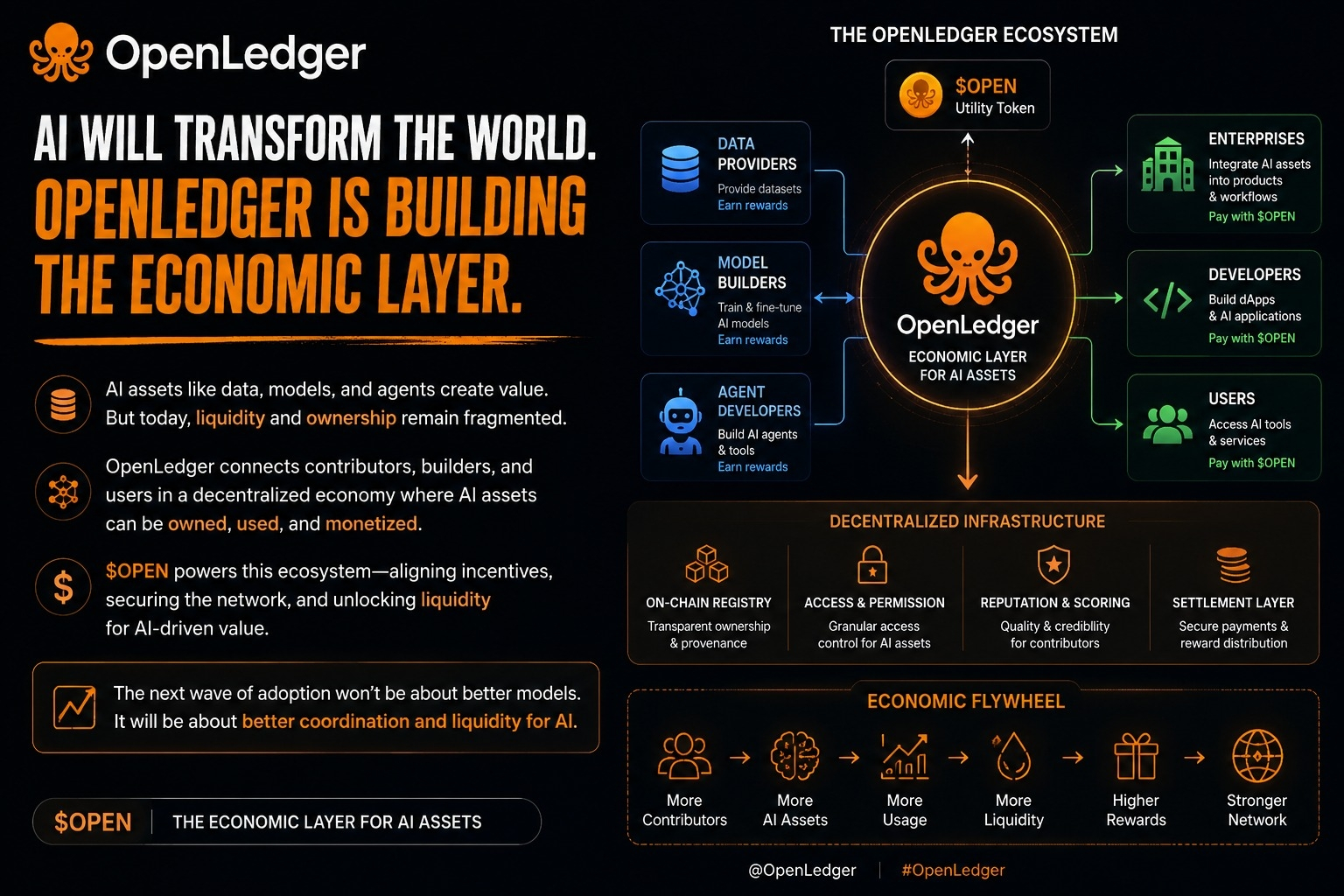
The reason I think this narrative is arriving at the right time is because crypto itself is changing underneath the surface.
The last cycle was heavily infrastructure-focused. Layer 1 competition dominated attention. Then modularity became the obsession. After that came restaking, parallel execution, and AI speculation. But beneath all of these rotations, the market keeps searching for sustainable on-chain activity that is not purely financial engineering.
AI is one of the few sectors that can potentially generate that.
Not because AI tokens pump harder, but because AI introduces actual productive behavior into blockchain ecosystems. Data generation, inference, model coordination, agent interaction, and autonomous execution all create economic activity that feels fundamentally different from yield farming loops.
That is where OpenLedger becomes interesting to me.
From what I observe, the architecture attempts to sit between blockchain coordination and AI value exchange. Instead of treating AI as a side application, it tries to make AI-native assets first-class citizens on-chain. That sounds simple conceptually, but it is extremely difficult operationally because AI systems produce value differently than traditional crypto applications.
Liquidity becomes more complicated. Attribution becomes more complicated. Ownership becomes more complicated.
Who deserves value when an AI agent improves using public datasets, external inference layers, and collaborative fine-tuning? How should contributors be rewarded over time? How do you prevent extraction where only large operators benefit while smaller contributors receive nothing?
These are not easy problems.
What I appreciate is that OpenLedger appears to focus on economic structure instead of only performance metrics. Many projects advertise faster inference or cheaper compute. Those things matter, but markets usually reward systems that coordinate incentives effectively over long periods. Ethereum succeeded because it created economic gravity for developers and applications. Stablecoins succeeded because they solved liquidity movement more efficiently than banks in certain contexts.
OpenLedger seems to be attempting something similar for AI coordination.
Of course, there are uncomfortable realities here too.
One issue I continue thinking about is whether decentralized AI economies genuinely need blockchain settlement layers at scale. This is still unresolved. Many AI products operate perfectly fine using traditional infrastructure. The average user does not necessarily care whether an agent is decentralized. They care whether it works.
That means OpenLedger ultimately cannot rely on narrative alone. Real usage matters.
Another challenge is fragmentation. The AI sector evolves extremely fast. Frameworks change quickly, dominant models shift rapidly, and user behavior remains unstable. Building economic infrastructure around such a volatile environment is difficult because the target itself constantly moves.
There is also the problem of speculation distorting utility.
Crypto markets have a habit of pricing narratives long before actual adoption appears. If OpenLedger gains attention, the token could attract speculative inflows disconnected from real network demand. That creates dangerous expectations because price appreciation alone does not validate infrastructure quality.
Still, token behavior can reveal important things over time.
If the OpenLedger ecosystem begins attracting genuine builders, developers, and agent-based activity, I would expect on-chain behavior to gradually reflect that. More transactions tied to AI interaction, liquidity formation around productive assets, and increasing demand for network participation would matter far more to me than short-term volatility.
The token itself, OPEN, becomes meaningful only if it captures economic coordination within the ecosystem. Otherwise it risks becoming another detached AI narrative asset floating on speculation alone.
That distinction is critical.
One thing I have learned from watching crypto cycles closely is that markets eventually separate performative narratives from infrastructure that actually accumulates usage. It does not happen immediately. Sometimes it takes years. But eventually the difference becomes obvious in user retention, developer activity, liquidity depth, and transaction quality.
Right now, AI in crypto still feels early enough that most people are looking at surface-level excitement instead of structural design.
That is why OpenLedger caught my attention.
Not because I think it guarantees success, and not because AI narratives automatically win, but because it is attempting to solve something deeper than most projects in this sector. It is trying to build economic coordination around machine intelligence itself.
That is a much larger ambition than launching another AI token.
Whether the market is truly ready for that is still uncertain. Maybe the infrastructure arrives too early. Maybe centralized AI platforms remain dominant longer than expected. Maybe users never care about ownership layers beneath AI systems at all.
But I also think there is a real possibility that future AI economies require neutral coordination layers where data, models, agents, and liquidity interact transparently without relying entirely on centralized platforms.
If that future develops, projects like $OPEN may end up being remembered less as AI speculation and more as early financial infrastructure for machine-driven economies.
And honestly, that possibility feels much more important than the current price action people obsess over every day.