
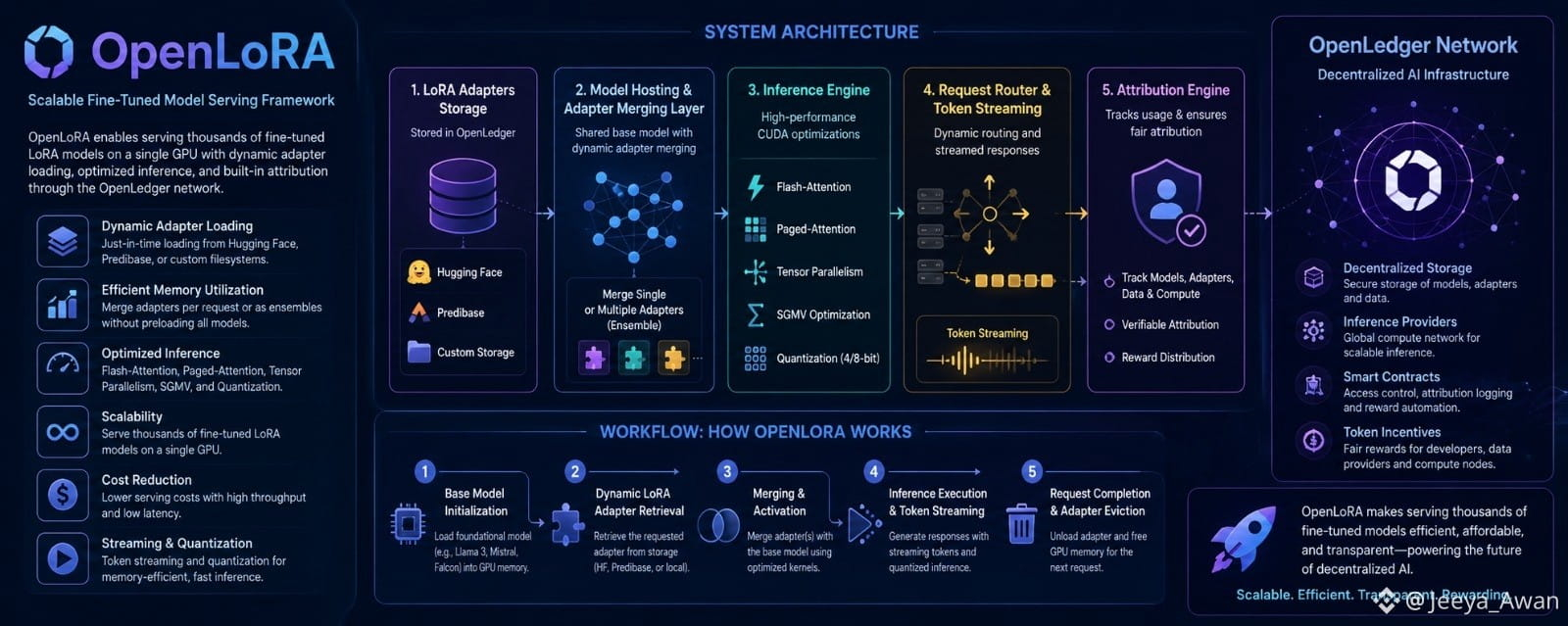
When I first started exploring the AI side of OpenLedger, I expected another complex infrastructure project that only developers with heavy technical backgrounds could understand. But after spending time learning about OpenLoRA, I realized it solves a problem that most people outside AI rarely notice, how difficult and expensive it is to run large numbers of fine-tuned AI models efficiently.
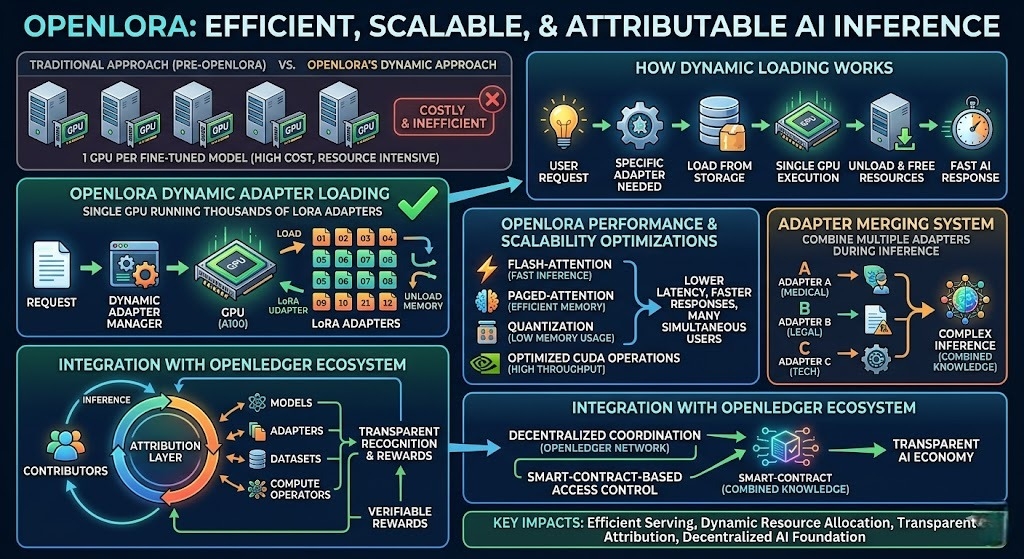
What impressed me the most about OpenLoRA is that it is not trying to build just another chatbot or AI tool. Instead, it focuses on the invisible layer underneath AI systems: the infrastructure responsible for serving and managing fine-tuned models at scale.
OpenLoRA is designed around LoRA models, which are lightweight fine-tuned versions of larger AI models. Normally, serving many of these models can become extremely expensive because each one often requires separate resources and memory allocation. OpenLoRA changes this approach completely by allowing thousands of LoRA adapters to run dynamically on a single GPU without loading everything into memory at once.
The idea became much clearer to me when I understood how dynamic adapter loading works. Instead of permanently storing every fine-tuned model inside GPU memory, OpenLoRA only loads the specific adapter needed for a request at that exact moment. Once the task is complete, the adapter can be removed again to free resources. This creates a much more efficient workflow while reducing hardware costs significantly.
Another thing that stood out to me was how OpenLoRA combines performance with scalability. The framework uses several advanced optimizations like flash-attention, paged-attention, quantization, and optimized CUDA operations to keep inference fast and memory usage low. Even though these terms sound highly technical, the practical impact is simple: faster AI responses, lower latency, and the ability to serve many users at the same time without overwhelming infrastructure.
I also found the adapter merging system particularly interesting. Instead of relying on a single fine-tuned model, OpenLoRA can combine multiple adapters during inference. This means different specialized behaviors or knowledge sets can work together dynamically. It feels like a smarter and more flexible approach compared to traditional static deployments.
One aspect that makes OpenLoRA different from many AI serving frameworks is its connection to the broader OpenLedger ecosystem. Attribution is deeply integrated into the system. Every inference can track which models, adapters, datasets, and contributors were involved. That creates transparency around AI generation instead of hiding everything behind black-box systems.
From my perspective, this attribution layer may become one of the most important parts of decentralized AI in the future. Most AI systems today benefit from countless contributors without clearly recognizing them. OpenLoRA and OpenLedger seem to be pushing toward an ecosystem where developers, dataset providers, and compute operators can all receive verifiable recognition and rewards based on actual usage.
I also appreciate how the infrastructure is designed for long-term scalability rather than short-term hype. The decentralized coordination through the OpenLedger Network, combined with smart-contract-based attribution and access control, gives the system a much larger vision than simply hosting models. It feels more like an attempt to build a transparent AI economy where contribution and ownership can actually be tracked fairly.
After researching OpenLoRA, I started viewing AI infrastructure differently. Most people only see the final AI output, but systems like OpenLoRA reveal how much engineering is required behind the scenes to make scalable AI possible. Efficient model serving, dynamic resource allocation, transparent attribution, and decentralized coordination may not sound flashy at first, but they are likely to become critical foundations for the next generation of AI ecosystems.
If decentralized AI continues growing, frameworks like OpenLoRA could play a major role in making advanced AI systems more accessible, scalable, and contributor-friendly instead of remaining controlled by only a few centralized platforms.
Do you think transparent attribution and decentralized infrastructure could eventually become a standard part of future AI systems?
