
Look around the Web3 space, and you’ll notice a repetitive, almost exhausting pattern: crypto loves to treat human behavioral problems as simple engineering tasks.
A new project emerges, drops a heavy whitepaper full of architectural jargon, and suddenly everyone acts as if clean code can magically fix broken human incentives. It never has. It never will.
The real, ugly truth of digital economies is much simpler, yet far harder to solve: People create value constantly, but systems consistently fail to track who actually deserves the credit.
Web2 mastered this extractive relationship. Users generated the data, fine-tuned the algorithms with their clicks, and built the digital landscape. Platforms captured 99% of the financial upside. Now, Artificial Intelligence is walking into the room, and it is making this value-capture crisis infinitely more complicated.
Because AI doesn’t just consume data. AI consumes human contribution.
The Black Box of Machine Intelligence
When you look at an AI output—a line of code, a piece of digital art, or a trading strategy—you are looking at a polished final product. What you don't see is the chaotic, fragmented machinery underneath.
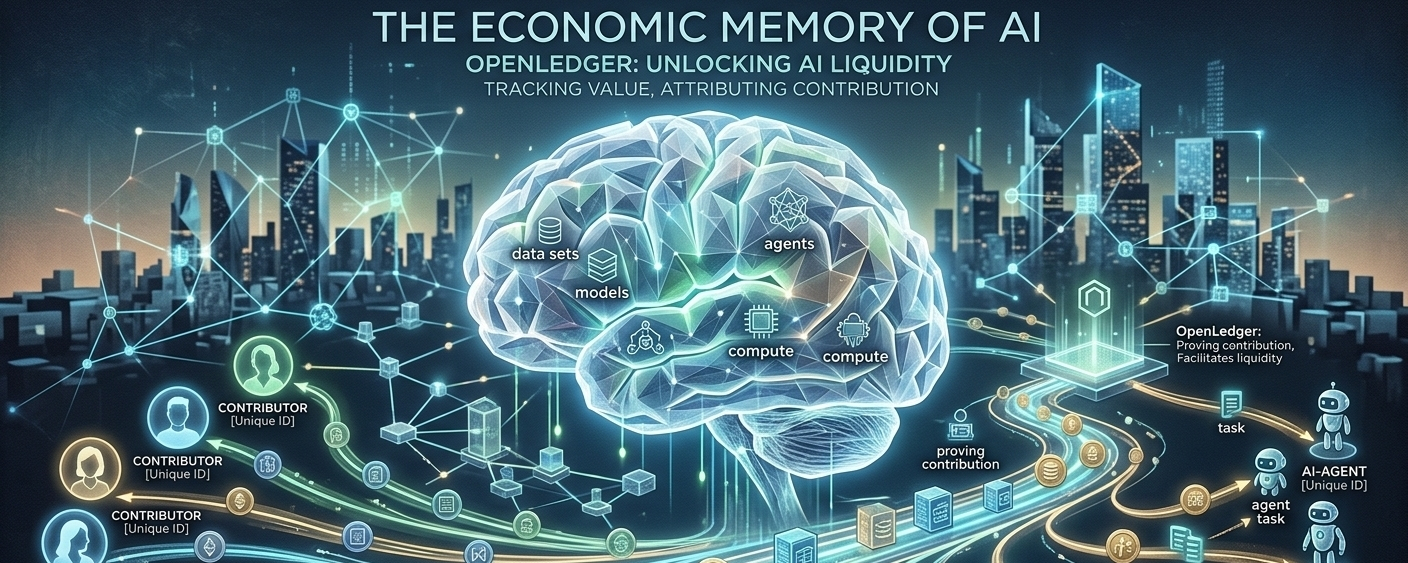
An AI output is a collision of separate worlds:
Data Injection: Massive datasets curated by thousands of individual hands.
Model Architecture: Neural networks designed by researchers.
Compute Infrastructure: Heavy hardware processing data at immense scale.
Autonomous Agents: Specialized entities executing micro-tasks.
In traditional manufacturing, we have supply chains. A car manufacturer knows exactly where every screw, piece of leather, and microchip came from. Ownership has clear, legal boundaries.
AI completely smears those boundaries. It takes data from Source A, a model from Creator B, compute from Provider C, and delivers a flawless user experience where all the original contributors are rendered invisible.
This isn't just an ethical problem; it's a massive economic bottleneck. Economies grind to a halt when participants realize their input yields zero traceable rewards.
Enter OpenLedger: Building a Coordination Layer, Not a Narrative
This is the exact wound OpenLedger is trying to patch. They aren’t launching another empty AI narrative or trying to pump a temporary token story. They are asking a much more boring—yet entirely dangerous—question:
How do you create economic memory around intelligence itself?
Strip away the crypto buzzwords, and OpenLedger’s core thesis is straightforward: AI systems run on inputs. Those inputs come from real contributors. Therefore, those contributors must have a permanent, measurable footprint inside the economic lifecycle of that AI.
Instead of letting datasets, models, and agents vanish into a corporate black box, OpenLedger positions itself as a decentralized coordination layer. It treats these elements not as isolated tools, but as active, visible economic participants.
Think of it like logistics before modern supply chains. The factories, ships, and raw materials always existed, but the coordination was broken. Value leaked everywhere due to a lack of visibility. OpenLedger isn't trying to invent AI intelligence; it’s trying to organize it.
The Tokenomics Trap: Distinguishing Motion from Traction
But let’s be entirely candid. Execution in this space is a minefield, and OpenLedger faces the same existential threat that has destroyed dozens of promising Web3 ecosystems: the gamification of incentives.
Crypto has a bad habit of falling in love with surface-level metrics. We stare at Dune Dashboards, look at transaction volume, active wallet counts, and explosive social media engagement, and we convince ourselves a project is winning.
We’ve seen this movie before. We saw it with DeFi liquidity mining. We saw it with Play-to-Earn (P2E) gaming. Ecosystems looked massive right up until the rewards dried up—and then the users vanished overnight. They confused farming with real market demand.
The second you make data and AI contribution measurable, users change their mindset. They stop asking "How do I contribute something genuinely useful?" and start asking "How do I game the algorithm to maximize my $OPEN rewards?"
On a blockchain ledger, a sybil bot farm and a high-quality human data contributor can look terrifyingly similar. Fake volume can masquerade as network health while real, organic utility gets drowned out by the noise.
The Unforgiving Questions OpenLedger Must Answer
Superior technology rarely wins the market. Convenience, speed, and simplicity do. If OpenLedger wants to survive past its initial incentive phase, it has to answer the unglamorous questions that most hype-driven projects ignore:
Quality vs. Noise: How does the protocol filter out synthetic, garbage data designed solely to farm rewards?
Granular Attribution: When an AI model utilizes 50,000 different data inputs to generate a single valuable output, how do you fairly fractionate the micro-rewards?
Privacy vs. Provenance: How do you track data lineage and attribution without compromising user privacy or revealing proprietary data?
External Value Inflow: How does the ecosystem bring in sustainable, external revenue so that value isn't just spinning in a closed, speculative circle?
The Bottom Line: Forgetting Will Be Expensive
OpenLedger isn't a guaranteed home run, but it isn't an empty hype machine either. It occupies a critical middle ground. It is making a long-term macro bet that in the coming decade, intelligence itself will become a liquid, tradeable asset class.
If that bet is correct, the traditional way of handling AI data is completely unsustainable. We cannot build the future of global intelligence on a foundation of uncredited, untracked human contribution.
Ultimately, OpenLedger’s success may not even be the main storyline here. The real takeaway is that future AI economies will absolutely demand a system that remembers who built them. Because when intelligence becomes the primary driver of global wealth, forgetting who contributed to it will simply become too expensive.