
Most people talk about AI infrastructure as if the hard part is already behind us.@OpenLedger
The models are here. The interfaces are smooth. You type something into a box, and a response appears almost instantly. From the outside, it feels finished. Or at least inevitable. The conversation usually moves toward scale after that — bigger models, faster inference, more intelligent systems.
But after sitting with it for a while, I started noticing something smaller.
Not the models themselves, but the quiet human activity underneath them.#OpenLedger
Someone labeling edge cases late at night. Someone cleaning a dataset that nobody will ever see. Someone testing outputs over and over, adjusting tiny things that barely register individually but slowly shape the behavior of the system. Most of AI seems to emerge from these repeated, almost invisible actions.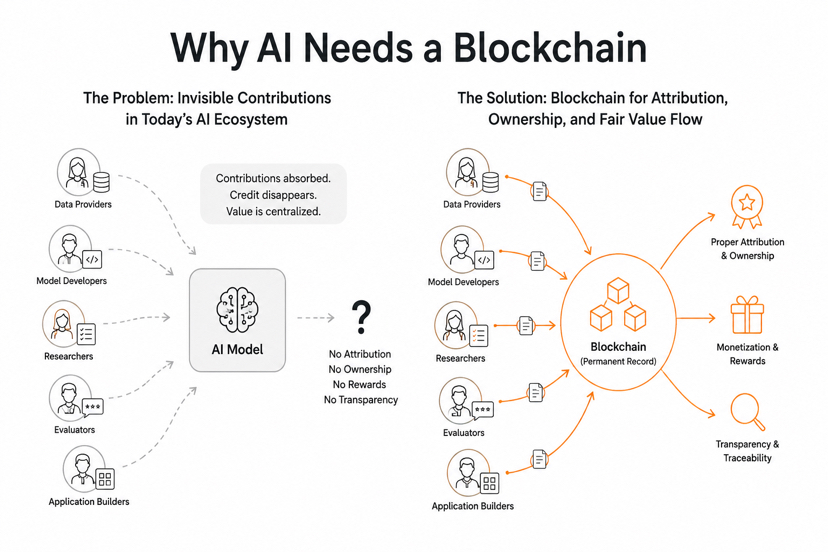
And yet the structure around AI rarely treats those actions as meaningful.
We tend to imagine AI as a product created by companies or labs. A model gets released, a brand name gets attached to it, and the value appears concentrated in one visible place. But the actual process feels much more scattered than that. The intelligence may look centralized. The labor behind it usually isn’t.
That tension is probably where the blockchain conversation starts making more sense.
At first, blockchain in AI sounds like another attempt to force two trends together. Most people hear it and immediately think about tokens, speculation, or infrastructure diagrams. The surface explanation is always about decentralization.
But the deeper part may have less to do with ideology and more to do with memory.
Right now, AI systems forget where they came from.
Not technically. Internally, companies may have logs and records. But culturally, economically, and structurally, the chain of contribution disappears very quickly. Data gets absorbed into training pipelines. Evaluators improve outputs without ownership. Researchers influence systems indirectly. Small contributors become part of the background noise.
The strange thing is that modern AI depends heavily on this background noise.
Specialized AI especially doesn’t emerge from massive internet scraping alone. It comes from narrower, more deliberate inputs. Curated medical datasets. Industry-specific corrections. Human feedback from people who understand a field deeply enough to notice subtle mistakes.
Those contributions are slower. More careful. Often repetitive.
And repetition changes behavior.
If someone knows their work disappears into a closed system forever, their relationship to the work changes. Maybe they contribute less. Maybe they stop caring about quality after a certain point. Maybe the internet gradually fills with synthetic content because original contributors no longer feel connected to outcomes.
That part feels easy to miss because the system still functions on the surface.
The outputs keep improving. Funding keeps flowing. New products appear every month. But underneath that movement, there’s a quiet dependency on people continuing to contribute attention without clear ownership, visibility, or reward.
OpenLedger seems to recognize this misalignment more directly than most AI infrastructure projects.
Not by trying to replace AI development entirely, but by focusing on attribution itself — the ability to trace where things came from, who shaped them, and how value moves afterward.
That sounds administrative at first. Almost boring.
But when you think about how people behave online, attribution changes more than credit. It changes motivation.
People return to systems when they feel visible inside them.
Not always financially. Sometimes recognition alone changes participation. A username attached to an insight. A traceable contribution history. A sense that small actions accumulate somewhere instead of dissolving into a platform.
Blockchain becomes interesting here not because it makes AI decentralized in some abstract political sense, but because it introduces persistence.
A permanent memory for contribution.
And maybe AI quietly needs that more than we expected.
Most centralized AI systems operate like sealed containers. You see the interface, but not the path behind it. The training data is vague. The decision-making process is opaque. Even mistakes become difficult to locate because the system has no socially visible history.
What blockchain adds is less about trustlessness and more about traceability.
Not perfect transparency. Just enough structure for contributions to remain connected to outcomes over time.
That changes the emotional texture of participation.
A person correcting model outputs behaves differently if those corrections become part of a visible chain rather than disappearing into an anonymous optimization loop. The action feels smaller when it vanishes. More consequential when it leaves a mark.
And AI development, at its core, may simply be the accumulation of these tiny behavioral decisions.
Who keeps contributing.
Who stops.
Who feels ownership.
Who feels extracted from.
The interesting part is that none of this is really about technology alone. The systems already work reasonably well. The question is whether the human layer underneath them remains sustainable as AI becomes more dependent on specialized knowledge and continuous feedback.
Because eventually, the bottleneck may not be compute.
It may be willingness.
The willingness to contribute useful data. To refine outputs carefully. To participate in systems that increasingly shape public knowledge while offering very little visibility into how value flows back to the people involved.
Maybe that’s why blockchain keeps reappearing around AI, even after the hype cycles fade.
Not because every AI system needs a token attached to it.
But because people seem to keep rebuilding the same idea in different forms: a way to remember who helped create the intelligence in the first place.
I’m not sure whether blockchain fully solves that problem. Maybe no system really can. Human contribution is messy, collaborative, overlapping. Attribution itself becomes blurry once enough people are involved.
Still, it’s difficult to ignore how much modern AI depends on invisible labor while simultaneously making that labor harder to see.
And once you notice that, the conversation shifts a little.$OPEN
The question stops being whether AI can scale.
It becomes harder not to wonder what happens if the people underneath it slowly stop feeling connected to what they’re building.
