
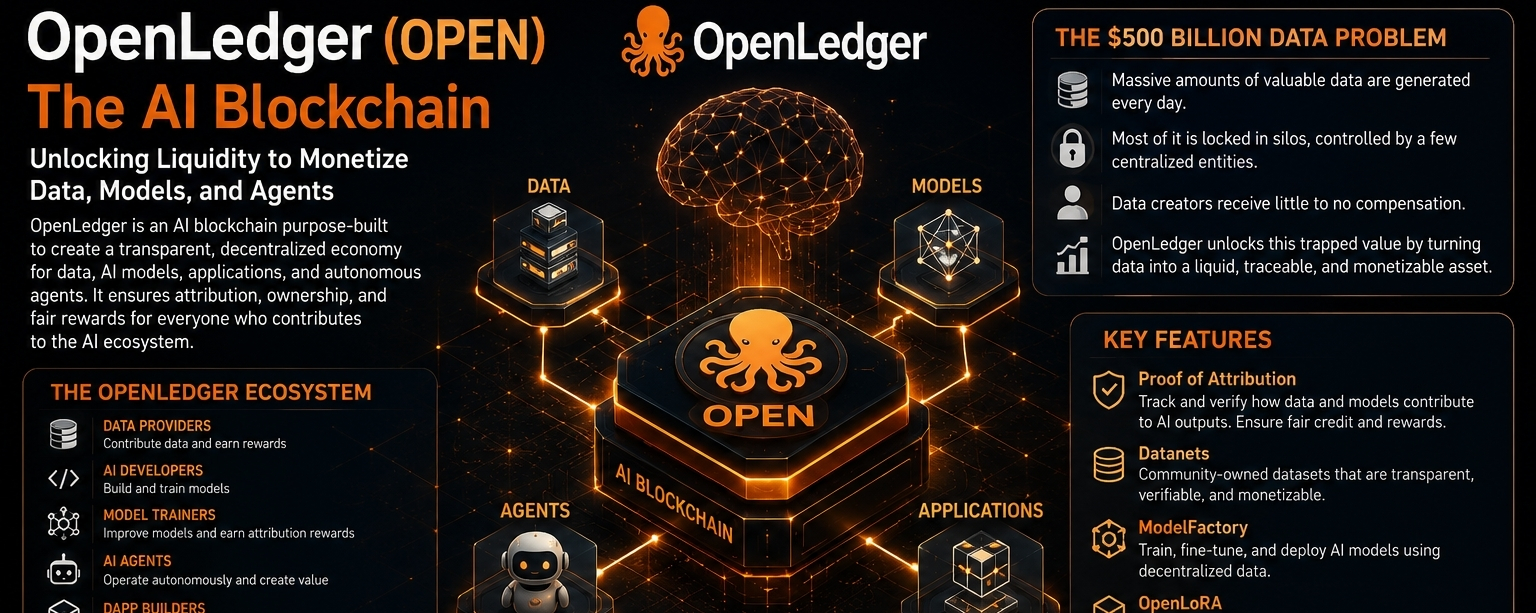
OpenLedger (OPEN) is emerging as one of the most ambitious projects at the intersection of artificial intelligence and blockchain technology. Built with the vision of transforming AI from centralized and opaque systems into transparent, auditable, and community-owned infrastructure, OpenLedger focuses on solving one of the largest hidden challenges in the AI industry: the monetization and attribution of data.
The project positions itself as an “AI Blockchain” designed specifically for data liquidity, AI model ownership, agent monetization, and transparent reward systems. Unlike traditional blockchains that mainly focus on payments, decentralized finance, or NFTs, OpenLedger is attempting to build an entire economic layer for artificial intelligence.
At the core of OpenLedger lies the idea that data has become one of the most valuable assets in the digital world, yet the people and organizations generating this data are rarely compensated fairly. Large technology companies collect massive datasets, train AI models on them, and monetize the results while contributors receive little or no ownership, transparency, or rewards. OpenLedger attempts to change this system by embedding attribution and verifiable provenance directly into blockchain infrastructure.
CoinMarketCap +2
The platform introduces a framework where datasets, AI models, applications, and intelligent agents can all become monetizable digital assets. Developers can deploy specialized AI models on-chain, track how data influences outputs, and create programmable incentives that reward contributors automatically. This creates an ecosystem where AI development becomes decentralized, transparent, and economically fair.
CoinMarketCap +2
One of the strongest narratives surrounding OpenLedger is its focus on the so-called “$500 billion data problem.” Massive amounts of valuable data exist globally, but much of it remains siloed, inaccessible, or uncompensated. OpenLedger aims to unlock this trapped value by turning datasets into liquid and traceable economic assets. Through blockchain verification mechanisms, contributors can prove ownership and receive rewards whenever their data contributes to model training or AI-generated outputs.
CoinMarketCap +1
Another important concept within the OpenLedger ecosystem is “Proof of Attribution.” This mechanism enables transparent tracking of how datasets and models contribute to AI decisions and outputs. In traditional AI systems, users often cannot determine which data influenced a response or who should be rewarded for the model’s intelligence. OpenLedger seeks to solve this issue by maintaining verifiable on-chain records of data usage and model influence.
YouTube +1
The ecosystem is designed to support multiple components of the AI economy. These include data providers, AI developers, model trainers, decentralized applications, autonomous AI agents, and end users. Each participant can interact within a shared blockchain infrastructure while maintaining ownership and receiving incentives for contributions.
OpenLedger also promotes the concept of community-owned AI. Instead of AI infrastructure being dominated entirely by centralized corporations, the platform encourages open participation where communities can collaboratively build, train, and monetize AI systems. This aligns closely with broader Web3 ideals of decentralization and user ownership.
The OPEN token acts as the native utility asset of the ecosystem. It is used for network transactions, staking, governance participation, rewards distribution, and economic incentives throughout the platform. The token also plays a role in securing the network and facilitating interactions between AI applications and datasets. According to market data, the token has a maximum supply of 1 billion OPEN tokens.
CoinMarketCap +1
As of recent market statistics, OpenLedger has gained significant attention within the AI crypto narrative. The project achieved listings on multiple exchanges and attracted strong interest from the crypto community due to its positioning within the rapidly growing AI sector. Market capitalization, trading volume, and community growth have increased notably during periods of AI-related market momentum.
CoinMarketCap +3
Community discussions across crypto forums and Reddit frequently compare OpenLedger to earlier AI-focused blockchain projects such as Fetch.ai and SingularityNET. However, supporters argue that OpenLedger differentiates itself through its focus on attribution, data monetization, and on-chain AI accountability rather than simply offering decentralized AI services.
Reddit +2
The broader AI-blockchain sector has expanded rapidly because of increasing concerns around centralized AI control. As AI systems become more powerful, questions surrounding ownership, accountability, transparency, and economic fairness are becoming increasingly important. OpenLedger positions itself as infrastructure for an open AI economy where contributors retain visibility and ownership over their digital intelligence assets.
The project’s philosophy also overlaps with emerging academic discussions around decentralized AI ecosystems. Research surrounding “Open, Monetizable, and Loyal AI” explores similar concepts involving blockchain-powered transparency, decentralized governance, and monetizable AI infrastructure.
arXiv
Technically, OpenLedger aims to support scalable deployment of AI models and applications while maintaining blockchain verifiability. The platform combines decentralized ledger systems with AI-oriented infrastructure to create environments where intelligent systems can operate transparently and autonomously. This includes support for specialized models, autonomous agents, and data networks that can evolve over time.
Another major attraction for developers is the possibility of creating AI-powered decentralized applications where every interaction, training update, and economic reward can be recorded on-chain. This can potentially improve trust, auditability, and monetization opportunities across industries such as healthcare, finance, education, cybersecurity, gaming, and automation.
OpenLedger also enters the rapidly expanding AI agents market. Autonomous agents are expected to become a major part of future digital economies, handling tasks such as trading, customer service, research, automation, and data analysis. OpenLedger’s infrastructure is designed to support these agents while enabling transparent monetization and ownership mechanisms.
Despite its promising vision, OpenLedger still faces significant challenges. The AI blockchain sector remains highly competitive and speculative. Success will depend on real-world adoption, developer activity, ecosystem growth, scalability, and the ability to deliver practical utility beyond market hype. Many blockchain-AI projects struggle to transition from narrative-driven momentum into sustainable long-term ecosystems.
There are also technical and regulatory questions surrounding AI accountability, decentralized governance, intellectual property rights, and data privacy. OpenLedger’s long-term viability will likely depend on how effectively it balances decentralization with usability and compliance.
Nevertheless, OpenLedger has positioned itself within one of the strongest narratives in the current technology landscape: the fusion of AI and blockchain. As artificial intelligence continues to dominate technological innovation globally, projects focused on decentralized AI ownership and monetization are attracting increasing attention from developers, investors, and Web3 communities.
For supporters, OpenLedger represents more than just another cryptocurrency. It is an attempt to create an economic infrastructure layer where intelligence itself becomes transparent, traceable, and monetizable. By enabling data contributors, developers, and autonomous agents to participate in a shared blockchain economy, OpenLedger aims to redefine how AI systems are built, governed, and rewarded in the decentralized era.
#openLedager @OpenLedger $OPEN
