
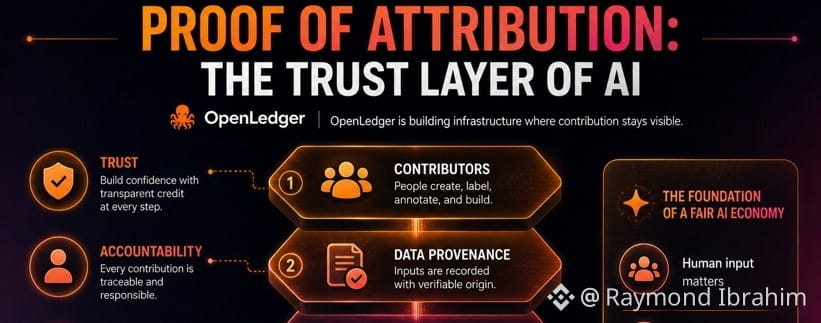
The OpenLedger is interesting because it is not trying to win attention only by using the AI narrative.
Right now, the crypto market is full of projects that connect themselves with artificial intelligence. Some talk about agents. Some talk about compute. Some talk about model deployment. Some simply use the word AI because it attracts attention.
But OpenLedger is focused on something deeper.
It is focused on attribution.
That may sound like a simple word, but in the future AI economy, attribution could become one of the most important layers of trust.
AI systems do not become powerful by themselves. Behind every useful model, there are many invisible inputs. There is data. There is research. There is user behavior. There is expert feedback. There are creators, developers, writers, communities, and people who contribute knowledge in different forms.
These contributions help AI systems become more useful.
But the problem is that most of these contributors are never seen once the final value is created.
A model may generate an answer. A company may use that answer. A product may earn revenue from that answer. But the original people, datasets, or communities that helped create that value often remain disconnected from the outcome.
This is the gap @OpenLedger is trying to address.
Instead of treating data as something that disappears inside a model, OpenLedger is building around the idea that contribution should remain traceable. If human input helps AI create value, that input should not be invisible forever.
This is where the concept becomes important.
The future of AI will not only depend on who has the fastest model or the biggest infrastructure. It will also depend on trust. Users, companies, developers, and creators will increasingly care about where data comes from, how it is used, and whether value can move fairly through the system.
That is why #OpenLedger feels different from many AI crypto projects.
It is not only asking how AI can become more powerful. It is asking how AI can become more transparent, more accountable, and more connected to the people who help build its intelligence.
For me, this is a stronger long-term conversation than simple hype.
If AI continues to grow, the question of data ownership will become harder to ignore. Creators will want recognition. Researchers will want proper credit. Communities will want fair participation. Businesses will want cleaner data provenance. Developers will want systems that can prove where value is coming from.
OpenLedger is positioning itself around that need.
The idea of Proof of Attribution gives the project a clear direction. It creates a framework where contribution can be tracked, connected, and potentially rewarded. That gives $OPEN a role beyond speculation because the token is connected to a larger infrastructure concept.
Of course, a good idea alone is never enough.
Every crypto project still has to prove execution. OpenLedger needs real adoption, active builders, useful products, strong demand, and long-term trust from the market. Token supply, unlocks, liquidity, and overall market conditions can also affect short-term price action.
So this is not a risk-free story.
But it is a serious narrative.
The reason OpenLedger stands out is because it focuses on a problem that is likely to become bigger as AI becomes more valuable. When AI starts creating more economic output, people will not only ask what the model can do. They will ask who contributed to that value, who owns the data behind it, and who deserves to benefit from the outcome.
That is a much deeper question than hype.
And that is why $OPEN deserves attention.
In a market where many AI tokens are only selling excitement, OpenLedger is trying to build around ownership, attribution, and fair value movement. If the team can turn that vision into real usage, it could become an important part of the AI and blockchain conversation.
OpenLedger is not just about AI.
It is about making AI value more traceable, more transparent, and more connected to the contributors behind it.
Not financial advice. Always do your own research.