
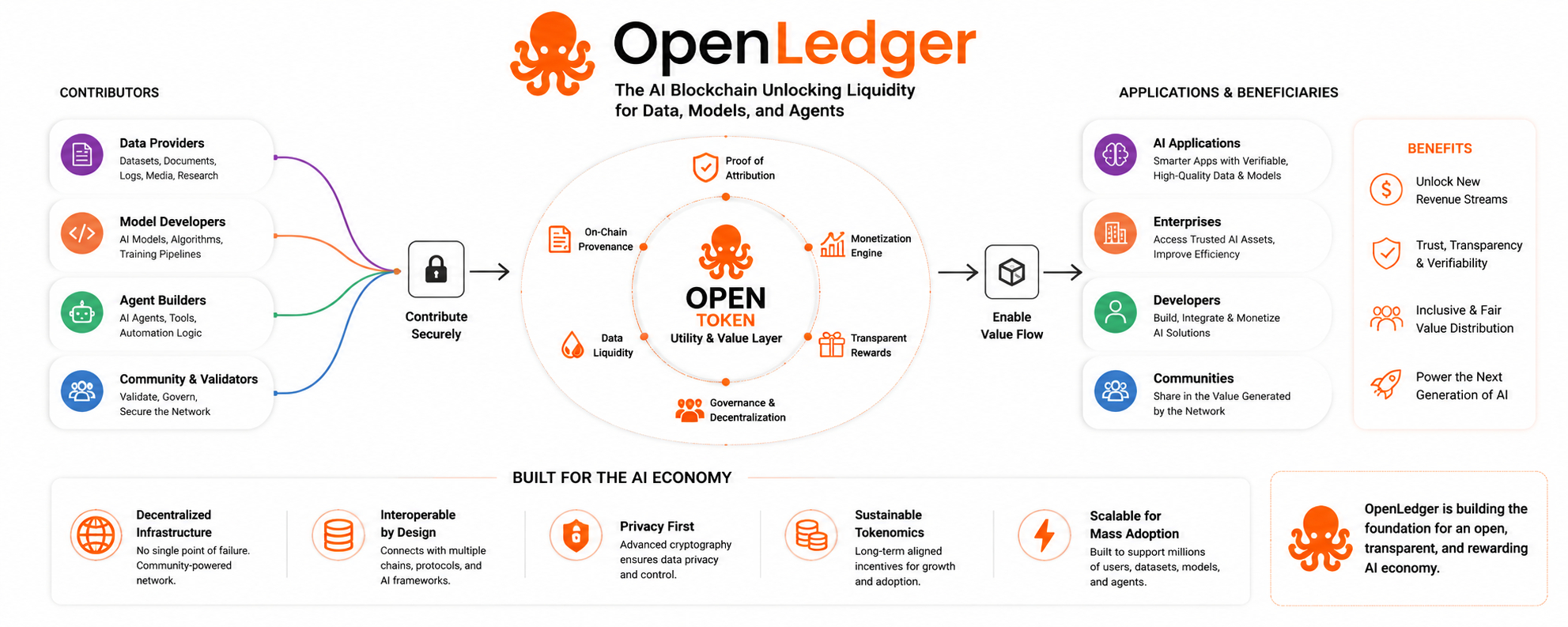
For a long time, the internet trained us to believe that information naturally wants to be free. Everything moved toward openness, endless copying, frictionless sharing, and platforms that scaled by absorbing as much human activity as possible. But artificial intelligence is changing that logic in a subtle and uncomfortable way. Information is no longer just information. In the AI era, information becomes labor. It becomes infrastructure. It becomes capital.
That shift is exactly where OpenLedger enters the picture.
At first glance, OpenLedger looks like another project sitting at the intersection of AI and blockchain — two industries that are already overloaded with hype, oversized promises, and futuristic language. But underneath the branding and tokenomics is a more serious idea. The project is trying to solve a growing imbalance in the AI economy: millions of people contribute data, expertise, and behavioral signals that train intelligent systems, yet almost none of those contributors share in the economic value created afterward.
Every AI model is built on hidden human effort. Researchers produce papers. Developers write code. Communities generate conversations. Experts create specialized datasets. Entire industries unknowingly feed machine learning systems every single day. Yet once those systems become profitable, the rewards usually concentrate around a handful of companies with enough compute power, capital, and infrastructure to commercialize the output.
OpenLedger is attempting to challenge that structure by treating data, models, and AI agents as economic assets that can be tracked, monetized, and connected back to contributors. That sounds technical on paper, but philosophically it is actually a question about ownership. If artificial intelligence increasingly learns from humanity itself, then who should benefit from the intelligence it produces?
The timing of this idea is not accidental. AI is entering a different phase now. The first wave of artificial intelligence was about proving capability. Can machines write? Can they generate images? Can they reason, summarize, predict, or imitate? That phase created excitement. The next phase is more complicated because it is about economics. Who controls the models? Who owns the data? Who gets compensated? Who carries legal responsibility? Who verifies where information came from? Those questions are becoming impossible to ignore.
This is where OpenLedger starts feeling less like a speculative crypto experiment and more like an attempt to build accounting infrastructure for intelligence itself.
Most AI systems today operate like black boxes. Data goes in, predictions come out, and the internal process remains difficult to interpret. We rarely know which dataset influenced a response or which contributors made a system more accurate. In some cases, even the companies building the models cannot fully explain why certain outputs appear. That opacity creates problems not only for trust, but for economics. If contribution cannot be measured, compensation becomes impossible to distribute fairly.
OpenLedger’s core vision revolves around attribution. The project talks about “Proof of Attribution,” which essentially means creating mechanisms to trace how data and contributors influence AI systems and outputs. That may sound abstract, but the implications are enormous. It introduces the possibility that AI could eventually function less like an extraction engine and more like a participation economy.
Imagine a future where medical researchers contribute oncology datasets into a decentralized AI network. Every time those datasets improve diagnostic models used by hospitals or pharmaceutical companies, value flows back toward the contributors. Or imagine specialized legal datasets that continuously generate royalties whenever AI systems use them to produce legal analysis. In that kind of world, data stops being a disposable resource and starts becoming a yield-generating digital asset.
That idea changes the emotional relationship between humans and AI. Right now many people feel that artificial intelligence is quietly absorbing human creativity and expertise without permission, attribution, or compensation. OpenLedger’s philosophy pushes toward a different model where intelligence becomes economically traceable. Instead of disappearing into the machine, contributors remain visible inside the system.
The deeper insight here is that the future AI economy may depend less on raw compute power than people currently assume. Open-source models are becoming increasingly accessible. Powerful foundational models are spreading quickly. Over time, the real scarcity may not be models themselves, but high-quality, trustworthy, domain-specific data.
That creates a completely different market dynamic.
The next generation of valuable AI systems may not be giant universal models trying to know everything. Instead, they may be specialized intelligence networks trained on highly curated datasets from industries like medicine, finance, law, logistics, engineering, agriculture, or science. Those systems will compete based on the quality and uniqueness of their data ecosystems.
OpenLedger appears to be positioning itself precisely for that future. Its concept of “Datanets” reflects this shift. Rather than viewing AI as a single centralized intelligence, the project imagines networks of specialized datasets feeding purpose-built models and autonomous agents. In that framework, data liquidity becomes one of the defining economic forces of the AI era.
That phrase — data liquidity — sounds almost harmless until you think about what it actually means. Liquidity has traditionally belonged to finance. It refers to how efficiently assets move and generate value. OpenLedger applies that logic to intelligence itself. It is attempting to transform static datasets into active economic resources that can circulate, produce returns, and participate inside decentralized marketplaces.
That may eventually reshape how societies think about knowledge ownership. Entire industries are built on isolated data silos that rarely interact efficiently. Hospitals sit on valuable medical information. Governments control massive public datasets. Corporations accumulate behavioral and operational data at enormous scale. Most of these assets remain economically dormant outside their immediate environments.
If systems like OpenLedger succeed, datasets themselves could become programmable financial primitives. Communities, institutions, and even nations may eventually compete over AI data sovereignty in the same way countries once competed over natural resources or industrial capacity.
There is also a political layer hidden beneath all of this. Artificial intelligence is becoming increasingly centralized. A small number of companies dominate advanced model development because the barriers to entry are so high. Compute infrastructure, research talent, proprietary datasets, and capital concentration all reinforce that dominance. Many people in technology quietly worry that AI could evolve into one of the most centralized industries in modern history.
OpenLedger represents a response to that fear. It proposes that intelligence production can be decentralized economically, not just technically. Instead of concentrating value entirely around model owners, it tries to distribute value across the ecosystem of contributors that make AI possible in the first place.
Whether that vision becomes reality is another question entirely.
The technical challenges are enormous. Attribution inside neural networks is incredibly difficult because modern AI systems are probabilistic and deeply complex. Tracing exactly how one dataset influenced one output is not straightforward. There are also major questions around verification, governance, scalability, adoption, and regulatory compliance. Many blockchain projects describe ambitious futures that nevlber materialize into practical ecosystems.
And yet, even with those uncertainties, OpenLedger reflects an important historical transition.
The internet monetized attention. Social media monetized behavior. Blockchain monetized trust. Artificial intelligence is beginning to monetize cognition itself.
That changes the structure of economic life in ways people are only starting to understand.
The most valuable systems of the next decade may not simply be the smartest models. They may be the systems that know how to measure contribution, distribute rewards, and create sustainable economic relationships between humans and machines.
That is the deeper significance of OpenLedger. It is not just trying to build another cryptocurrency. It is trying to build financial infrastructure around intelligence creation. Whether the project ultimately succeeds or fails, the question it raises is becoming unavoidable.
When machines continuously learn from human knowledge, who owns the value that emerges afterward?
Right now, there is no clear answer. But projects like OpenLedger suggest that the future AI economy may eventually demand one.