
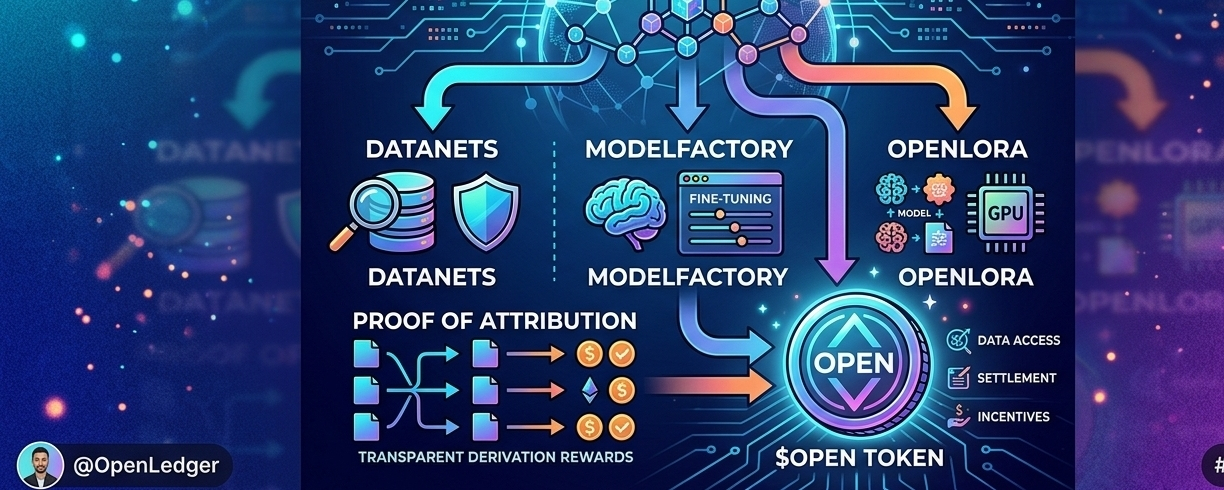
The artificial intelligence boom has a massive structural flaw: the core resources powering the revolution high-quality data, foundational models, and specialized AI agents are heavily centralized. Tech giants routinely harvest public and private data without giving proper credit or compensation to the creators. This is where @OpenLedger enters the equation, building an EVM-compatible infrastructure designed specifically to act as the sovereign financial layer for the decentralized AI revolution.
By treating data and machine learning processes as liquid economic assets, this ecosystem shifts the paradigm from closed-source corporate dominance to an open, verifiable intelligence economy backed by its native token, $OPEN .
The Three Core Pillars of the Infrastructure
Unlike general-purpose Layer 1 or Layer 2 networks built around DeFi or NFTs, this platform is engineered from the protocol level up to serve the unique computational and storage demands of AI pipelines. It establishes this through three interconnected tools:
Datanets (Community-Owned Data Hubs): Think of these as topic-specific, on-chain data repositories (e.g., specialized hubs for legal analysis, medical snippets, or smart contract auditing). Contributors can securely upload domain-expert datasets. Every single entry is hashed, time-stamped, and given permanent on-chain provenance records for transparent auditing and compliance.
ModelFactory: A sleek, completely no-code graphical user interface (GUI) dashboard that allows developers to fine-tune foundational open-source LLMs (like LLaMA, Mistral, or DeepSeek). Developers can pull permissioned, high-quality data directly from the active Datanets, configure tuning parameters, and track real-time training analytics without touching a terminal line.
OpenLoRA: Deploying and hosting thousands of individual, fine-tuned models is traditionally a massive financial drain on hardware. OpenLoRA solves this scaling bottleneck by utilizing a highly cost-efficient serving architecture capable of hosting thousands of micro-models concurrently on a single GPU cluster.
Proof of Attribution (PoA): The Engine Behind "Payable AI"
The absolute breakthrough of the protocol lies in its novel Proof of Attribution (PoA) consensus mechanism. Traditionally, open-source contributors only get rewarded at the exact moment they upload a dataset—if they get paid at all.
PoA completely rewrites this relationship. It tracks and measures exactly how much a specific dataset influences a machine learning model's output during live training and inference phases.
The Payable AI Paradigm: Whenever an end-user or autonomous application triggers an AI model that was shaped by your data contribution, PoA accurately traces that derivation back to your specific data hash and instantly issues micro-rewards on-chain.
The Economic Engine: The Utility of $OPEN
At the very center of this growing network is the $OPEN token, which acts as the bloodline for transactions, computational settlement, and alignment across the intelligence ecosystem:
Data Marketplace Access: AI teams and individual developers use the token to license and purchase secure access to highly specialized, community-curated Datanet clusters.
Infrastructure Settlement: The token serves as the default medium of exchange for processing cross-chain computations, fine tuning infrastructure fees, and agent-to-agent transactions.
Security & Incentives: Node operators and data curators stake the token to secure the verification layer, earning dynamic network yields while keeping the entire pipeline clean and free from adversarial data poisoning.
As Web3 and AI continue their rapid convergence, building an on-chain ledger that is explainable, auditable, and inherently fair to contributors is no longer optional it is a necessity. By establishing a robust financial foundation where human intelligence is properly valued, the ecosystem is laying down the precise rails required for a truly open internet of intelligence.