The conversation around AI ownership has become increasingly complex. Not simply in the legal sense of who controls a product, but in the deeper question of where intelligence itself originates.
Every modern AI model is shaped by countless invisible contributions — datasets, research, labeling, corrections, writing, and continuous human feedback. Yet once these systems become commercially valuable, the contributors behind that intelligence often disappear from the narrative entirely.
That is the structural issue @OpenLedger is attempting to address.
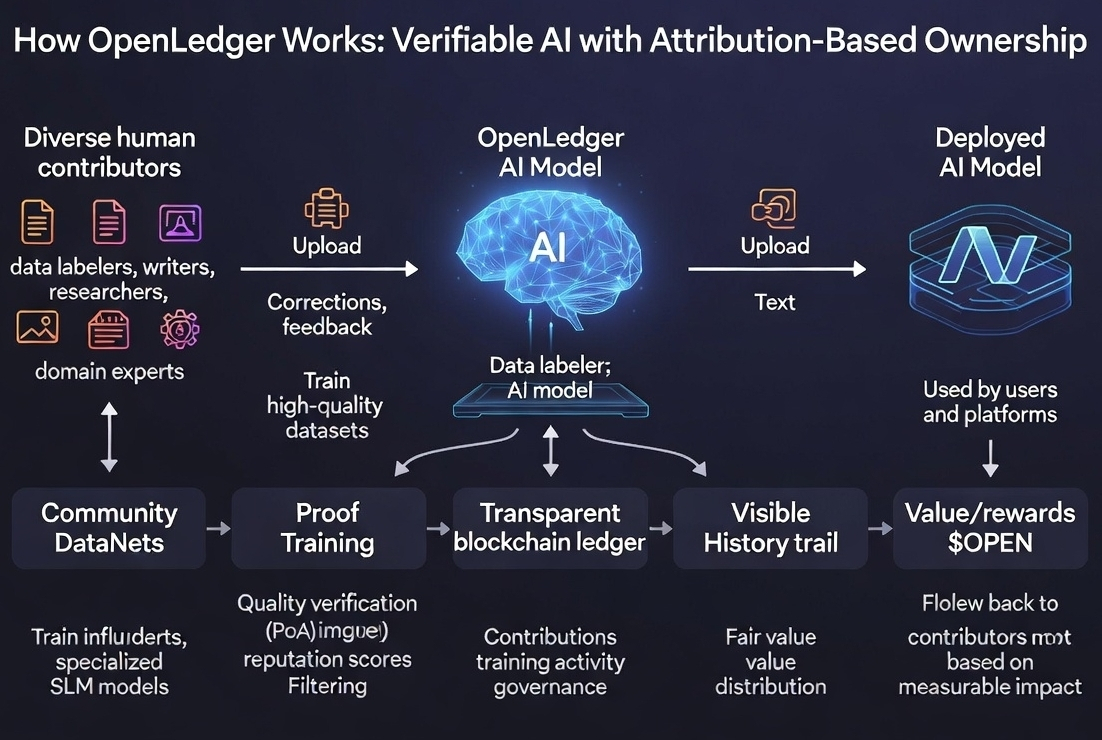
At its core, OpenLedger is built around a compelling idea: AI systems should retain transparent attribution for the people and data that helped create their intelligence. Rather than treating AI models as isolated products, the project promotes a framework where intelligence carries a verifiable history of contribution.
Its ecosystem combines community-driven datasets, specialized AI models, and transparent records tied to training activity, governance, rewards, and reputation systems. While technically ambitious, the broader philosophy behind the project is fundamentally human — contributors should remain connected to the value they help generate.
For years, AI development has followed an imbalanced model. Human knowledge enters the system, but recognition and economic value rarely return to the individuals improving accuracy, organizing information, refining outputs, or validating data quality.
OpenLedger challenges this dynamic through the concept of attribution-based ownership.
The principle is straightforward: if specific datasets or contributions improve a model’s performance, the individuals behind those contributions should not become invisible once the system scales. Their impact should remain measurable, transparent, and potentially rewardable.
This introduces a meaningful shift in how value distribution could function within AI economies. Instead of ownership residing solely with the entity deploying the model, value may also flow back toward the contributors who shaped the intelligence itself.
However, implementing this vision is far from simple.
AI systems do not isolate influence cleanly. Contributions overlap continuously — one dataset may strengthen reasoning, another may reduce hallucinations, while others only improve performance in niche or edge-case scenarios. Measuring meaningful contribution inside large-scale models is an extremely difficult technical challenge.
That is why OpenLedger’s true challenge extends beyond transparency alone. The larger objective is creating meaningful transparency.
The platform attempts to address this through contribution tracking, data quality evaluation, reputation systems, training influence measurement, and mechanisms designed to filter harmful or low-quality inputs. Maintaining that balance is critical, because open contribution without standards can weaken an ecosystem instead of strengthening it.
Yet the most important aspect of this discussion may not be technical at all.
Verifiable AI fundamentally changes how society thinks about intelligence and trust. It challenges the idea that users should rely entirely on opaque black-box systems without visibility into the origins of their knowledge. It also raises broader questions about whether companies should benefit exclusively from collective intelligence while contributors remain unrecognized.
As AI expands deeper into finance, automation, software development, infrastructure, and decision-making systems, these questions become increasingly significant:
• Who influenced the model?
• Who benefits from its success?
• Who is accountable when harmful data creates harmful outcomes?
• And who deserves rewards when collective knowledge generates real economic value?
OpenLedger does not fully solve these questions today. The project still needs to prove that attribution systems can scale effectively and that contributors will have sustainable incentives to participate long term.
Even so, the direction itself feels important.
The future of AI ownership may not belong solely to a single company attached to a model. It may evolve into something more transparent and collaborative — a network where contribution, recognition, and value remain connected rather than disappearing behind the machine.
That future will likely remain imperfect and heavily debated.
But it may still be far more equitable than the silence that exists today.