
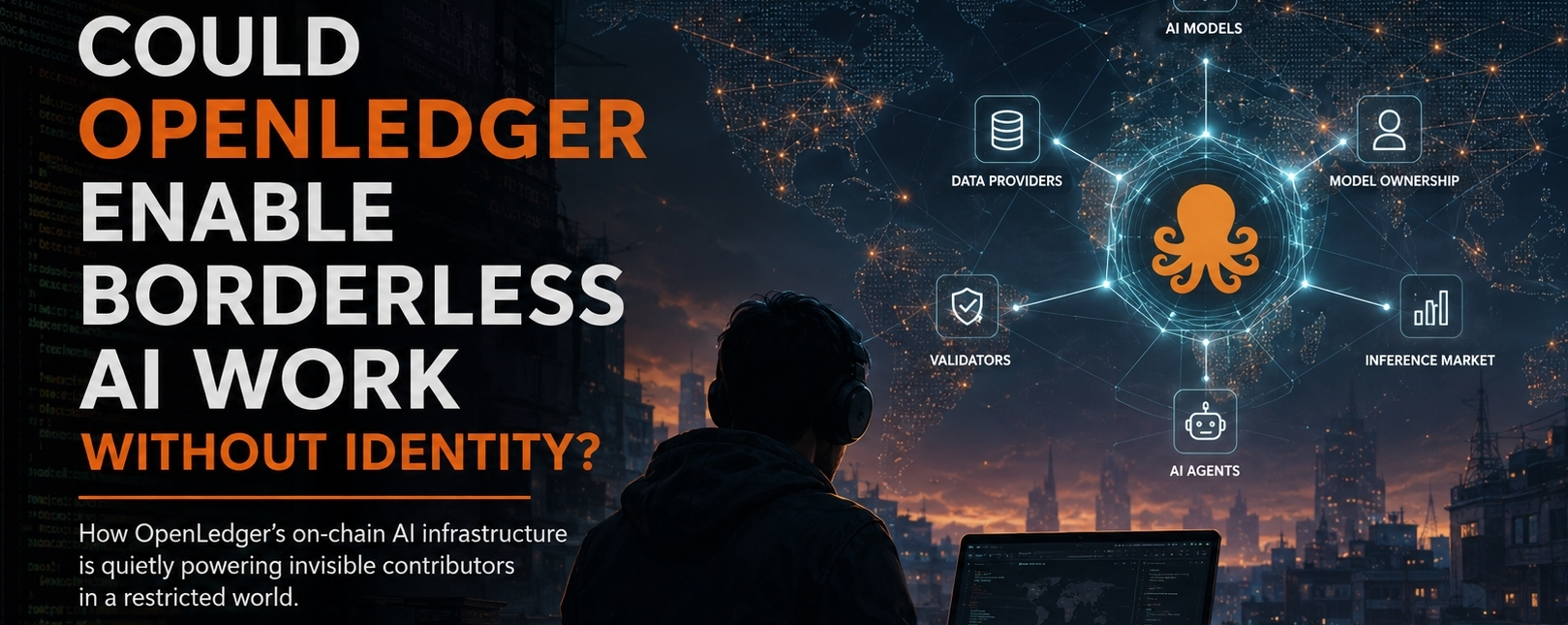

Something changed quietly over the last year. I started noticing more AI contributors hiding instead of promoting themselves.
Not because they lacked skill. Mostly because visibility became risk.
In some regions, publishing data sets, training models, or interacting with global AI networks started attracting attention that people simply did not want. Sanctions. surveillance. capital controls. platform restrictions. Sometimes just the fear of being seen participating in systems outside local approval structures.
At the same time AI work itself became more fragmented. The market stopped rewarding only massive centralized labs. Smaller contributors started finding ways to monetize narrow intelligence. Specialized data. local context. validation work. inference coordination. agent behavior tuning.
That shift matters a lot for OpenLedger.
The project feels less important to me as a pure AI chain and more important as infrastructure for invisible participation. Almost like a financial layer for intelligence contributions that can move without forcing identity into the center of the system.
I think people still underestimate how powerful that becomes in restricted countries.
A developer in a heavily monitored region may not be able to openly launch a startup. They may not even have access to global payment rails. But contributing to decentralized AI networks is different. The work can become modular. Distributed. Sometimes anonymous enough to blend into ordinary on-chain activity.
That is where OpenLedger starts feeling structurally relevant instead of narratively exciting.
Its on chain AI infrastructure creates a system where contribution itself becomes measurable and rewardable. Data providers, validators, model builders, and AI agents interact inside the same economic environment. Ownership and participation are tied directly into the blockchain architecture rather than sitting behind corporate platforms.
I keep thinking about what this means for people who cannot safely participate in normal tech economies.
OpenLedger’s Ethereum compatibility matters here more than people realize. Wallet integration and smart contract coordination make participation look financially native rather than institutionally approved. That changes the entry point completely. A contributor does not necessarily need a local company, banking relationship, or public identity layer to interact with the network.
They just need access.
And honestly, that creates uncomfortable questions too.
Because once AI contribution becomes globally monetizable without strong identity exposure, OpenLedger stops being just a coordination system. It becomes part of a parallel labor economy. Quietly borderless. Quietly difficult to regulate.
I do not think the market has fully absorbed that yet.
Most people still discuss AI crypto through token prices or speculative narratives around agents. But underneath that noise, OpenLedger is experimenting with something more sensitive: whether intelligence itself can become exportable labor without exporting the worker.
That is a very different thing.
The interesting part is how incentives shape behavior inside the network. OpenLedger does not really rely on idealism. It assumes contributors respond to economic opportunity. Data monetization, AI model ownership, liquidity around model outputs, and agent deployment all push users toward participation because there is potential upside attached to useful activity.
That incentive realism actually makes the system feel more believable to me.
But it also creates fragility.
If rewards become the main driver, low-quality participation eventually appears. Synthetic data farms. fake validation loops. automated contribution spam. Every on chain incentive system runs into this pressure. OpenLedger is not magically immune just because the theme is AI.
The harder challenge is whether the network can continuously identify useful intelligence instead of merely measurable activity.
I think about that a lot when people describe AI ownership as the future.
Do contributors really care about owning model participation? Or do they simply want stable income streams that survive unstable local economies? Those are not the same motivation. In many restricted regions, financial access matters more than governance rights or ideological decentralization.
OpenLedger may eventually discover that its strongest users are not crypto-native investors at all. They may be invisible contributors operating quietly from places where global participation was previously impossible.
And that changes the emotional tone of the network.
The system starts looking less like speculative infrastructure and more like economic camouflage for intelligence work.
There is something both hopeful and uneasy about that.
Because governments eventually notice when value starts leaving borders through nontraditional channels. Especially when the exported resource is not capital or manufacturing but human cognition itself.
I can already imagine the tension forming over time. Anonymous AI contribution markets. Wallet-based earnings. Cross-border model coordination. Agents interacting economically without revealing where contributors actually live.
OpenLedger seems oddly positioned for that future.
Not because it loudly promises revolution. Mostly because its architecture accidentally aligns with deeper geopolitical pressure already building around AI labor and digital sovereignty.
Still, I am not sure the market is fully ready for what that implies.
People like the idea of decentralized AI when it sounds abstract. They become less comfortable when decentralization starts protecting economically active people that traditional systems cannot easily see, track, or control.
Maybe OpenLedger arrives at exactly the right moment.
Or maybe it arrives before the world decides whether silent knowledge economies are something it actually wants to allow.