
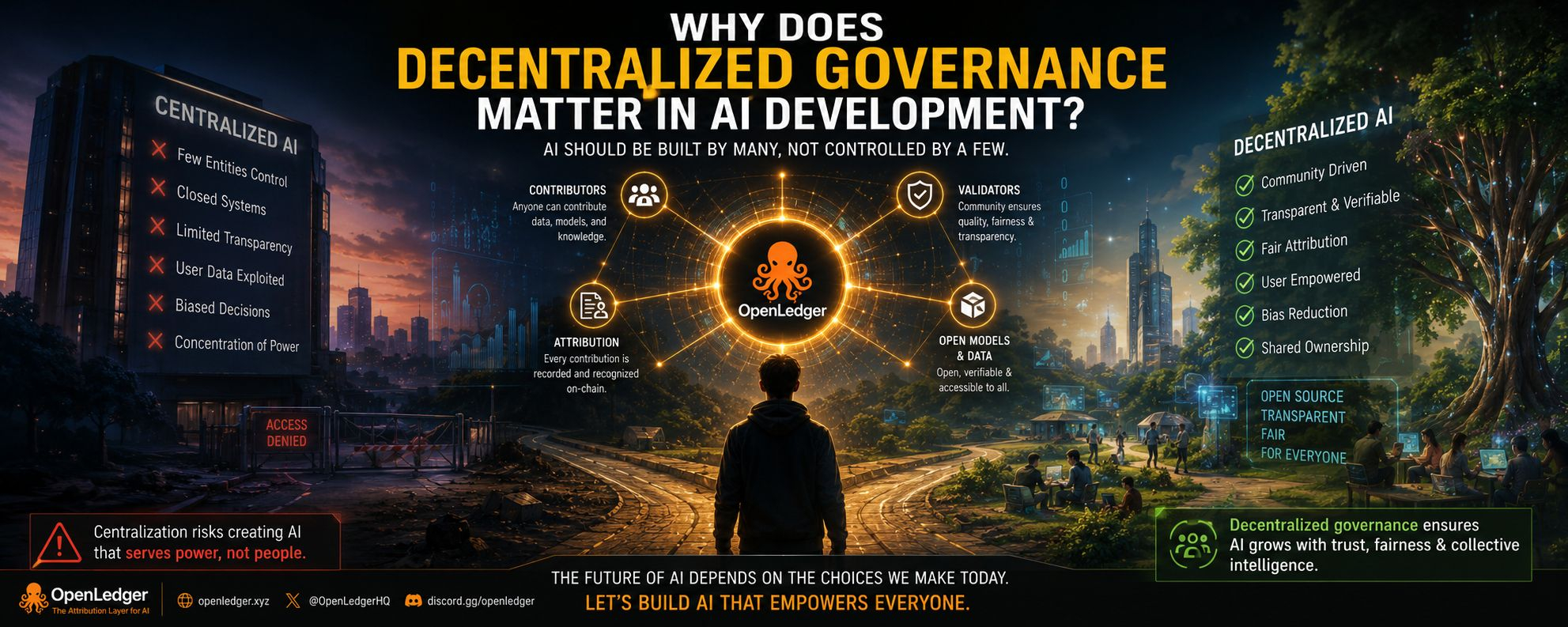

today i was scrolling through Binance Square like normal checking random posts, market noise, people talking about AI again like always
and honestly, most of it started sounding the same after a while.
AI will change everything. AI is the future. next revolution.
everyone keeps repeating that part.
but then i stopped on OpenLedger again… and something about the governance side kept bothering me in a good way.
because the more powerful AI becomes the more strange it feels that a small number of companies still control most of it.
models, training decisions, data access, safety rules, visibility, monetization
almost everything important happens behind closed systems.
and i don’t think most people fully realize how important that becomes later.
because AI isn’t just another app anymore.
it’s slowly becoming infrastructure.
the same way search engines shaped information social media shaped attention AI may end up shaping decision-making itself.
and if that happens then governance matters way more than people think.
that’s where decentralized governance starts feeling less like a Web3 feature and more like a necessary balance layer.
because honestly, intelligence controlled by only a few entities eventually creates the same problem every centralized system creates: the people contributing value slowly lose influence over the system itself.
and AI already runs on massive invisible contribution.
human feedback, datasets, corrections, conversations, testing, evaluation, specialized knowledge
millions of people indirectly shape these systems every day.
but most of them never really have a voice in how the systems evolve afterward.
that disconnect feels bigger every time i think about it.
because if AI is trained collectively why is control usually centralized?
OpenLedger keeps pushing toward a different direction there.
not just decentralized infrastructure but decentralized coordination around intelligence itself.
and maybe that’s the real challenge.
because governance inside AI isn’t only about voting.
it’s about: who decides model behavior, who controls updates, who benefits economically, whose contribution gets recognized, whose data matters, what becomes visible, what gets filtered out.
those decisions shape the intelligence people interact with every single day.
and centralized systems usually optimize for platform survival first.
that’s normal. every system protects itself.
but decentralized governance changes incentives slightly.
instead of one entity controlling evolution… the system starts behaving more like negotiation between contributors, validators, developers, communities, and usage itself.
not perfect. probably messy sometimes.
but maybe that messiness is healthier long-term.
because intelligence is becoming too important to exist without accountability.
and blockchain starts mattering differently there too.
not just for transactions but as memory.
a layer that keeps track of: contribution, attribution, governance, model evolution, economic distribution.
almost like OpenLedger is trying to make AI systems remember who helped shape them instead of absorbing contribution invisibly.
and honestly that idea feels more important the longer i sit with it.
because maybe the future problem won’t be whether AI becomes intelligent.
maybe the real problem is: who gets to steer that intelligence once everyone depends on it. and if governance stays centralized while intelligence becomes global
then AI may end up repeating the exact same internet power structures we already struggle with today.
which is probably why decentralized governance suddenly feels less ideological and more necessary.
