
@OpenLedger Is Turning AI Data, Models, and Agents Into Liquid Onchain Assets
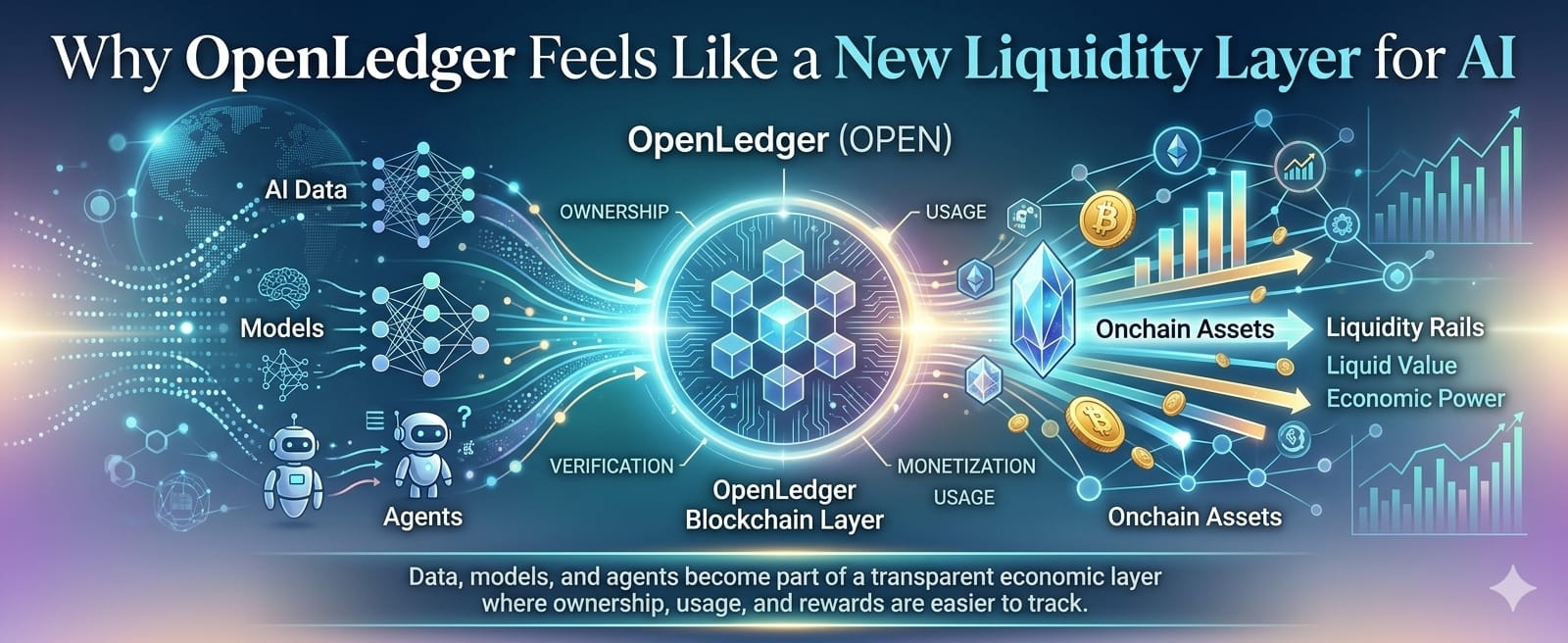
OpenLedger (OPEN) is building around one of the most important ideas in the AI and blockchain space: turning data, models, and agents into assets that can actually be owned, verified, monetized, and used across an open network. In most AI systems today, value is created from data, but the people, communities, and developers behind that data often stay invisible. OpenLedger is trying to change that by creating an AI blockchain where contribution does not disappear inside a closed model. Instead, data, models, and agents can become part of a transparent economic layer where ownership, usage, and rewards are easier to track.
What makes OpenLedger interesting is that it is not only talking about AI in a general way. It is focused on liquidity. That matters because liquidity is what turns something from being useful into being economically powerful. Data on its own can be valuable, but if it cannot be priced, accessed, verified, or monetized properly, then most of that value stays locked. The same applies to AI models and agents. A model may be useful, and an agent may perform real tasks, but without a proper market layer around them, their value remains limited. OpenLedger is trying to unlock that hidden value by giving these AI assets a blockchain-native foundation.
The bigger picture is simple but powerful. As AI grows, the world will need more than just bigger models. It will need trustworthy data, accountable systems, and clear incentives for the people who help build intelligence. OpenLedger fits into that shift because it treats AI infrastructure as something that should be open, verifiable, and economically connected. Instead of letting value flow only to centralized platforms, OpenLedger introduces a structure where contributors, developers, data providers, model builders, and agent creators can all become part of the network economy.
This is why OpenLedger feels different from many AI crypto projects. A lot of projects use AI as a narrative, but OpenLedger is aiming at the infrastructure layer beneath the narrative. It is trying to create the rails where AI assets can move, generate revenue, and build reputation over time. If AI agents become a major part of the next digital economy, then the systems that help monetize and verify those agents could become extremely important. OpenLedger is positioning itself in that exact area, where blockchain is not just an add-on but a coordination layer for AI value.
The most organic way to understand OpenLedger is this: it is not only building for artificial intelligence, it is building for artificial intelligence ownership. Data should not simply be extracted. Models should not exist without traceability. Agents should not operate without economic identity. OpenLedger brings these pieces together and gives them a liquidity layer, making it possible for AI-related assets to become more open, useful, and financially active.
For the next cycle, projects that only chase hype may fade quickly, but infrastructure that solves real coordination problems can stay relevant much longer. OpenLedger has that kind of potential because it sits at the intersection of AI, blockchain, liquidity, and ownership. If the future of AI depends on better data, more transparent model usage, and smarter autonomous agents, then OpenLedger could become one of the projects people look back on as an early foundation for that shift.