I don’t think artificial intelligence becomes truly smart just because it has more data. More data can make it faster. It can make it sound more confident. It can help it answer more questions. But that doesn’t always mean it understands life better. In real situations, knowledge is never just about facts. It’s about experience, judgment, timing, culture, and the small details that only people close to a problem can understand.
That is why datanets are important.
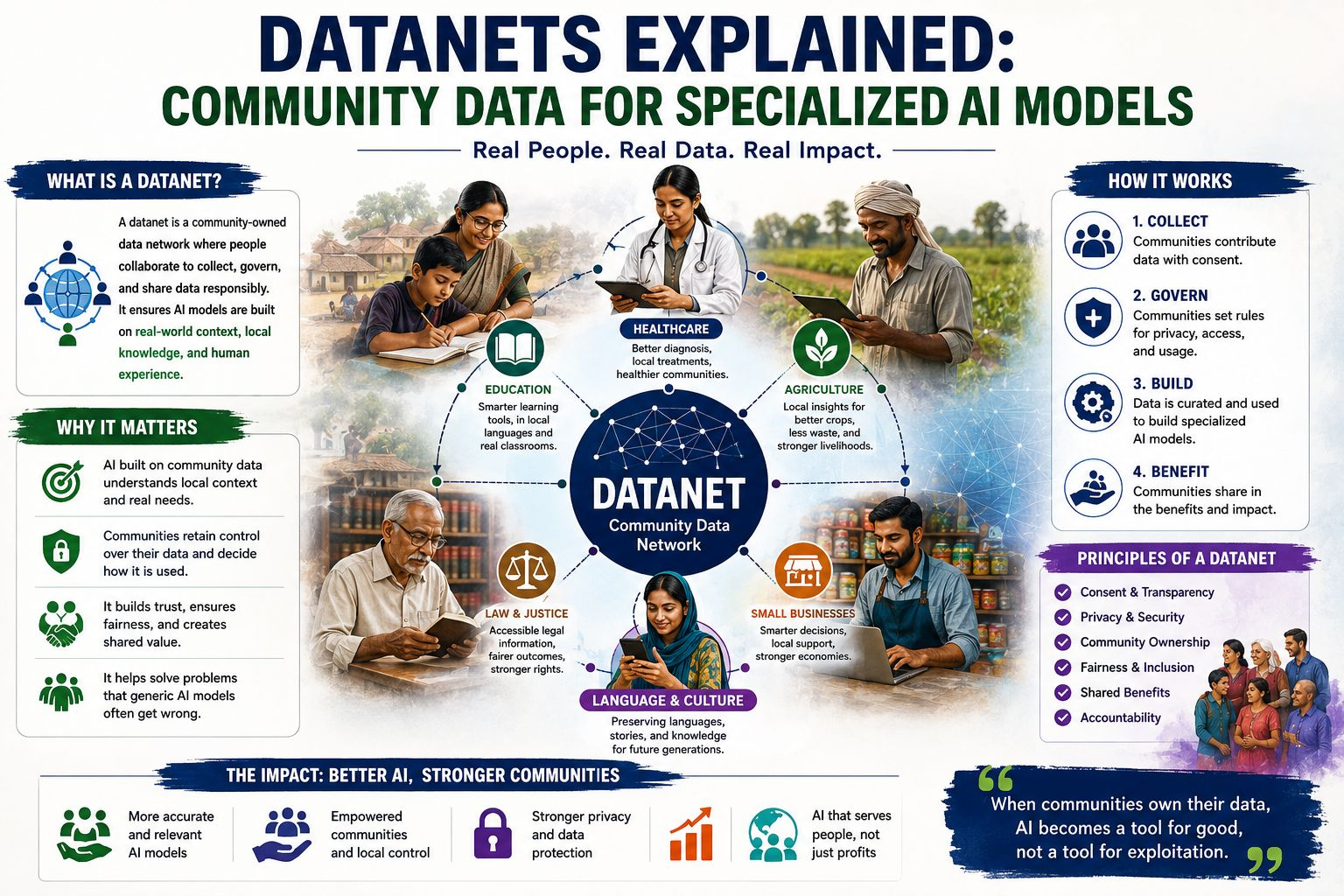
A datanet is not just a collection of information. It is a data network built by a community that understands the meaning behind the data. It could be created by doctors, teachers, farmers, lawyers, researchers, small business owners, or people who speak a local language. The value of a datanet is not only in the data itself, but in the people who know why that data matters.
For many years, AI companies have treated human knowledge like something they can simply collect and use. Articles, images, books, code, conversations, and professional knowledge have all helped train AI systems. But many of the people behind that knowledge were never asked. They were not paid. They were not included in the decisions. Their work became part of powerful systems, but they had very little control over what happened next.
That does not feel fair. It also does not feel human.
Datanets offer a better way. They suggest that communities should not only give data. They should also help control it. They should decide what can be shared, what should stay private, who can use the data, and who should benefit from it. This matters because data is not empty material. Behind every useful piece of data, there is usually a person, a place, a memory, a profession, or a lived experience.
A doctor’s knowledge is not only found in medical books. It comes from listening to patients, noticing fear, understanding local health problems, and making decisions when resources are limited. A teacher’s knowledge is not only in lesson plans. It comes from seeing when students are confused, tired, shy, or losing confidence. A farmer’s knowledge is not only in weather reports. It comes from years of watching soil, rain, pests, crops, and seasons. A lawyer’s knowledge is not only in written laws. It comes from understanding people, procedures, risk, and real consequences.
This is the kind of knowledge that general AI often misses. A broad AI model may give a decent answer, but it may not understand the real situation behind the question. It may explain farming, but not understand a specific region’s soil and water problems. It may explain healthcare, but not understand a patient who cannot afford treatment. It may explain education, but not understand a classroom where children speak different languages at home.
Datanets can help fix this gap. They can make AI more local, more practical, and more connected to real human needs. A healthcare datanet could help AI understand local diseases and patient realities. An education datanet could help AI support teachers and students in a specific curriculum or culture. An agriculture datanet could help farmers receive advice based on their own land and weather conditions. A language datanet could help preserve voices and cultures that are often ignored by big technology systems.
But datanets must be handled carefully. If they are controlled by the same powerful companies that already dominate AI, they could become another form of exploitation. A company might use words like “community” and “empowerment,” while still taking the data, owning the model, and keeping the profit. That would not be a real partnership. That would just be extraction with softer language.
A true datanet must give people real power. Communities should know how their data is being used. They should be able to say no. They should be able to remove their data. They should have a say in decisions. They should also share in the benefits if their knowledge helps create valuable AI tools.
This is especially important for sensitive areas like healthcare, education, law, and culture. Health data contains pain, fear, and personal history. Education data contains children’s struggles and learning journeys. Legal data contains conflict and private problems. Cultural data contains identity, memory, and tradition. These things should never be treated like ordinary raw material.
Not every piece of human knowledge should be collected. Not every story should become training data. Not every tradition should be turned into a product. Sometimes respect means using data carefully. Sometimes respect means leaving it alone.
Datanets also need fair governance. Communities are not perfect. Some voices are louder than others. Some people are ignored even when they have valuable knowledge. A datanet built by professionals might forget ordinary workers. A language datanet might ignore rural speakers. A farming datanet might include landowners but not laborers. So if datanets are going to be fair, they must include different voices, especially the voices that are usually left out.
The future of AI should not only belong to companies with the biggest models and the most money. It should also belong to the people who understand the meaning behind the data. Because data without meaning is just noise. And intelligence without responsibility can become dangerous.
For me, datanets are important because they bring AI closer to real life. They remind us that useful knowledge comes from people, not just machines. It comes from experience, mistakes, observation, care, and trust. If AI is built from human knowledge, then humans should not be pushed to the background. They should be respected as partners.
If we build datanets with honesty, consent, and fairness, they could make AI more accurate and more humane. They could help create tools that support doctors, teachers, farmers, lawyers, small businesses, and local communities. But if we build them carelessly, they will only repeat the same problem: taking knowledge from people while giving them little control in return.
The real question is not whether AI can become more powerful. It already can. The real question is whether it can become more responsible. Datanets give us a chance to answer that question in a better way.
AI should not be built by silently taking from communities. It should be built with them. It should respect their knowledge, protect their rights, and share the value it creates. Because behind every useful dataset, there are real people. And if AI forgets that, it may become impressive, but it will never become truly wise.