
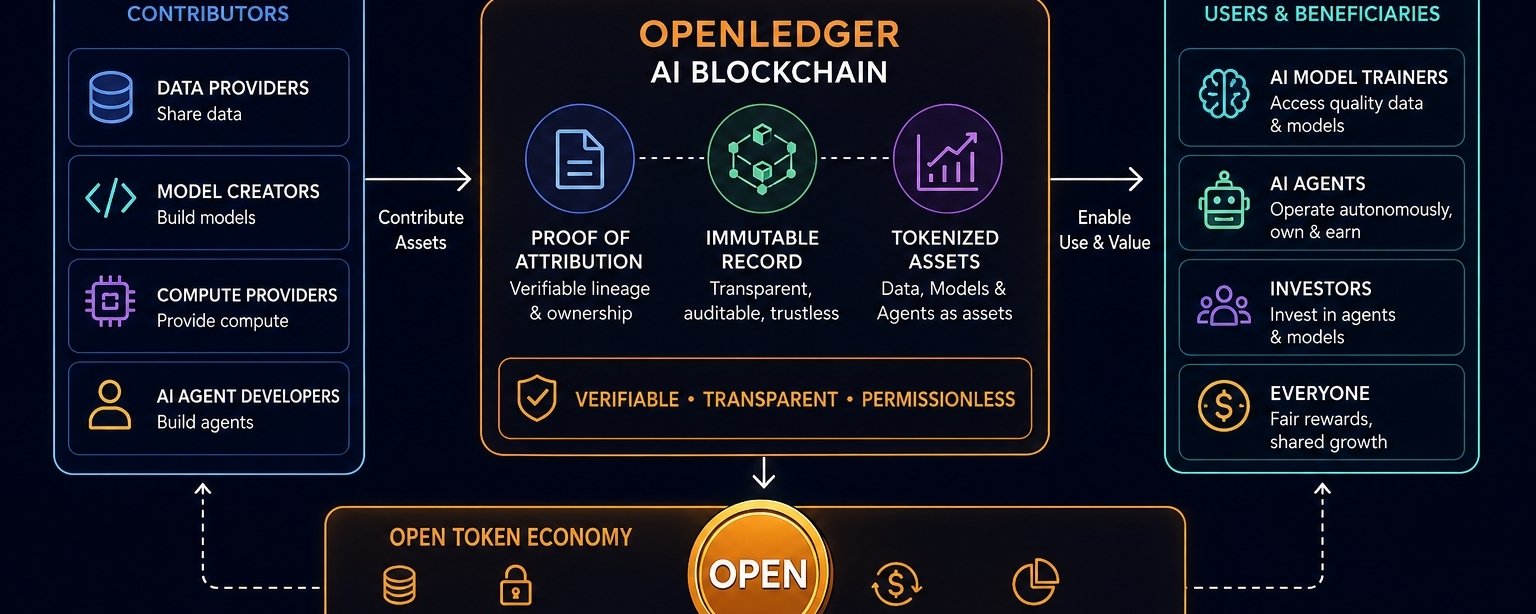
There is a quiet tension building in the world of artificial intelligence, a disconnect between the futuristic promises we see in headlines and the reality of how these systems are actually built. For years, we have been told that AI is the next industrial revolution, a tool that will solve cancer, optimize energy grids, and write poetry. Yet, beneath the glossy surface of chatbots and image generators lies a deeply flawed economic model. The current landscape is dominated by a handful of centralized tech giants that operate like black boxes, hoarding the two most valuable resources of the digital age: data and compute. The developers, researchers, and everyday users who actually fuel these systems with their information and creativity are left on the outside looking in, their contributions effectively unpaid labor. This is where OpenLedger enters the conversation, not just as another blockchain project, but as a fundamental infrastructure play designed to democratize the very lifeblood of AI.
To understand why OpenLedger is necessary, we first have to look at the problem it aims to solve, which is the lack of verifiable attribution and liquidity in the AI supply chain. In the traditional Web2 model, a company might scrape billions of images or text entries from the public internet to train a model. The creators of that data—artists, writers, programmers, and ordinary internet users—have no way to prove their contribution, let alone monetize it. It is a one-way street where value flows upwards to the corporation, leaving the contributors with nothing but a free service, if that. OpenLedger proposes a radical shift in this dynamic by introducing the concept of "Proof of Attribution." Imagine a system where every piece of data, every trained model, and every autonomous agent carries a verifiable history of its creation and contributors. This isn't just about tracking data; it is about turning data into an asset class that can be owned, traded, and monetized in real-time.
The platform describes itself as an AI Blockchain, and this distinction is crucial. It is not a general-purpose chain trying to shoehorn AI capabilities into an existing architecture; it is built from the ground up to handle the specific demands of machine learning workflows. At its core, OpenLedger is an infrastructure layer that connects data providers, model creators, and AI agents in a transparent, trustless environment. By leveraging blockchain technology, specifically a high-performance architecture designed for heavy computational tasks, it ensures that when an AI model is trained, the lineage of that training is immutable. This solves one of the biggest hurdles in the industry: the "black box" problem. Suddenly, the opaque process of how an AI reaches a decision or how it was built becomes an open book, auditable by anyone on the network.
This brings us to the most compelling aspect of the OpenLedger ecosystem: the monetization of data, models, and agents. For the first time, we are seeing a viable path to turn these abstract digital concepts into liquid assets. Consider a small indie developer who has curated a high-quality dataset for medical research. In the current world, they might try to sell that dataset once, if they are lucky, or struggle to find a buyer. On OpenLedger, they can tokenize that dataset, making it available for model trainers to use. Crucially, because of the blockchain's tracking capabilities, the developer doesn't just sell it once; they can earn ongoing royalties every time that data is used to train a model that generates revenue. It transforms a static file into a perpetually yielding investment. This creates a powerful incentive for high-quality data creation. When people are fairly compensated for their contributions, the overall quality of the AI ecosystem rises, combating the "garbage in, garbage out" syndrome that plagues many current models.
But the vision extends far beyond static data. We are entering the era of AI agents, autonomous software programs that can perform tasks, make decisions, and interact with the world with minimal human oversight. OpenLedger is positioning itself as the financial and operational backbone for these agents. Imagine an AI agent designed to optimize trading strategies or manage supply chains. On a traditional platform, this agent would be a walled garden, its code proprietary and its actions opaque. On OpenLedger, the agent can be permissionless, meaning its performance and logic are verifiable on-chain. More importantly, the agent itself can own capital, pay for the data it consumes, and distribute profits to its creators and stakeholders. This unlocks a new dimension of liquidity. Investors can essentially buy a stake in a successful AI agent, backing it the way venture capitalists back a promising startup, knowing that the agent's performance is transparently recorded and its revenue streams are automated via smart contracts.
The role of the OPEN token in this ecosystem is to serve as the lifeblood that keeps these markets flowing. It is the currency used for transaction fees, staking, and incentivizing participants to maintain the integrity of the network. However, its most vital function is as a bridge between value creation and value capture. When a model is trained using a specific dataset, the payment in OPEN tokens can be automatically routed to the data provider, the compute provider, and the model architect. This programmable money layer eliminates the need for intermediaries, legal disputes over intellectual property, and delayed payments. It creates an economy that operates at the speed of software, where value is transferred instantly and accurately based on the actual utility provided. This is the essence of "unlocking liquidity"—taking assets that were previously illiquid, like a proprietary algorithm or a niche dataset, and giving them a transparent, global market price.
What makes this approach so engaging for the broader tech community is that it addresses the growing ethical and economic concerns surrounding AI. There is a palpable anxiety among creatives and knowledge workers that they will be replaced by the very machines trained on their work. OpenLedger offers a counter-narrative: a future where humans and AI collaborate, and where the human contribution is perpetually recognized and rewarded. It suggests a symbiotic relationship rather than a parasitic one. For instance, a writer could contribute their style to a language model and receive micropayments every time that model is used to generate text in their voice. This shifts the focus from AI as a tool of displacement to AI as a platform for scalable individual creator economies. It is a vision that aligns the incentives of tech giants, indie developers, and everyday users, potentially steering the industry away from a winner-takes-all outcome.
Of course, no technology is without its challenges, and the path to a decentralized AI economy is fraught with technical and adoption hurdles. Scalability remains a concern for any blockchain handling the massive throughput required for AI training and inference. Furthermore, convincing the major AI players to migrate from their current closed, high-margin business models to an open, transparent system will be a significant uphill battle. However, the momentum is shifting. The open-source AI movement is growing rapidly, driven by a belief that monopolies on intelligence are dangerous and inefficient. OpenLedger provides the missing economic layer that open-source has always lacked—a way to monetize without closing the source. It offers a viable alternative where the network effect of open data and models can compete with the deep pockets of centralized corporations.
As we look toward the future, the convergence of blockchain and artificial intelligence feels less like a trend and more like an inevitability. The current centralized model is efficient for the owners but brittle and unaccountable to the rest of the world. OpenLedger represents a maturation of the crypto space, moving beyond speculative trading to solve real-world problems of ownership and attribution in the most dynamic sector of the global economy. It is building the rails for a new kind of internet, one where intelligence is a commodity that is traded openly, where data is an investment that yields returns, and where AI agents are not just tools, but economic entities in their own right.
In conclusion, OpenLedger is doing more than just building a blockchain; it is architecting a new social and economic contract for the age of artificial intelligence. By tackling the hard problems of attribution and liquidity, it promises to unlock a wave of innovation that could be stifled by the current gatekeepers. For the data scientist sitting on a valuable dataset, the developer with a breakthrough model, or the investor looking to capture value in the AI boom, this platform offers something that has been missing for too long: agency. It is a move towards a world where the creators of the future's most powerful tools are also its owners, ensuring that the age of AI is defined not just by unprecedented intelligence, but by unprecedented fairness. The technology is complex, but the premise is simple: if we want AI to truly serve humanity, then the economy of AI must be built for everyone.
