
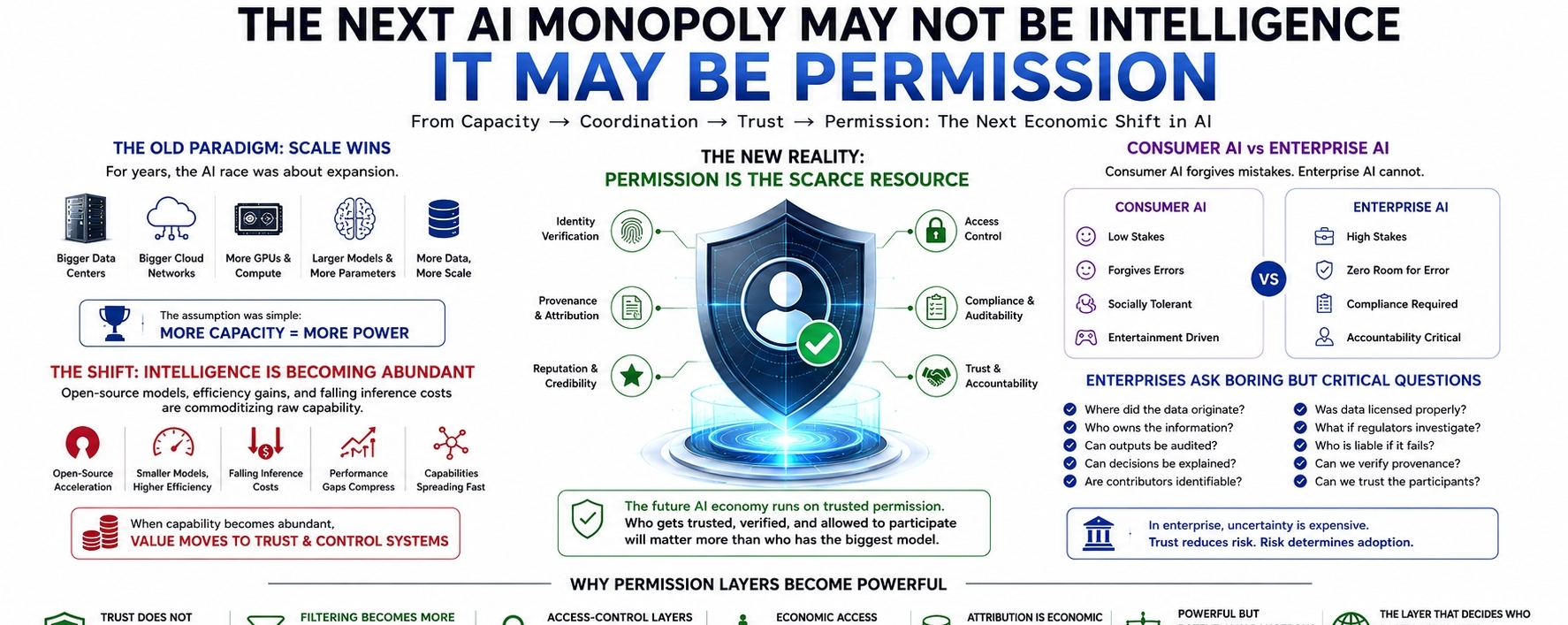
The Next AI Monopoly May Not Be Intelligence
It May Be Permission
For most of the last decade, digital infrastructure has been measured through expansion. Bigger systems won. Bigger data centers. Bigger cloud networks. Bigger compute clusters. Bigger models trained on larger oceans of information.
Scale became the dominant language of technology because scale was easy to understand. Investors could visualize it. Markets could price it. Media narratives could simplify it into a single sentence:
More capacity equals more power.
Artificial intelligence inherited that logic almost automatically.
The assumption became deeply embedded across the entire industry:
The company with the largest models, the most GPUs, the biggest training runs, and the deepest infrastructure stack would eventually dominate the future.
And for a while, that assumption looked correct.
Every major breakthrough seemed to reinforce it.
Larger models produced better outputs. More parameters created stronger reasoning. Bigger datasets unlocked wider capabilities. Compute became the strategic weapon of the modern economy.
Even today, most AI discussions still orbit around the same gravitational center:
Who has the most compute? Who is scaling faster? Who can train bigger systems? Who can acquire more chips? Who can expand infrastructure first?
Markets continue rewarding this story because it feels tangible.
There is comfort in measurable expansion.
But technological history has a strange habit of changing scarcity once industries mature.
At first, the scarce resource is usually capacity.
Later, the scarce resource becomes coordination.
And eventually, the scarce resource becomes trust.
I think AI may be approaching that transition now. Quietly. Almost invisibly.
Because beneath all the noise around model performance, open-source competition, and compute races, another layer is beginning to matter far more than people expected.
Permission.
Not permission in the simplistic software sense.
Permission in the economic sense.
Who gets trusted. Who gets verified. Who gets allowed near sensitive systems. Who is considered credible enough to participate in high-stakes environments.
That layer may ultimately become more valuable than intelligence itself.
And I suspect the market is dramatically underestimating how important this shift could become.
The Marketplace Framing May Already Be Outdated
Projects like OpenLedger are usually described in familiar crypto language.
An AI marketplace. A decentralized coordination layer. A network where contributors provide data or intelligence resources while developers consume them.
Tokens align incentives. Participants earn rewards. Supply meets demand.
Simple. Clean. Understandable.
Crypto loves marketplace narratives because marketplaces fit naturally into token economics. Activity generates volume. Volume generates fees. Tokens absorb value from network participation.
The framework feels intuitive because crypto has repeated it for years.
But the more I look at actual enterprise AI adoption, the less convinced I am that “marketplace” is the right lens anymore.
The real bottleneck in AI may not be matching supply with demand.
It may be determining which participants can safely supply anything at all.
That sounds subtle at first. Almost semantic.
But it becomes extremely important the moment AI leaves low-risk consumer environments and enters systems where mistakes carry real consequences.
Because the rules change completely once AI begins interacting with institutions instead of individuals.
Consumer AI And Enterprise AI Live In Different Universes
Consumer AI creates the illusion that capability is the only thing that matters.
If an image generator produces a distorted hand, people laugh. If a chatbot invents fake trivia, users move on. If a recommendation algorithm makes weak suggestions, nobody calls legal teams.
The stakes remain socially low.
But enterprise systems operate under entirely different conditions.
The moment AI starts influencing financial approvals, legal reviews, insurance decisions, healthcare workflows, internal operations, compliance analysis, fraud detection, customer access systems, or contract infrastructure, the conversation changes immediately.
Suddenly nobody cares how “creative” the system feels.
Nobody cares about viral demos.
Nobody cares whether the model sounds intelligent in public benchmarks.
Organizations begin asking boring questions instead.
And boring questions are usually the ones that determine whether real adoption happens.
Questions like:
Where did this training data originate?
Who owns the underlying information?
Can outputs be audited?
Can decisions be explained?
Can contributors be identified?
Was the data licensed properly?
What happens if regulators investigate?
Who becomes liable if the system fails?
Can we verify provenance?
Can we trust the participants behind the outputs?
These are not technical questions.
They are operational survival questions.
And crypto ecosystems historically underestimate how much institutions care about them.
Engineers often optimize for openness. Institutions optimize for accountability.
Those incentives are not always compatible.
Intelligence Is Becoming Abundant
This is where the AI narrative becomes extremely interesting.
Because while the market remains obsessed with intelligence production, intelligence itself is becoming less scarce surprisingly fast.
That is not what most people expected two years ago.
The assumption was that frontier models would remain protected behind enormous infrastructure moats.
But reality evolved differently.
Open-source models improved faster than expected. Smaller models became more efficient. Inference costs began falling. Capabilities spread across the market rapidly. Performance gaps compressed.
The industry is slowly discovering something important:
Raw intelligence may commoditize faster than anticipated.
Not completely. Not immediately.
But enough to shift where value accumulates.
This happens in almost every technological cycle.
At first, production matters most.
Later, distribution matters.
Eventually, trust layers dominate everything.
The internet followed this pattern.
Cloud computing followed this pattern.
Payments followed this pattern.
Even social media followed this pattern.
Early growth rewards openness. Mature systems reward filtering.
AI may be entering the same transition.
Because once many systems become capable, capability alone stops differentiating participants.
And when capability stops being scarce, institutions begin optimizing for safety, traceability, and reliability instead.
That changes the entire economic structure underneath AI.
Trust Does Not Scale Like Compute
Compute scales aggressively.
Trust does not.
You can purchase more GPUs. You can train larger models. You can expand infrastructure rapidly.
But trust accumulates differently.
Slowly. Socially. Politically. Economically.
Trust requires reputation, accountability, provenance, verification, historical consistency, enforceable behavior, and governance structures people believe in.
Those systems are far harder to build because they involve human coordination rather than pure engineering.
And this is where OpenLedger starts looking less like a marketplace and more like a permission infrastructure layer.
That distinction matters enormously.
Most people interpret attribution systems as reward mechanisms.
Contributors provide value. Networks distribute compensation. Tokens align incentives.
Reasonable enough.
But attribution may ultimately matter more for filtering than rewarding.
That changes everything.
Attribution Is Not Just About Payment
It Is About Economic Credibility
Imagine two datasets entering an AI system.
Dataset A comes from broadly scraped public information with unclear ownership history, uncertain permissions, and no transparent provenance.
Dataset B comes from verified contributors with explicit licensing rights, documented origins, known usage conditions, and auditable history.
Technically, both datasets might improve model performance.
But economically, they are not remotely equivalent.
One introduces hidden uncertainty. The other reduces institutional risk.
And uncertainty becomes extremely expensive at scale.
This is where many crypto-native discussions miss the point.
The issue is not whether data can technically be used.
The issue is whether organizations feel safe building critical systems around it.
Those are completely different standards.
A model trained on ambiguous data may function perfectly today while creating catastrophic legal or operational liabilities later.
A model trained through verified contribution systems may appear slower or more restrictive initially, but institutions may prefer it precisely because it reduces unknown exposure.
That difference compounds over time.
The same thing happened in finance.
The same thing happened in cloud infrastructure.
The same thing happened in payments.
The systems that survived long term were not always the most open.
They were the ones institutions trusted enough to integrate deeply.
The Future AI Economy May Run On Permission
This becomes even more important once AI agents enter serious operational environments.
Everyone talks about autonomous agents as if widespread deployment is inevitable.
Maybe it is.
But people often assume the only missing ingredient is capability.
I doubt that.
An AI agent could become extremely competent and still remain commercially unusable.
Why?
Because competence without trust creates liability.
A company may believe an agent can perform tasks effectively while still refusing to let it interact with sensitive systems.
No serious institution wants anonymous or unverifiable autonomous systems handling financial workflows, contract execution, internal governance, compliance infrastructure, identity verification, enterprise operations, or customer-facing decisions unless the surrounding trust architecture is extremely mature.
That means the scarce resource eventually becomes something different.
Not intelligence.
Permission.
Trusted permission.
Who is authorized to contribute. Who is authorized to operate. Who is authorized to access valuable systems. Who is considered economically credible enough to participate.
This is not just infrastructure anymore.
It becomes economic access control.
And historically, access-control layers become some of the most powerful businesses in existence.
Because once institutions build operational dependency around trusted coordination systems, switching becomes painful.
Trust compounds. Integration compounds. Verification history compounds.
The network effect becomes behavioral rather than purely technical.
Those are the strongest infrastructure moats markets ever produce.
Every Open System Eventually Builds Hierarchies
There is also a deeper pattern repeating across technology itself.
Open systems rarely stay fully open forever.
At the beginning, openness feels efficient.
Maximum participation accelerates growth. Minimal friction encourages adoption. Permissionless contribution expands ecosystems rapidly.
But scale changes incentives.
As systems grow larger, noise increases. Spam increases. Manipulation increases. Liability increases. Coordination costs rise. Bad actors emerge. Verification becomes expensive.
Eventually, filtering becomes more valuable than openness itself.
This happened in social media.
This happened in payments.
This happened in cloud computing.
This happened in identity systems.
Even platforms that publicly celebrate decentralization quietly build trust hierarchies behind the scenes.
Because large systems eventually need differentiated credibility.
Not every participant gets treated equally forever.
That may be exactly where AI infrastructure is heading now.
And if that transition accelerates, attribution systems stop looking like optional features.
They start looking like foundational infrastructure.
The Dangerous Side Of Permission Economies
Of course, none of this is purely positive.
Permission systems create enormous risks too.
The moment economic value becomes attached to trust status, governance becomes political.
Who defines credibility?
Who decides which contributors qualify?
Who determines acceptable provenance standards?
Who can revoke participation rights?
Can reputation systems be manipulated?
Do tokens become coordination mechanisms — or toll booths?
These are serious concerns.
And history suggests gatekeeping systems naturally consolidate power over time.
That tension may become one of the defining conflicts inside decentralized AI infrastructure.
Because the same mechanisms that create institutional trust can also create exclusionary structures.
Too much openness creates chaos.
Too much filtering creates centralization.
Finding balance becomes extremely difficult.
Especially once real economic value enters the system.
The Market May Still Be Looking In The Wrong Direction
There is another uncomfortable reality here.
Even if OpenLedger solves meaningful infrastructure problems, that still does not guarantee token success.
Crypto repeatedly confuses useful protocols with valuable assets.
A network can become operationally important while the token itself captures very little durable value.
That risk remains real.
Enterprise adoption also moves far slower than crypto markets expect.
Most organizations still prefer traditional vendors, centralized accountability, and conventional legal agreements because procurement systems understand those structures better.
Institutional migration toward decentralized coordination layers may take years longer than token markets anticipate.
But even with those risks, I keep returning to the same conclusion:
The market may still be asking the wrong question entirely.
People continue debating whether AI marketplaces can scale.
But the more important question may be something deeper:
What happens when intelligence itself becomes abundant?
Because abundance changes economic priorities.
When capability spreads broadly enough, value migrates toward control systems.
Toward verification. Toward accountability. Toward provenance. Toward trusted coordination. Toward permission.
And if AI infrastructure is truly moving in that direction, then the dominant layer of the next decade may not be the systems producing intelligence.
It may be the systems deciding whose intelligence can safely participate in the economy at all.
That is a very different kind of infrastructure.
Less visible. Less exciting. Far more powerful.
And historically, those are exactly the layers that become hardest to replace once the world starts depending on them.
