
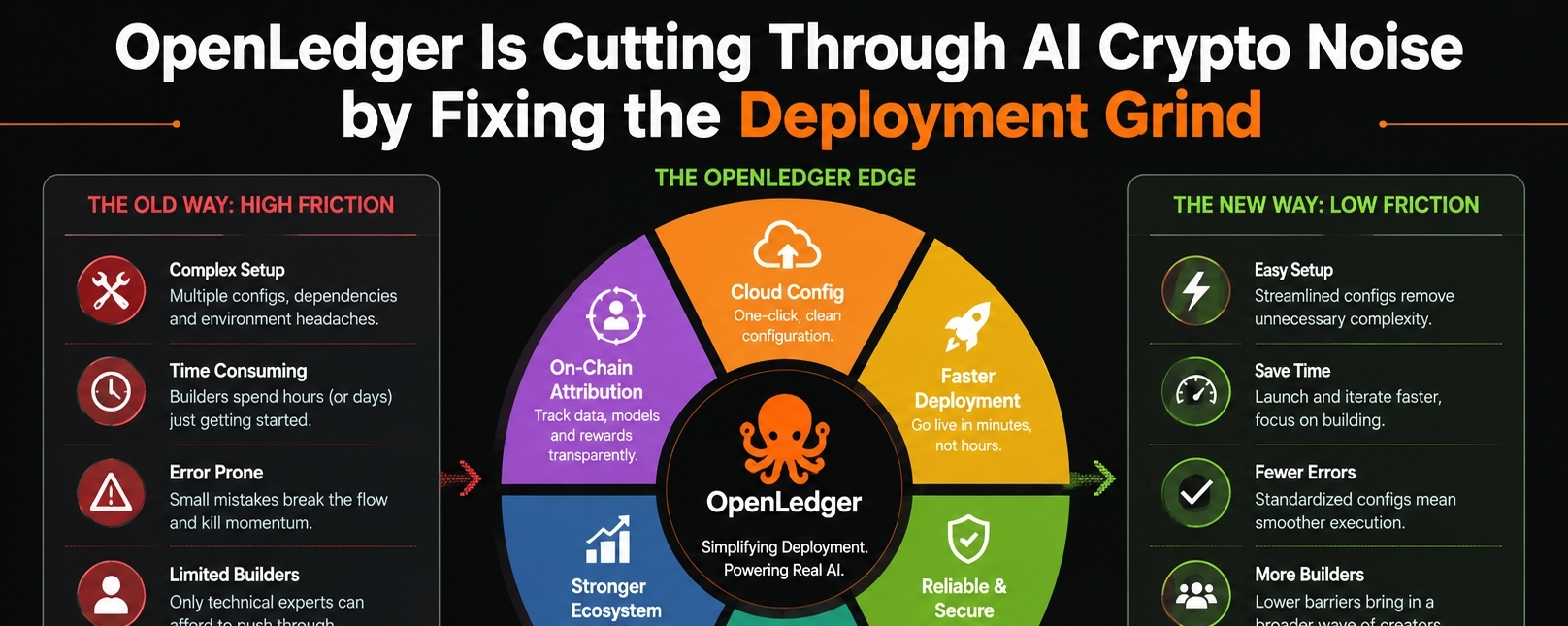

OpenLedger is starting to look less like another project trying to squeeze itself into the AI trade and more like one dealing with the part nobody wants to glamorize.
Deployment.
I know, it sounds dull. That is usually where the real work is hiding.
Every cycle has the same noise. New chain. New AI angle. New agent story. New promise that this time the system will be different. I’ve watched enough of these things come and go to know the pitch is never the hard part. The hard part starts when someone actually tries to build on it and gets buried under config files, network settings, wallet links, permissions, runtime errors, and all the tiny stupid things that can kill momentum before the idea even gets tested.
That is why OpenLedger’s cloud config updates are worth paying attention to.
Not because they are flashy. They are not. Nobody gets excited reading about setup flows unless they have already suffered through bad ones. But that is the point. AI deployment is still a grind. You can have a decent model, a clean agent idea, a strong data layer, and still lose builders because the path from idea to live execution feels like dragging metal through mud.
OpenLedger seems to be working on that friction.
And honestly, that is more interesting to me than another loud claim about AI on-chain.
The project’s broader idea is simple enough on paper: data contributors, models, agents, and rewards should be connected inside one system. Not scattered across closed platforms. Not hidden behind black boxes. Not built in a way where the people creating value disappear while the platform captures everything.
Good idea.
But good ideas are cheap in crypto. Painfully cheap.
The question is whether OpenLedger can make the system usable enough that builders do not quit halfway through the setup. Because if deploying an agent takes too much patience, most people will not do it. If every environment needs hand-holding, the ecosystem stays small. If the same problems keep repeating across every builder, the whole thing starts to feel less like infrastructure and more like unpaid troubleshooting.
I’ve seen that pattern before. Too many times.
A smoother cloud config layer does not solve everything, but it does attack one of the first places projects start bleeding users. Builders do not want to spend days fighting the base layer. They want to configure, deploy, test, break something, fix it, and move forward. That loop matters. It is where real ecosystems are born, not in announcement posts.
The thing with AI agents is that people talk about them like they are already fully alive.
They are not.
Most of them are still fragile. They need the right data. The right permissions. The right execution environment. The right wallet controls. The right network behavior. One wrong setting and the agent becomes useless, or worse, dangerous. A demo can hide that. A real deployment cannot.
So when OpenLedger puts energy into cloud config, I do not read it as a small technical footnote. I read it as the project touching the part that decides whether anything built on top can survive contact with reality.
That matters even more because OpenLedger’s model depends on connection.
Data has to feed models. Models have to power agents. Agents have to do something useful. Rewards have to trace back to whoever helped create the value. That chain sounds clean when written down. In practice, it is full of places where things can snap.
Deployment is one of those places.
If that layer is messy, the rest of the economic design starts to wobble. Attribution does not mean much if the model never gets used properly. Rewards do not mean much if agents cannot stay live. A marketplace does not mean much if builders cannot get from idea to working product without burning out.
That is the part I keep coming back to.
OpenLedger is not just trying to sell an AI story. It has to prove that AI systems can be launched, tracked, and rewarded in a way that makes sense inside a crypto-native environment. That sounds simple until you actually try to make it work.
The cloud config updates point in the right direction because they lower the entry cost for experimentation. Smaller builders need that. Independent developers need that. The long tail of people who might create weird, useful, niche agents need that. Big teams can throw engineers at ugly infrastructure. Smaller teams cannot. They just leave.
And once they leave, they usually do not come back.
This is where I get cautious, though.
A better setup flow is not the same as adoption. It is not proof that OpenLedger has figured out the whole AI economy. It does not prove agents will generate meaningful demand. It does not prove attribution will work cleanly when real incentives are involved. Crypto users are very good at gaming reward systems. Builders are very good at chasing incentives and disappearing when the rewards dry up.
I’m looking for the moment this actually breaks.
Not because I want it to fail. Because every serious project eventually hits the point where the pretty design meets ugly behavior. Users spam. Agents misfire. Data quality drops. Rewards attract farmers. Infrastructure gets tested harder than the team expected. That is where you find out what the project really is.
OpenLedger still has to pass that stage.
But I will give it this: focusing on deployment is a more honest move than recycling another shiny AI slogan. It suggests the team understands that builders do not live inside pitch decks. They live inside docs, dashboards, terminals, broken configs, failed tests, and late-night fixes that nobody on the timeline sees.
That is the real grind.
If OpenLedger keeps making that grind lighter, it gives itself a chance. Not a guarantee. A chance.
The market is exhausted. People have heard too many promises. AI crypto especially has been stuffed with noise, half-working demos, and projects that borrow the language of intelligence without building anything durable underneath it. So the bar is higher now. Or at least it should be.
OpenLedger’s cloud config work is not the full answer.
It is plumbing.
But after watching so many projects build a beautiful front door on top of a flooded basement, I have started paying more attention to plumbing.
Maybe that is where OpenLedger’s real signal is hiding. Not in the loud parts. Not in the slogans. Just in whether builders can show up, deploy something useful, and not feel like the system is fighting them the whole way.