
Most tokens are souvenirs. People buy them, hold them, and wait for someone else to arrive and bid higher. The protocol underneath either moves value or it doesn't, and that distinction — routing versus holding — is what separates infrastructure from speculation dressed in a whitepaper.
The actual problem in AI markets today isn't compute. It's that value disappears at every handoff. A researcher contributes training data. A developer fine-tunes a model on top of it. An agent deploys and generates revenue downstream. None of those upstream contributors see a cent of what their work ultimately produced. There is no financial memory in these systems. Each layer is amnesiac by design, because the incumbents — the platforms, the labs, the API aggregators — built it that way deliberately. Leakage isn't a bug. For them, it's the business model.
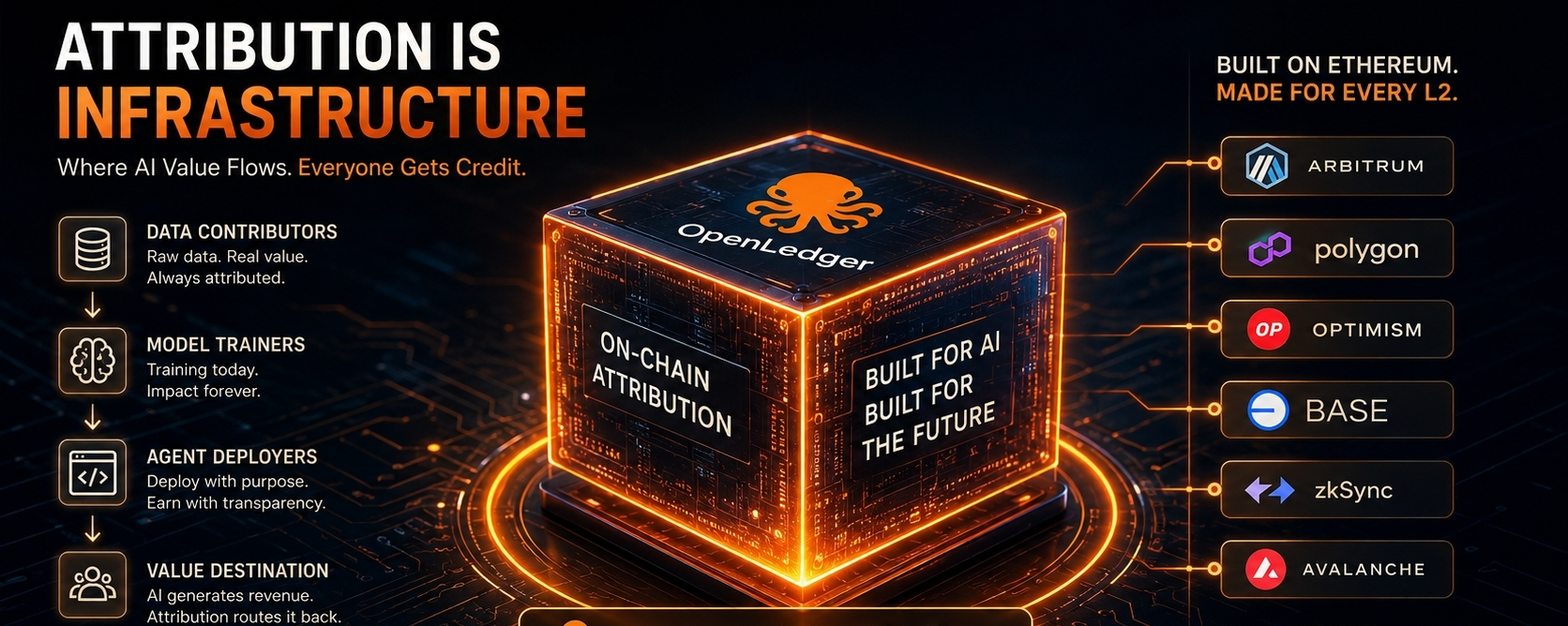
@OpenLedger is built around a different assumption: that every meaningful action in an AI pipeline should be attributable, and attribution should be automatic, not negotiated. The architecture puts data monetization, model training, and agent deployment entirely on-chain. Not as a dashboard feature. As the actual execution layer. When an agent earns, the chain already knows who taught it. That's not a product claim — that's what on-chain state makes structurally possible when you build for it from the start rather than bolt it on afterward.
The Ethereum compatibility angle matters more than most people are willing to sit with. Developers don't rebuild tooling for ideology. They route through whatever has the deepest integrations, the most familiar standards, the lowest friction for their existing stack. By following Ethereum standards completely and connecting natively to L2s, @OpenLedger doesn't ask developers to choose it. It makes itself available to the infrastructure decisions they've already made. That's how protocols actually get adopted — not through conversion, through convenience.
$OPEN is where the incentive engineering becomes legible. When contributors are compensated through a token that also governs how the network values future contributions, behavior changes. Not because people become altruistic. Because the math changes. A contributor who holds Open has a reason to care whether the data they provide produces better models, because better models drive more usage, and more usage is what gives the token its actual function. That feedback loop — contribution, verification, compensation, reinvestment — is how you build an economy that doesn't depend on continuous outside capital to survive.
The projects that survive full cycles aren't the ones with the loudest narratives. They're the ones where the token does something the protocol actually needs, and the protocol does something the market actually uses.
Value that can't be traced will always be captured by whoever sits closest to the exit.


#OpenLedger #Market_Update #TrendingTopic #MegadropLista #meme板块关注热点