
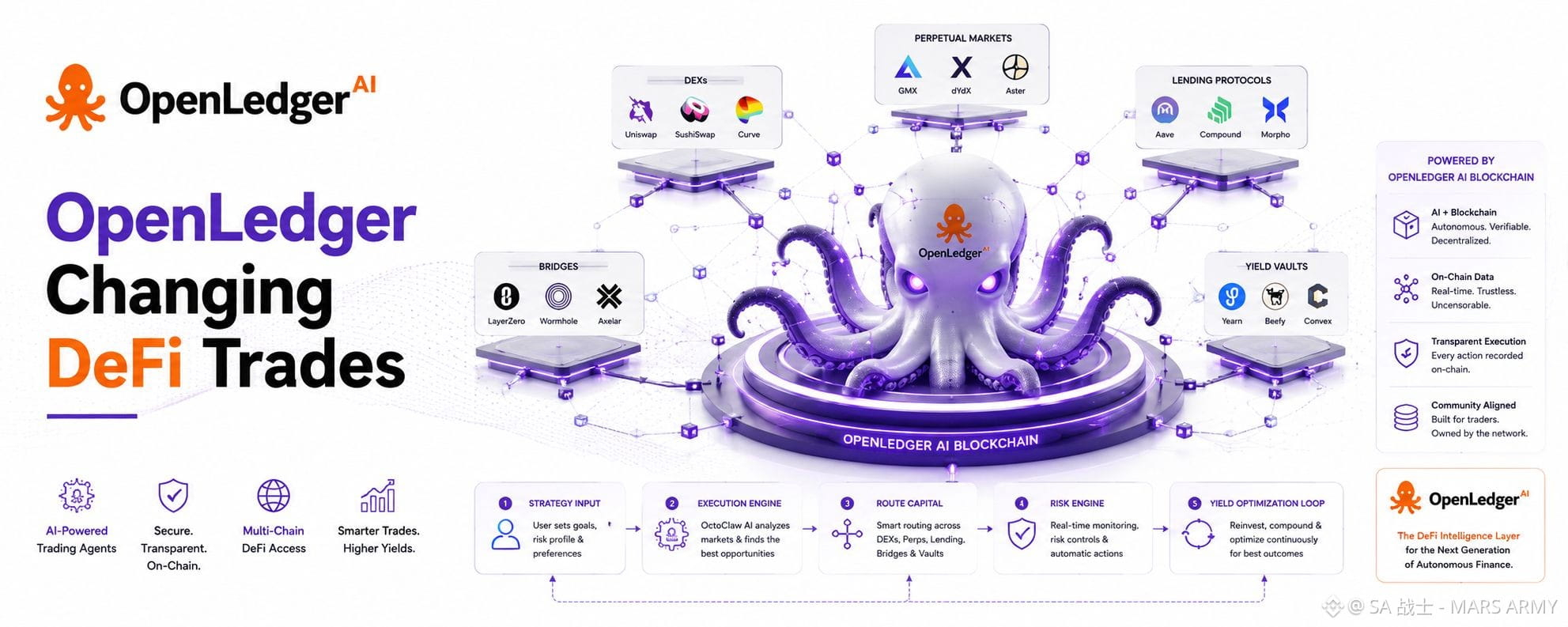
When I first looked at OctoClaw’s execution engine, Compression took all my focus.Crypto has been promising automation for years. Strategies that used to require five dashboards, a Telegram group, a custom bot script, and constant attention are now being deployed in seconds through a single interface. That changes the texture of trading in a deeper way than most people realize.
The timing matters. DeFi volume quietly crossed $180 billion monthly again this quarter as liquidity rotated back into onchain markets, while Ethereum L2 transaction costs have fallen more than 90% from peak 2021 levels. Those two numbers together explain the environment OctoClaw is stepping into. Cheap execution plus returning liquidity creates the foundation for autonomous agents to actually function at scale instead of just sounding impressive in pitch decks.
On the surface, the product looks simple. A user selects a strategy, allocates capital, defines risk limits, and launches an agent that routes trades across venues automatically. But underneath that simplicity is the harder problem most protocols never solve: execution fragmentation. Liquidity in crypto now lives everywhere. A single trade may touch a DEX aggregator, a perp venue, a bridge, and a lending protocol within seconds. Humans cannot realistically optimize across all of that in real time anymore.
That’s where strategy-based execution becomes more interesting than ordinary automation. If an agent detects widening spreads between perpetual futures and spot liquidity, it can hedge exposure while simultaneously parking idle collateral into yield-bearing vaults. Surface level, that sounds like simple arbitrage. Underneath, the engine is continuously balancing latency, slippage, gas costs, and liquidation thresholds at the same time. Each variable affects the others.
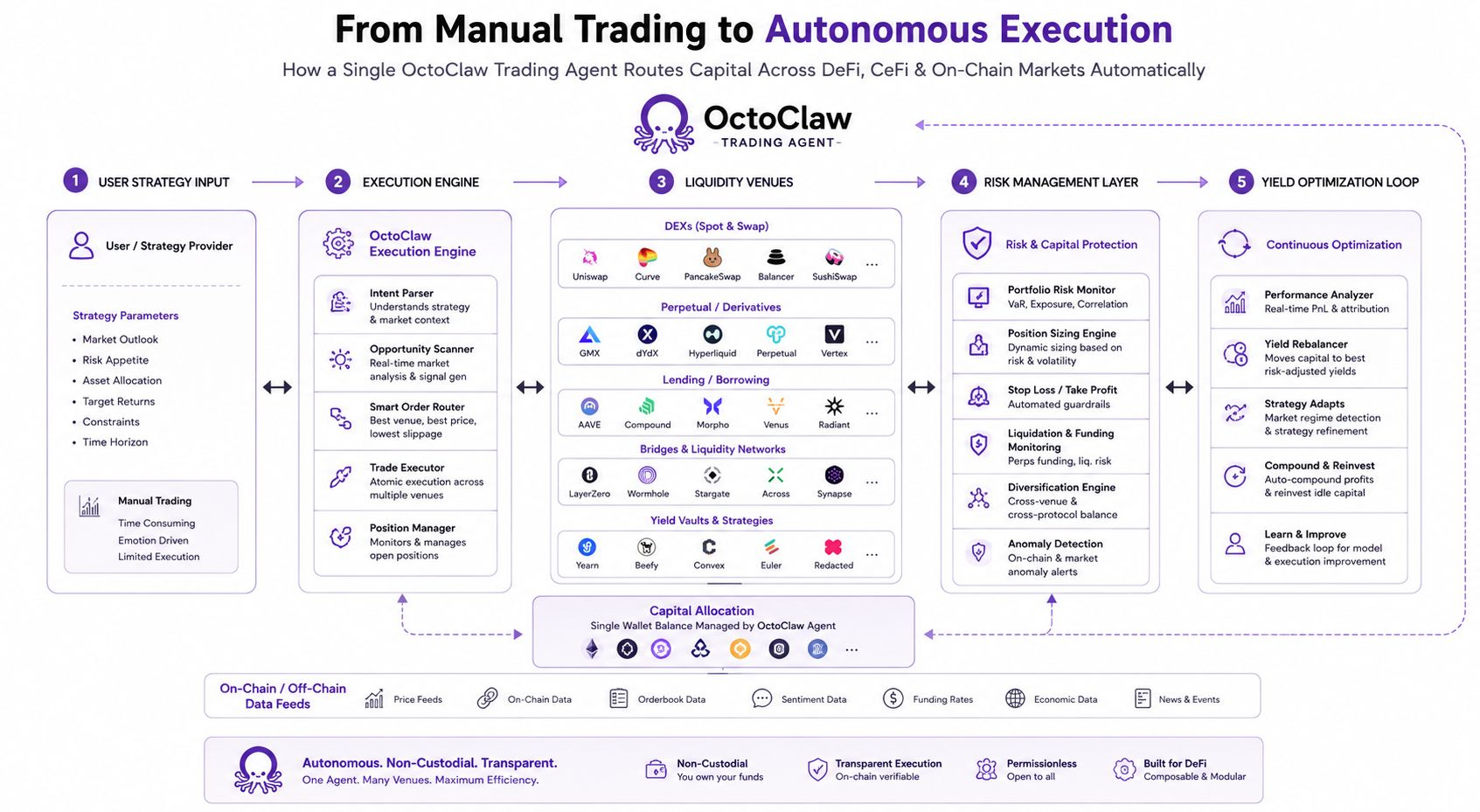
A 0.4% spread opportunity disappears quickly if execution takes 20 seconds longer than expected. A yield vault earning 11% APY becomes dangerous if the collateral inside it can’t be accessed during volatility spikes. Understanding that helps explain why execution architecture matters more now than raw strategy ideas. Alpha is increasingly operational.
The one-click deployment angle also says something bigger about who DeFi products are being built for now. Earlier cycles rewarded people willing to manually bridge assets at 2 a.m. and monitor health factors every hour. That behavior created status because complexity itself became a moat. OctoClaw is betting the next phase belongs to systems that abstract that complexity away without hiding the risks entirely.
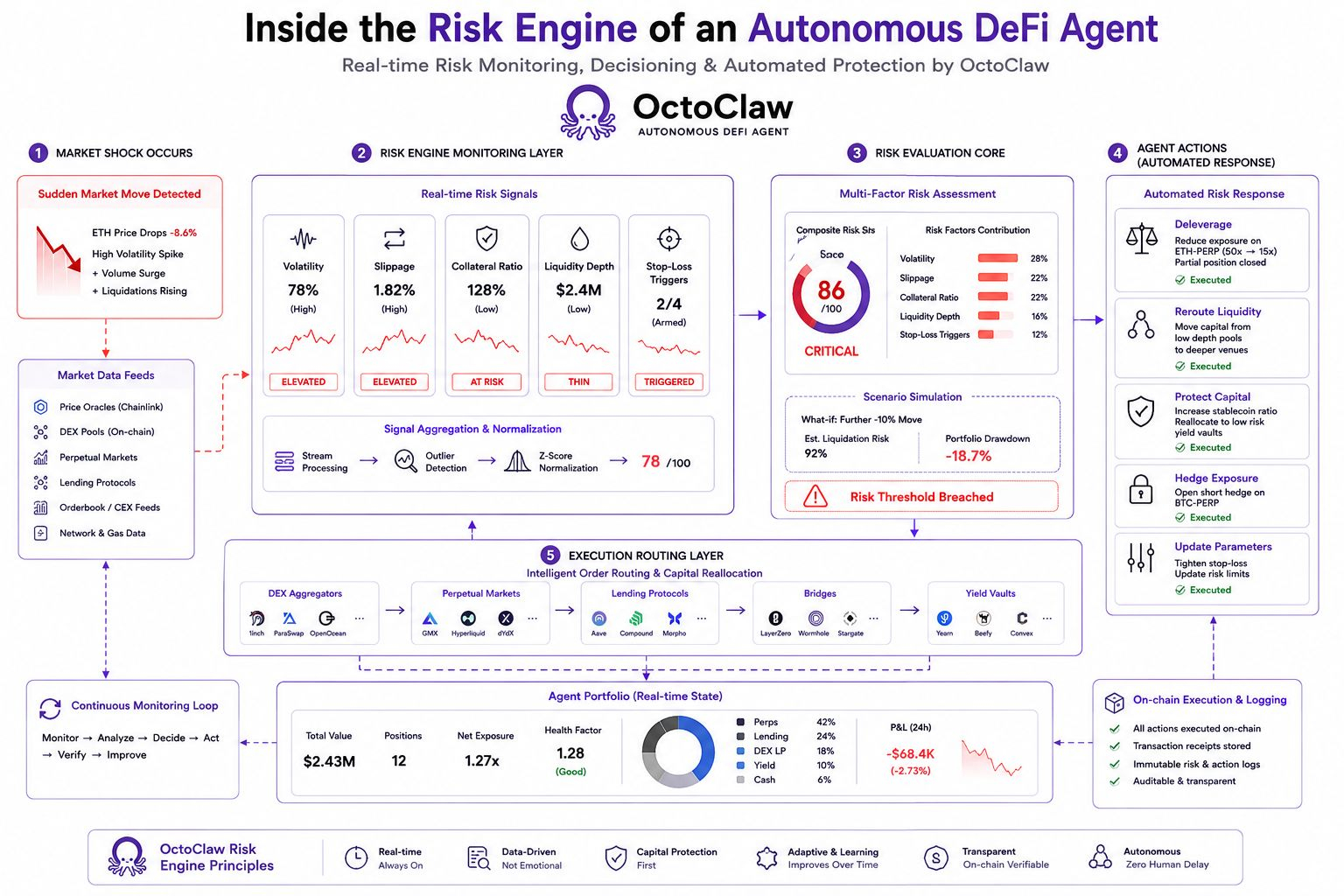
That distinction matters. There’s a quiet difference between simplification and concealment. Good autonomous infrastructure should expose risk clearly even while automating execution. From what’s emerging in these systems, risk management is becoming the actual product layer. Dynamic stop conditions, volatility-triggered deleveraging, venue diversification, and exposure caps are no longer optional features. They are the reason autonomous agents survive at all.
And survival is not theoretical in this market. Bitcoin volatility has compressed below historical averages several times this year, but altcoin liquidity remains fragile underneath. A token can still drop 25% in an hour on relatively thin books. If an autonomous agent aggressively compounds yield without accounting for liquidity depth, the strategy can unwind violently during stress events. We already saw smaller AI-assisted vaults struggle with this during sharp memecoin rotations earlier this cycle.
Meanwhile, tokenization flows introduce another layer entirely. Once assets become composable representations instead of static holdings, execution engines start behaving more like operating systems than trading bots. A tokenized treasury position can collateralize a lending strategy while simultaneously feeding liquidity into another venue. Capital stops sitting still.
That efficiency creates obvious upside. Early signs suggest capital utilization rates inside automated DeFi systems are climbing materially compared to passive vault models from two years ago. Some structured strategies now keep over 70% of assets continuously productive instead of leaving large portions idle for safety buffers. But the counterargument is real too. More composability means more dependency chains. One failed oracle update or bridge delay can ripple through interconnected strategies faster than users expect.
What makes OctoClaw interesting isn’t that it removes humans from trading. It’s that it changes the role humans play. Instead of micromanaging execution, users increasingly define constraints, incentives, and acceptable risk boundaries while autonomous systems handle the mechanical layer underneath. That mirrors what happened in traditional finance long ago, just compressed into crypto’s faster cycle speed.
And if this holds, the bigger pattern becomes difficult to ignore. The future of DeFi may not belong to protocols people actively use every day. It may belong to invisible execution layers quietly coordinating liquidity, yield, collateral, and routing in the background while users interact mainly with outcomes.
The real shift isn’t autonomous trading itself. It’s that crypto is slowly becoming less about placing trades and more about designing behavior.
