
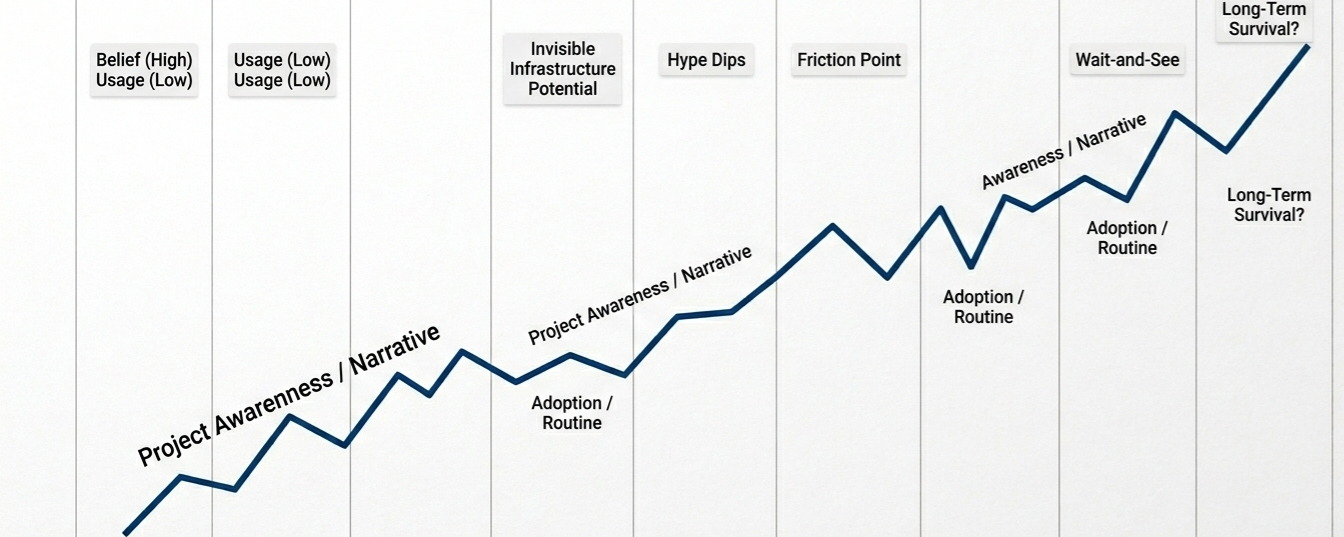
I keep noticing how infrastructure keeps returning to the center of conversation every few years, almost like people are constantly searching for the next layer that will quietly shape everyday life. I’ve watched this happen with cloud services, digital payments, social platforms, and now with AI-linked blockchain systems. Each cycle arrives carrying the same feeling that something major is changing underneath everything else. But what stands out to me more now is how quickly people start repeating the language around these systems before the systems themselves actually become part of normal behavior. Sometimes belief grows much faster than usage does.
That feeling stayed with me while reading about OpenLedger. Not because it seemed louder or more dramatic than other projects, but because it appeared to exist quietly between several larger shifts happening at once. AI is moving fast. Data is no longer treated like simple background information. It is starting to look more like an asset people contribute to constantly without fully realizing its value. More of daily life now feeds digital systems in invisible ways, yet most people remain disconnected from whatever long-term value those systems create. Somewhere inside that changing environment, OpenLedger seems less focused on being a product people notice and more focused on becoming part of the structure underneath.
At least that is the impression I keep coming back to.
I remember when conversations around crypto felt more straightforward. There was a time when decentralization alone sounded convincing enough. People genuinely believed that distributing power differently would naturally create something fairer. Maybe many of us wanted technology to solve deeper economic imbalances simply by redesigning systems. But over time, I started paying attention to something else entirely. The projects that survive are rarely the ones making the biggest promises. They are usually the ones people continue using without having to think about them every day.
That slowly changed the way I look at infrastructure.
What OpenLedger seems to recognize is that people contributing data, computation, and interaction to AI systems are often invisible inside the process. AI models now learn from enormous streams of human activity happening constantly in the background. Conversations, search habits, preferences, corrections, behavior patterns. Entire digital lives become part of systems most people never really see. Yet the people contributing to that ecosystem usually remain far removed from ownership or participation in the value being created.
That tension feels increasingly difficult to ignore.
Still, I’ve learned that identifying a real problem does not automatically mean a system becomes part of real life. The technology world often confuses awareness with adoption. A project can describe an important shift very clearly and still remain distant from everyday behavior. That gap between narrative and routine feels more important to me now than technical ambition alone.
Infrastructure has always been strange in that way. The strongest systems eventually disappear into habit. People do not stop every morning to think about electricity before turning on a light. Roads matter because they become ordinary enough to fade into the background. Real infrastructure becomes invisible through repetition. Crypto, however, still often feels like something asking to be constantly noticed. It demands attention instead of blending naturally into behavior.
Maybe that is the real challenge projects like OpenLedger are facing.
Across parts of Asia, Africa, and other fast-growing digital regions, questions around ownership and participation are becoming harder to avoid. Millions of people contribute value online every single day while remaining disconnected from the systems collecting long-term economic benefit. OpenLedger seems aware of that imbalance. But awareness alone is never enough. The harder question is whether systems like this eventually become natural to use or whether they remain ideas mostly discussed inside online communities and investor circles.
I’ve become less interested in whether a project sounds revolutionary and more interested in whether it quietly reduces friction over time. Because that is usually what decides survival. Not hype. Not attention. Habit.
So when I think about OpenLedger now, I do not really see certainty. I see a project existing in the middle of a transition that still feels unfinished, where AI, infrastructure, and ownership are slowly starting to overlap in ways people do not completely understand yet. And maybe that uncertainty is the most honest part of the entire conversation.
Because in the end, systems rarely matter because they sounded important when they were introduced. They matter because years later people are still using them without needing to explain why. #OpenLedgar $OPEN @OpenLedger
