There is a quiet change happening around AI.
At first, most people talked about AI like it was one thing. A model. A chatbot. A tool that gives answers. That made sense for a while, because that was the part people could see. You typed something, the system replied, and the whole experience felt like magic packed into a box.
But after using AI for long enough, another picture starts to appear.
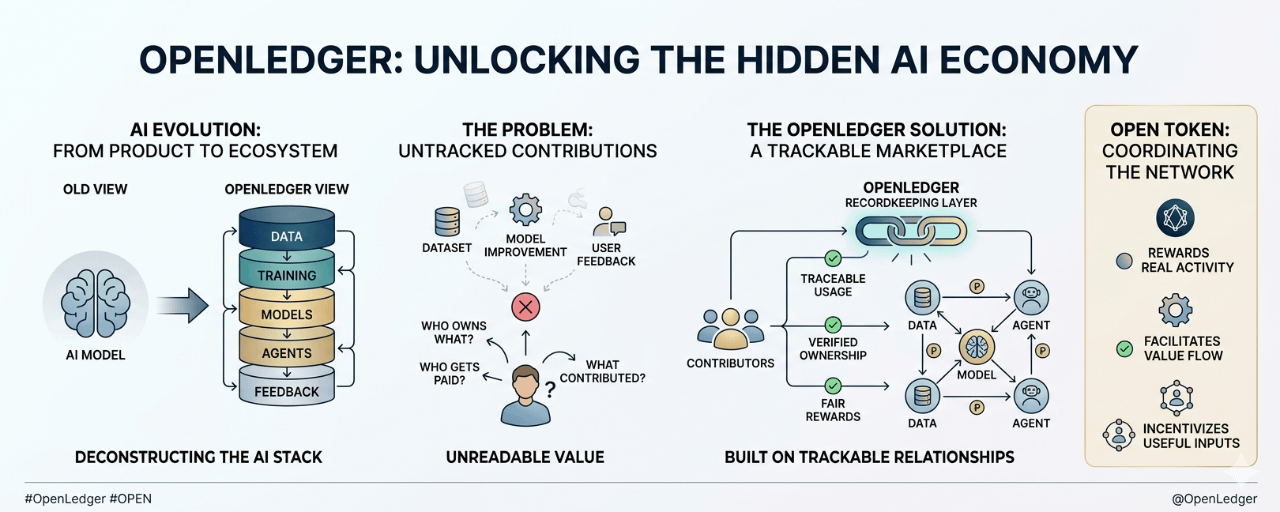
AI is not really one thing. It is a stack of many things. Data sits underneath it. Training methods sit on top of that. Models are shaped by both. Then come agents, workflows, applications, users, feedback, and all the small improvements that happen along the way.
Once you see that stack, the question becomes harder.
Who owns which part?
Who gets paid when something is useful?
Who can prove that their contribution actually mattered?
That is the kind of problem @OpenLedger seems to be pointing at.
Instead of looking at AI only from the final product side, OpenLedger looks at the supply side. Not just who uses AI, but who feeds it, improves it, and gives it something valuable to work with. That angle feels important because the AI economy is still very uneven. Some platforms capture most of the visible value, while many of the inputs remain hidden.
Data is a good example.
A dataset can be extremely valuable, but it is often hard to price. It may be useful for one model and useless for another. It may become more valuable when combined with other data. It may help an agent perform better in a very specific context. But outside of a clear system for tracking usage, that value is difficult to measure.
So the data just sits there.
Or it gets used once.
Or it gets absorbed into something larger.
Or the original source gets forgotten.
#OpenLedger seems to ask what happens if these hidden inputs become more traceable. Not in a loud or abstract way, but in a simple economic way. If something helps an AI system perform better, there should be a way to see that. And if there is a way to see that, there may also be a way to reward it.
That changes the shape of the conversation.
The focus moves away from “AI replacing people” and toward “people becoming part of AI networks.” That does not solve every concern, of course. It does not remove the risks around data quality, privacy, ownership, or misuse. But it does open a more practical question: can contributors participate in the value they help create?
That is where blockchain comes into the picture.
Not as a decoration. Not as a reason to force a token into everything. The only useful role for a blockchain here is recordkeeping. It can create a shared layer where usage, ownership, and rewards are easier to follow. The value is not in the word “blockchain” itself. The value is in whether the system makes relationships clearer.
And AI has many unclear relationships.
A model may depend on a dataset. An agent may depend on a model. A user may depend on the agent. A developer may improve the agent after watching how people use it. A new dataset may make the model better again. The chain of contribution can get messy very quickly.
Without structure, that mess benefits whoever controls the center.
With structure, maybe more participants can stand closer to the value they create.
That is the more interesting angle around OpenLedger. It is not only about monetizing AI assets. It is about making AI less centralized around final interfaces and more open around the parts that make those interfaces useful.
$OPEN the token, belongs inside that larger design. A token can help coordinate activity in a network, but only if the network itself has real activity. That distinction matters. A token without useful demand is just a market object. A token connected to actual usage can become part of how value moves between contributors.
So the question is not simply whether $OPEN can trade well.
The better question is whether OpenLedger can create reasons for people to bring useful things into the system.
Useful data.
Useful models.
Useful agents.
Useful feedback.
That sounds simple, but it is not. Marketplaces are difficult. AI marketplaces may be even harder. Quality is hard to judge. Bad data can damage outcomes. Models can be copied. Agents can overlap. Contributors may expect rewards before there is enough demand. Users may not care about the system behind the result as long as the result works.
These are real frictions.
And maybe that is why this space is worth watching without getting carried away. The idea makes sense, but execution will decide most of it. OpenLedger would need to make participation feel natural. It would need to make attribution useful without making everything complicated. It would need to show that contributors can earn from real usage, not only from early attention.
The bigger pattern is still clear, though.
AI is becoming less like a single product and more like an economy of parts. Some parts think. Some act. Some remember. Some provide raw material. Some connect systems together. When that happens, the old question of “who built the AI?” starts to feel too small.
The better question may be: who helped it become useful?
OpenLedger is one attempt to answer that question through ownership, tracking, and shared value. Whether it becomes a major layer or a smaller experiment is still open. But the direction feels natural.
As AI grows, the invisible parts may not stay invisible forever.
@OpenLedger #OpenLedger $OPEN

Articolo
OpenLedger (OPEN): When AI Starts Looking More Like a Marketplace
Disclaimer: Include opinioni di terze parti. Non è una consulenza finanziaria. Può includere contenuti sponsorizzati. Consulta i T&C.