
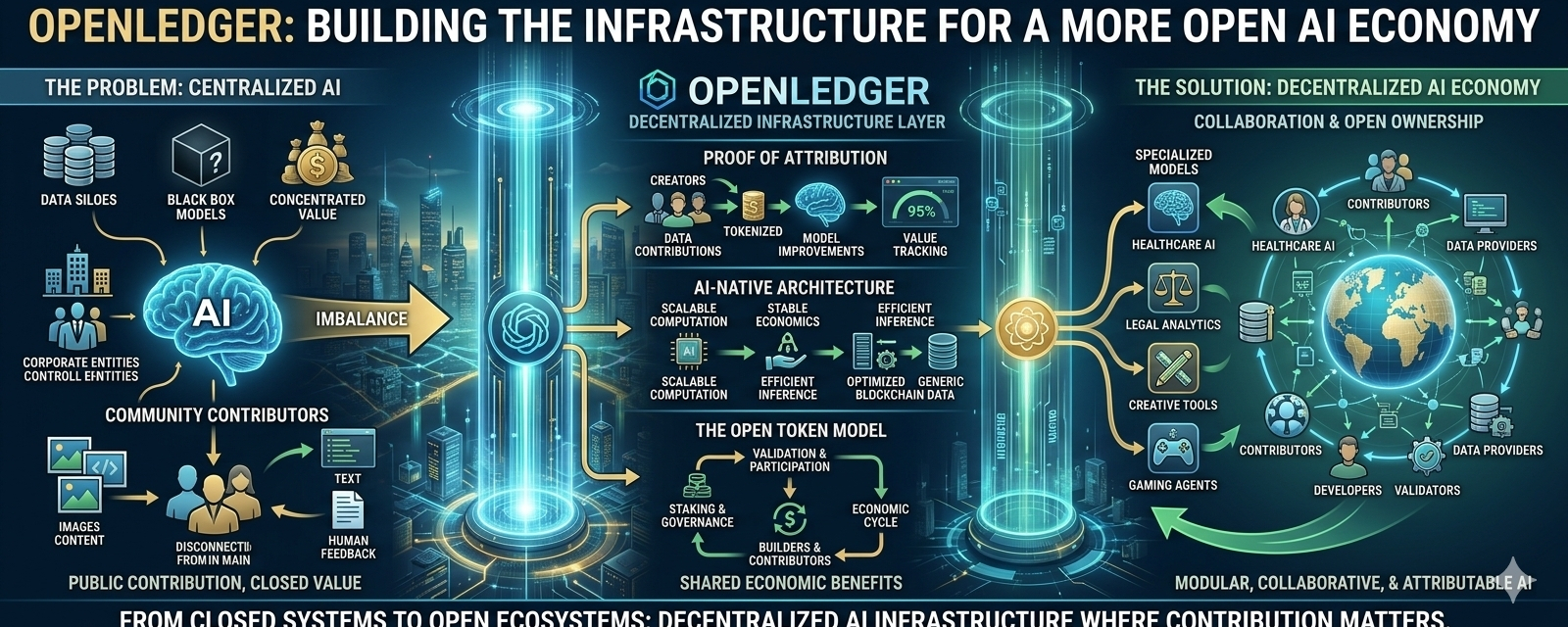
When I first came across OpenLedger, what caught my attention wasn’t the usual “AI meets blockchain” narrative that almost every crypto project seems to be pushing lately. That space has become crowded very quickly, and honestly, most projects sound nearly identical after a while. Everyone talks about artificial intelligence, decentralization, automation, and the future, but very few explain how they actually plan to solve the deeper problems inside the AI industry itself. OpenLedger felt different because its entire direction seems built around something practical rather than promotional. Instead of trying to create hype around AI, it appears focused on building the infrastructure that could make AI ownership and contribution more open in the future.
The more I looked into it, the more I realized that OpenLedger is approaching AI from a completely different angle compared to most platforms entering this sector. Right now, the global AI industry is heavily centralized. A small number of companies own the models, control the data pipelines, manage the computing infrastructure, and ultimately capture most of the financial value created by these systems. Meanwhile, millions of people indirectly contribute to AI every day through content, conversations, public data, creative work, feedback loops, and online activity, yet almost none of those contributors participate in the upside being generated. That imbalance is becoming harder to ignore as AI expands deeper into digital life.
What makes OpenLedger interesting is that it seems designed around fixing that imbalance instead of simply competing with the biggest AI companies directly. The project appears to understand that the future of AI may not belong entirely to one corporation or one closed ecosystem. Instead, AI could evolve into something more collaborative, where developers, contributors, validators, and data providers all become part of the same economic network. OpenLedger’s vision feels less like building another AI application and more like building the foundation for a decentralized AI economy where contribution actually matters.
One of the ideas that really separates OpenLedger from other projects is its focus on Proof of Attribution. The concept itself sounds simple at first, but the implications behind it are massive. Today, most AI systems operate like black boxes. Huge amounts of data are collected, processed, and used to improve models, but there’s very little transparency around who contributed what or how much value those contributions created. OpenLedger seems to be working toward a framework where datasets, model improvements, and AI activity can actually be tracked and connected back to the people responsible for them. If that system works at scale, it could completely change how value flows inside AI ecosystems.
That’s important because modern AI depends heavily on public contribution while remaining economically closed at the top. People create the conversations, images, articles, behavior patterns, and interactions that help train intelligent systems, but ownership and profits remain concentrated within a small group of companies. OpenLedger’s entire philosophy appears built around the belief that this structure eventually becomes unsustainable. As AI becomes more integrated into industries, businesses, entertainment, education, and online platforms, the demand for transparency and fair participation will probably grow much stronger.
Another thing I find notable is OpenLedger’s focus on specialized AI systems instead of only chasing giant universal models. A lot of the industry conversation today revolves around scale, larger datasets, bigger models, and increasingly expensive infrastructure. But realistically, not every business or application needs a massive general-purpose AI model. Many industries work better with focused systems trained for specific environments. Healthcare companies need medical intelligence. Legal firms need systems built around contracts and regulations. Gaming platforms need AI capable of interacting naturally with players. Specialized models are often more efficient, cheaper to operate, easier to manage, and more practical in real-world environments. OpenLedger seems to recognize that the future of AI may become modular rather than centralized around a single dominant intelligence layer.
That approach also explains why the project talks so much about decentralized participation and data coordination. If AI development becomes more distributed in the future, then networks need mechanisms that can organize contributions at scale without depending entirely on centralized control. This is where blockchain actually becomes useful in a meaningful way. Instead of functioning as a marketing tool, the blockchain acts more like a transparent coordination and accounting layer underneath the AI activity itself. OpenLedger doesn’t appear obsessed with selling blockchain ideology. The focus seems far more operational, centered on creating systems where contributors can interact, build, validate, and share value without needing to trust one single authority controlling everything.
The architecture behind the network also feels intentionally designed for AI-related workloads rather than forcing AI into a standard blockchain structure that was never optimized for it. That distinction matters because AI systems generate enormous activity through inference requests, validation processes, model interactions, and continuous computation. Many general-purpose blockchains struggle under heavy application demand, especially when costs become unpredictable or scalability limitations appear. OpenLedger’s AI-native infrastructure suggests the team understands that decentralized AI cannot succeed unless the underlying economics and technical framework remain stable enough for developers and applications to operate efficiently over the long term.
Even the OPEN token model feels more grounded compared to many crypto ecosystems that rely mostly on speculation. From what OpenLedger presents, the token supports staking, governance, validation, and network participation, but more importantly, it connects contributors and developers into the same economic cycle. In theory, value moves through the network instead of concentrating entirely at the top. That creates a much healthier structure where builders, validators, and contributors all benefit from ecosystem growth rather than functioning only as users feeding value upward.
Of course, none of this means success is guaranteed. Building decentralized AI infrastructure is incredibly difficult because both industries involved, blockchain and artificial intelligence, are still evolving rapidly on their own. Attribution itself is one of the hardest problems in AI today. Measuring exactly how much value a dataset contributed to a model is extremely complex. Preventing spam, manipulation, low-quality contributions, and unfair reward systems creates another layer of technical difficulty altogether. These are foundational problems the broader AI industry still hasn’t fully solved yet.
But honestly, that challenge is also what makes OpenLedger stand out more to me. It doesn’t feel like a project chasing temporary hype or trying to attach itself to whatever narrative is trending in crypto markets. Instead, it feels like a serious attempt to solve structural problems that could become increasingly important over the next several years as AI systems grow larger and more integrated into digital infrastructure worldwide.
When I step back and look at the bigger picture, what keeps standing out is how OpenLedger treats AI as an ecosystem instead of a single product. That difference matters. The future it seems to be building toward is not one where intelligence belongs entirely to one corporation hidden behind closed systems. It’s a future where AI becomes collaborative, modular, economically shared, and connected across networks of contributors. If the AI industry eventually moves in that direction, then infrastructure around attribution, ownership, coordination, and transparent participation may become just as valuable as the models themselves.
And realistically, that could be the deeper opportunity behind OpenLedger. The project isn’t trying to build another temporary AI application people use for a few minutes before moving on. It’s trying to build the economic foundation underneath decentralized AI systems that may eventually operate everywhere in the background of digital life. If that vision succeeds, most users probably won’t even think about the blockchain layer underneath the experience. They’ll simply interact with AI systems that feel more open, more transparent, and more connected to the communities helping create them every single day.
