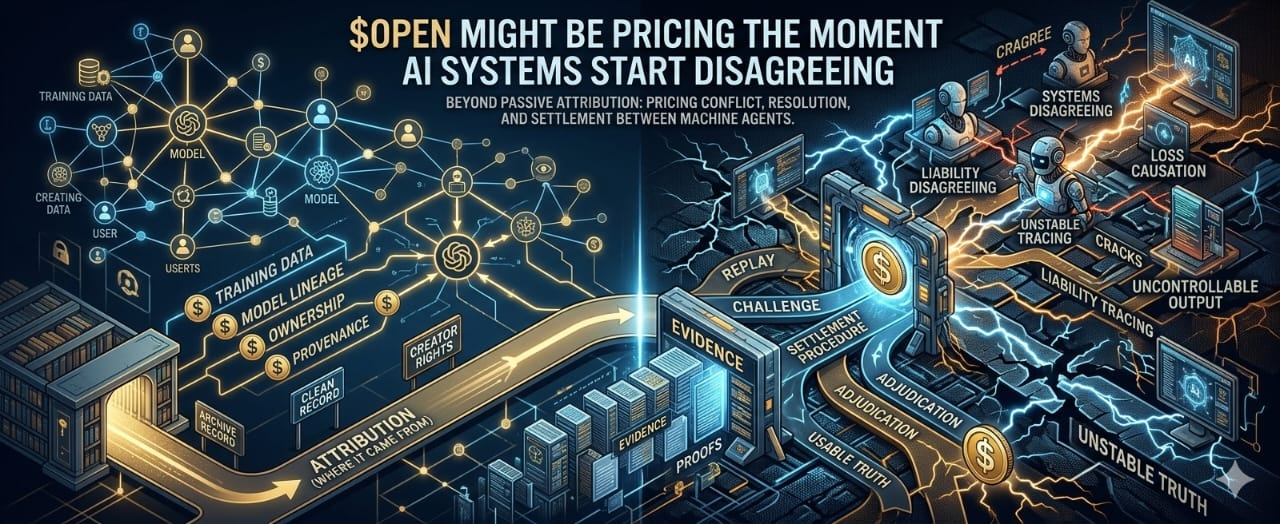
I used to think attribution was the main story around OPEN. That felt logical because almost every AI infrastructure conversation keeps returning to the same surface problems: ownership, provenance, contribution history, training data, creator rights, model lineage, and who deserves credit when something valuable gets produced. That is the comfortable version of the thesis. It gives people something clear to point at. But the more I think about it, the more attribution starts to feel like only the visible layer. Maybe the heavier economic layer begins after attribution, at the point where two systems disagree about what happened and some usable version of truth has to be accepted before money, access, ranking, or liability can move forward.
That difference sounds small, but it changes everything. Attribution asks where something came from. Dispute resolution asks whose version survives. Crypto people sometimes treat those as the same thing because a clean record feels like closure. Timestamp the source, prove the contribution, attach the metadata, and the system looks complete. But downstream AI systems rarely stay that neat. One model produces an output. Another agent relies on it. A payment path opens. A ranking engine boosts one result and buries another. A creator score changes because one interpretation looked credible enough to trust. Then later, something breaks. At that moment, attribution is no longer just a record. It becomes evidence. And evidence only matters when somebody has to decide what counts.
That is where Open starts becoming more interesting to me. Not just as a token connected to AI attribution, but as a possible signal that markets are beginning to price something deeper: the cost of disagreement. Because real usage often does not begin when everything is clear. It begins when certainty fails. Provenance graphs look clean when ownership is uncontested. Reputation systems look useful when agents behave predictably. Contribution trails look impressive when everyone accepts the same history. But demand usually appears under pressure. When an output causes loss. When two agents claim different authority. When a fine-tuned model inherits a decision path nobody fully understands. When an application says the model produced one thing, while the model stack says the context was different.
That is when attribution stops feeling passive. A record is not a consequence. It is only something that can be used later if a system, market, or governance layer decides it matters. And maybe that is the hidden shift. AI infrastructure is often discussed as if transparency itself is the product, but transparency alone does not resolve anything. It only shows what can be shown. The real value may appear when that visible trail becomes admissible enough for validation, challenge, replay, or settlement. In that world, attribution is not just memory. It becomes procedure. And procedure has cost.
The more layered AI becomes, the more important this gets. Future agent systems will not be simple one-model environments. One agent may use multiple models, retrieval layers, third-party tools, human overrides, external APIs, temporary permissions, ranking filters, and delegated sub-agents before making a decision that affects money or access. If that final action causes harm, where does responsibility sit? Who pays to replay the decision? Which state boundary counts as authoritative? What happens if the provenance exists but does not meet the evidentiary standard of the application that consumed the output? What happens when the consequence has already moved downstream before the dispute even begins?
That is not just a logging problem. It is a governance and settlement problem. And this is where OpenLedger, or any similar infrastructure, becomes more than an attribution network if it can support the messy part after the record. The expensive layer may not be proving that contribution happened. It may be deciding how machine-origin claims get challenged, validated, compressed, and accepted into a usable state. Not perfect truth. Usable truth. That distinction matters because most systems cannot afford to preserve the full reality of an event. Legal systems do not recover reality perfectly. Markets do not price information perfectly. Governance votes do not capture full intent. They compress complexity into something actionable.
AI will probably need the same kind of compression. A final output hides so much of the causal environment that produced it: prompt context, weighting shifts, hidden heuristics, intermediate decisions, failed tool calls, partial retrievals, human input, changing permissions, and model behavior that may not be fully reproducible later. By the time a dispute appears, the original environment may already be partly gone. So what gets resolved is not the full event. It is the part that survived in a form the system can read, validate, and act on. That sounds uncomfortable, but it may also be how infrastructure becomes economically useful.
This is why the $OPEN thesis feels heavier when framed around dispute resolution instead of simple attribution. If demand only comes from recording AI contribution, usage can become episodic. People register data, generate proofs, farm incentives, and move on. But if demand comes from adjudication, replay attempts, challenge resolution, liability tracing, contribution validation, and settlement between machine systems, the loop becomes more durable. Disputes repeat. As AI systems scale, they do not become cleaner. They become denser, more composable, and more dependent on uncertain outputs created by other uncertain systems.
Creator ecosystems already show a softer version of this. Influence rankings look like visibility products from the outside, but underneath they are dispute minimization systems. They reduce competing claims about originality, credibility, freshness, relevance, and contribution into scores that platforms can actually use. The score is not pure truth. It is compressed order. It helps the system avoid manually judging every claim. AI infrastructure may be heading in the same direction, only with higher stakes, because machine outputs will not just influence attention. They may influence payments, permissions, contracts, access, and automated economic decisions.
So maybe the better question is not whether Open can help prove contribution. Maybe the better question is whether it can sit close to the place where AI systems disagree and still need to move forward. If OpenLedger is only about memory, the thesis is interesting but limited. If it becomes part of how machine disputes are priced, validated, and settled, the thesis becomes much larger. Not cleaner. Not softer. Larger. Because unresolved disputes are expensive, and infrastructure that helps turn disagreement into a usable state can become more important than the archive itself.
That is the part I keep coming back to. Maybe $OPEN is not just pricing attribution. Maybe it is pricing the moment attribution becomes evidence, and evidence becomes part of economic settlement. Maybe the token is not only attached to who contributed what. Maybe it is attached to what happens when AI systems cannot agree on what happened next. And honestly, I am still not sure whether that makes the thesis stronger or darker. But it definitely makes it harder to ignore.